Posted in Family, Reading, Travel

All Fall Down

Preparing to visit Berlin for the first time a few weeks ago, I was unsure what I might find there.

My expectations had been partly shaped by a blend of fiction (Isherwood), film (Cabaret), and song, (Bowie’s “We Can Be Heroes”).

photo of the Brandenburg Gate with organ grinder
The jaunty tunes played by this organ grinder in front of the magnificent Brandenburg Gate reminded me of the Berlin of Isherwood’s time

At school I studied twentieth century history to A Level. In those days, the Berlin Wall was an impenetrable barrier between East and West, and I was living in Frankfurt with a postal address in West Germany.

the American sector sign
When I lived in Germany as a teenager, the Berlin Wall was still standing. This iconic sign that divided the American sector from the Russian remains as a chilling reminder, though this tourist seems unfazed.

Packing for our city break, I discarded the book I’d been saving to read on the trip: a historical novel set in Berlin during the Second World War. Might it be offensive to be seen reading a story about an era Berliners would prefer to forget?

I need not have worried.

The city turned out to be full of reminders of both World Wars and the Cold War, now serving as incitements to peace.

photo of the Kaiser Wilhelm church
Beside the bombed ruins of the bell tower of the Kaiser Wilhelm Church now stands beside a modern bell tower as a symbol of peace.

Even parts of the hated Berlin Wall have been left standing. When the Wall fell in 1989, Berliners resisted their initial impulse to destroy the whole of this brutal divider of East and West. Instead, they kept parts of it intact as a reminder of the importance of the freedom and democracy which the Wall once denied them.
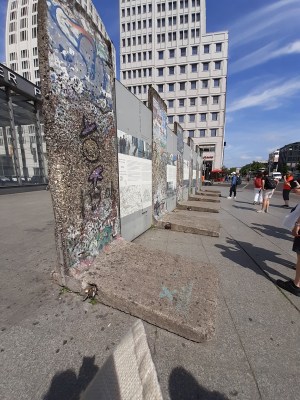
photo of sections of the wall on a street
Sections of the Berlin Wall forming an educational display for passers-by

The rest of it was to be painted by local artists, then broken up for sale as souvenirs. The Wall was so huge that there are still plenty of pieces to meet tourists’ demands, and they must be a healthy source of revenue for the city’s coffers.

Berlin is now an upbeat, creative and cosmopolitan place, full of green spaces, wide tree-lined boulevards and light.

Standing outside our hotel on the Kurfürstendamm (Berlin’s answer to London’s Bond Street), we could hear not the roar of traffic, but copious birdsong.

photo of the Leonardo Hotel
Where we stayed

There are very few motorists, because Berlin’s public transport system is so efficient and affordable that you don’t need a car to get around. Their trams, trains, U-bahns and buses are also very easy to use. There are no ticket barriers anywhere, as it’s assumed all travellers will be honest and buy tickets. This trust may not be misplaced, according to Lenin, who joked, “If Germans ever stormed a railway station, they’d first buy a platform ticket.”

selfie with my daughter by Checkpoint Charlie
With my daughter by the iconic Checkpoint Charlie

As in British towns, electric scooters are rife. The abundance of cycle paths in this flat city allows them to operate relatively safely. I wish I’d been quick enough with my phone camera to capture a sight that seemed to epitomise twenty-first century Berlin: a stream of electric scooters gliding freely past Checkpoint Charlie, still maintained as a landmark, into what used to be East Berlin.

Testdriving an iconic Trabant was a highlight of our visit to the wonderful DDR Museum

I had an unfortunate encounter with an electric scooter near the Brandenburg Gate, when I tripped over one left lying on the pavement. The scar on my left knee was an unwanted souvenir. But I also brought back a much better souvenir: a piece of the Berlin Wall,  which now sits on my desk as a permanent reminder to myself that no obstacle is truly insurmountable. Except that electric scooter by the Brandenburg Gate, obviously.

photo of souvenir piece of Berlin Wall with plastic mount

This post was originally written for the July 2022 issue of the Hawkesbury Parish News


Cover of Everyday Kindness hardback anthology
I was thrilled when L J Ross chose my story inspired by the Berlin Wall for inclusion in her charity anthology…

If you enjoyed this piece, you might enjoy this short story I wrote a couple of Christmases ago as a guest post for Helen Hollick’s blog, in which a souvenir of the Berlin Wall plays a crucial part: Christmas Ginger. It was later selected for L J Ross’s Everyday Kindness anthology in aid of Shelter, the charity for those without homes or in poor housing, and in the audiobook  edition it was read by the distinguished actress and novelist Celia Imrie.

graphic of Celia Imrie as narrator of Christmas Ginger
…and when Celia Imrie was chosen to narrate my story for the audiobook version edition.


Posted in Events, Reading, Writing

What I Did at Stroud Book Festival 2021

Stroud Book Festival describes itself as “a celebration of stories, ideas and community for readers of all ages”, and for six years has been bringing a flurry of events over four days to a variety of pleasant venues at this busy and diverse Cotswold market town. 

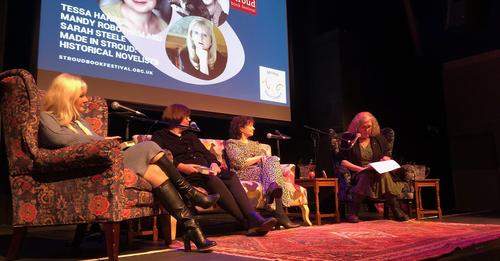
Although by chance I was away on a writing retreat at the start of it, I caught up with the Festival on Sunday, chairing the Made in Stroud: Historical Novelists panel in the afternoon, and in the evening attending the Stroud Short Stories event of which this time I was co-judge alongside organiser John Holland.

Three Novelists Inspired by Mid-Century History

I was delighted to have been invited to interview three Stroud authors about their latest historical novels in the delightful setting of Lansdown Hall, laid out café-style with delicious cake generously provided by the local Waitrose. These novels are:

  • Beneath a Starless Sky by Tessa Harris
    (German Jewish girl flees to Hollywood and becomes Fred Astaire’s dancing partner before being recruited by the British as a spy)
  • The Girl Behind the Wall by Mandy Robotham
    (identical twins in their twenties are separated by the overnight appearance of the Berlin Wall)
  • The Schoolteacher of St Michel by Sarah Steele
    (schoolteacher smuggles Jewish children across the border between Nazi-occupied Vichy France and free France).

(The authors are pictured in that order from left to right in the photo at the top of this column, and I’m in the hot seat on the far right.)

ad for panel event

My brief was to ask chiefly about research. It was fascinating to hear where they’d found their jumping-off point for their novels, from newspaper articles (one of my favourite sources of story ideas) to chance conversations with residents of those areas.

I was also intrigued as to why they took different approaches to writing about real people – Tessa puts words into the mouths of Hitler, Eva Braun, Edward VIII, Wallis Simpson, and Fred Astaire, while in Mandy and Sarah’s books, key figures of the age are kept at a distance, for example we hear the Berlin crowd’s reaction to Kennedy’s iconic “Ich bin ein Berliner” address, but do not encounter him in person.

To write my books – contemporary village mysteries, set in worlds I know very well – I need to do very little research, and I am always in awe of historical novelists who must (a) carry out enough research to write convincingly about their chosen era and (b) how they manage to tear themselves away to write their books, rather than losing themselves down potential rabbit holes. Covid has introduced a new challenge: to find all you need online when travel restrictions preclude in-person visits to places key to the story. Each of the three authors had different favourite sources: Youtube for Mandy, Pinterest for Sarah and biographies for Tessa.

When so many fiction and non-fiction books have already been written about your era, I asked them, how did you manage to make your topic your own? What differentiates your books from others? Although their books are very different, they each had the same answer: by holding a microscope up to individuals involved.

Their protagonists Lili Sternberg (“the girl who danced with Fred Astaire”), Berliner twins Karin and Jutta, and French schoolteacher Lucie Laval are all strong, exceptional women with important lessons about survival and resilience amidst enforced separation and deprivation that resonate strongly to readers living through the current pandemic, and I highly recommend all three novels.

Stroud Short Stories Go Wild

After that event I just had time for tea and cake in the Green Room before heading up the hill to The Cotswold Playhouse to greet the ten authors whose short stories had been chosen by co-judges John Holland and me to be read at this twice-yearly event. As all the stories are judged “blind”, ie the judges have no idea who wrote which story until they have chosen the final ten from among dozens submitted, it is always a joy to put the face and the name to the story. A full house in this delightful provincial theatre lapped up the ten very different stories, all on the given theme of “Wild”.

With John a slick, original and funny compere, the ten authors performed their stories to a rapt audience, from seasoned participants of previous SSSs, to those who had never before shared their work in public. They were, in the running order of the night:

Pauline Masurel with Fledglings 
Claire Jaggard with The Wild Woman 
Ali Bacon with The Pig and I
Jasmin Izagaren with Jumping Season
Melanie White with City Girl
Nick Adams with Demolition
Georgia Boon with Johnny Maunder Came to the Well
Hannah Glickstein with Wild Serenade
Rebecca Klassen with Clothed in Sacrifice
Robin Booth with Painted Ladies

Even though I had read and re-read each of the stories as part of the judging process, as is always the way, hearing them read aloud by their authors added to the experience, and I heard more nuances and subtleties and rhythm in the writing than before. All ten authors read brilliantly.

Until Next Time!

When John announced that the next Stroud Short Stories event will take place on 8th May 2022, I’m sure everyone present will have made a mental note for their next year’s diary. My only fear is that the stories were of such a high standard that some writers may be deterred from submitting. Please don’t be: Stroud Short Stories is renowned for showcasing brand-new writers as well as old hands, and with no entry fee, you have nothing to lose by giving it a go. Keep an eye on the SSS webiste, www.stroudshortstories.blogspot.com and follow its always entertaining Twitter feed @StroudStories so that you don’t miss out.

Huge congratulations to Artistic Director Caroline Sanderson and her tireless team for staging such an inspiring series of events and restoring a feeling of post-lockdown normality to the remarkable town of Stroud. I’m sure everyone who took part is looking forward to next year’s Stroud Book Festival already!

Coming Soon! (27th November)

Meanwhile I’m busy getting ready for my next public event – the first in a new HULF Talk series, a spin-off from my annual Hawkesbury Upton Literature Festival, bringing together four local authors talking about travel and adventure, from filming whales for The Blue Planet to hunting for yetis in the Himalayas! Admission is by advance ticket only, to enable us to keep Covid-safe, and you can find out more and order your ticket via Eventbrite here.

image block with logo and event details