Posted in Personal life, Writing

The Not So Commonplace Book

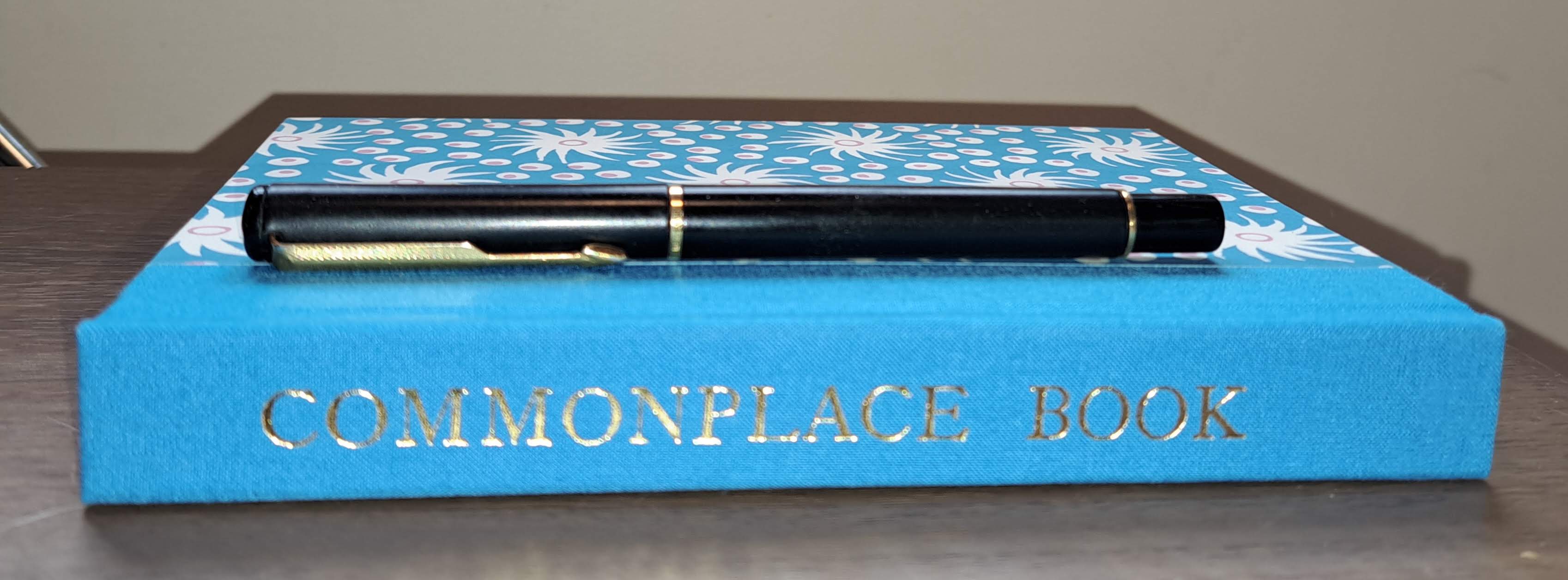
Forgive the contradiction in terms, but I’ve long mourned the decline of the commonplace book, so I was delighted to discover at a craft fair at Rodmarton Manor last autumn that local bookbinder Ursula Jeakins of Starsmead Bookbinding now creates beautiful volumes especially for that purpose.

While there’s been a surge of interest in journalling lately, the end products seem to be fancy versions of the desk diary or personal planner. They’re the jazzier descendant of the 1980s must-have accessory for executives, the Filofax.

Social media is full of ads for the dotted notebooks, pens, stencils, stickers .and washi tape (decorative Japanese masking tape) considered de rigueur for the curation of a modern journal. How do people find time to transform to-do lists into works of art? Perhaps they allocate hours to the activity in a neat grid in their journals.

The traditional commonplace book, on the other hand, for which you need only a notebook and pen, gets little airtime these days. Perhaps that’s because it’s less of a money-spinner for suppliers or dopamine source for buyers. For a commonplace book, you don’t need fancy effects. You just write down text extracts you’d like to preserve from whatever you’ve been reading. It’s the words that make the commonplace book worthwhile, not surface decoration.

front cover of a commonplace book by Ursula Jeakins
My new commonplace book crafted by Ursula Jeakins

Any striking piece of text qualifies for inclusion, whether taken from a book, a magazine or newspaper, or from online platforms. Your chosen quotes may be inspiring, provocative or enlightening. They may express original thoughts that especially resonate with you, or beliefs you’ve long held phrased in a new and beautiful way.

Long ago, when everyone wrote by hand and read only from the printed page, commonplace books were much more, er, common. To the literate classes, it was second nature to copy out prose or poetry that took their fancy. A good commonplace book distills into a single volume the best of what you’ve read. Even influential thinkers such as John Milton and Virginia Woolf also kept commonplace books.

A few years ago, I started keeping my own commonplace book in a notebook given to me by my best friend. The high-quality paper and hardback binding demanded a special purpose. Stationery addicts like me tend to hoard beautiful notebooks – and then end up writing mostly on scrap paper, rather than despoil their pristine pages. I was determined not to add this notebook to my guilty stockpile of blanks.

The cover of my current commonplace book is a facsimile of a book by Enid Blyton, not renowned for her eloquence, but she helped turn generations of children into avid readers, including me.

Cover of my Enid Blyton facsimile commonplace book

It’s intriguing to flick back through my commonplace book to see whose words of wisdom I’ve preserved over the years. They come from the likes of novelistsBarbara Pym and Philip Pullman, travel writers Jan Morris and Patrick Leigh Fermor, artists Leonardo da Vinci and David Hockney, and from Hawkesbury’s own stable of authors, John Ruthven, in an extract from his excellent memoir The Whale in the Living Room.

Confession time: I seldom go back to read what I’ve recorded there, but scientific evidence shows the act of writing something helps you process its essence and embed it in your subconscious. Perhaps I should start writing down where I park my car or leave my glasses so that I can find them again.

So, while the nights are still long, and it’s easier to find time to curl up by the fireside with a good book than inspring or summer, try starting your own commonplace book and gain extra mileage from your winter reading.

(This article first appeared in the January 2026 edition of the Hawkesbury Parish News.)


In Other News

Huge thanks to everyone who bought a copy of my latest mystery novel, Death at the Village Christmas Fair, helping it reach bestseller status. Of course, being a Christmas book, it will now rapidly plummet down the charts, but if you’re looking for a seasonal read for January, you might like to try these books from my back catalogue, each of which starts in January and finishes around Valentine’s Day:

cover of Murder at the Well
A hilarious romp in which Hector’s mischievous brother causes chaos – you’re going to love Horace! You’ll meet Billy’s brother too.


Cover of Murder at the Well
Set at the start of the spring term, this story introduces a mysterious visitor hiding a secret that could bring down the school. It’s up to Gemma, as always, to save St Bride’s!

Murder at the Well is the fourth Sophie Sayers mystery, and Wicked Whispers at St Bride’s is the third Gemma Lamb, but you don’t need to have read the earlier books for these to make sense.

Meanwhile, I’m having a quiet week, finally catching up with myself at my desk – which doesn’t mean just writing. There’s also always admin to do.

For example, today I had to submit some information and images to event organisers, ready for my appearance at the London Book Fair in March and the London Festival of Writing in June. (See event details and links in the right hand sidebar.) Those events feel like a long way off just now, but I’m sure they’ll come round fast.


What I’m Reading

Busy as I am, I still make sure I squeeze in at least an hour of reading each day, usually in the morning after breakfast. I’ll add below my brief reviews for the last three books I read in 2025. By chance, I’ve met the authors of all three – Judith in a Zoom call, Joly as a student of the course I teach for Jericho Writers, and Amon Chizema when he introduced hmself at last year’s Troubador Self Publishing Conference.  All three books are great examples of self-publishing done well, and I really enjoyed reading all three.

(Click the titles to go to each book’s sales page on Amazon.)


Burnt SienaBurnt Siena by Judith May Evans

Having visited Siena as a tourist a long time ago, I was keen to read this book to provide some insights into its medieval history, and soon found myself swept up in an epic tale of mercenaries fighting for power and influence, affecting ordinary people throughout the region, in particular two childhood sweethearts torn apart by the conflict.

The detail was powerful and realistic, incorporating the merciless horror of the battles without ever becoming sensationalist. The characterisation is thoughtful and complex, and I particularly enjoyed the inclusion of the later St Catherine of Siena and her extraordinary take on faith, with walk-on parts for medieval writers Chaucer and Boccaccio in their roles as ambassadors for their respective rulers.

It’s a rollercoaster of a read in terms of the romantic thread, with a satisfying ending. Highly recommended.


The Porcelain Poet (Harrison Catcliffe series Book 2)The Porcelain Poet by Joly Braime

What a joy! A gripping page-tuner that satisfies in so many ways – twisting plot, strong and believable characterisation, vividly described interesting settings, political overtones, historic atmosphere, told with knowing wit and charm. Very glad to learn that Harrison Catcliffe and friends will return for a third adventure. Highly recommended. (The first in this series, The Tin Face Parade, is also a terrific read.)


The Land Remembers: Blood, Soil, and SurvivalThe Land Remembers: Blood, Soil, and Survival by Amon Chizema

This is a beautiful, slow-burn story of one man’s struggle to sustain his African farm, in the face of diversity.

The name of the farm, Alkubelan, is thought to be an ancient name for the African continent – but even if I hadn’t known that, I’d still have thought it read like an allegory for the whole of Africa and even for the planet and humanity.

An inspiring example of how when greed and selfish desires are cast aside, humanity can work together for the common good. Highly recommended.
Posted in Personal life, Writing

In Praise of Old Technology

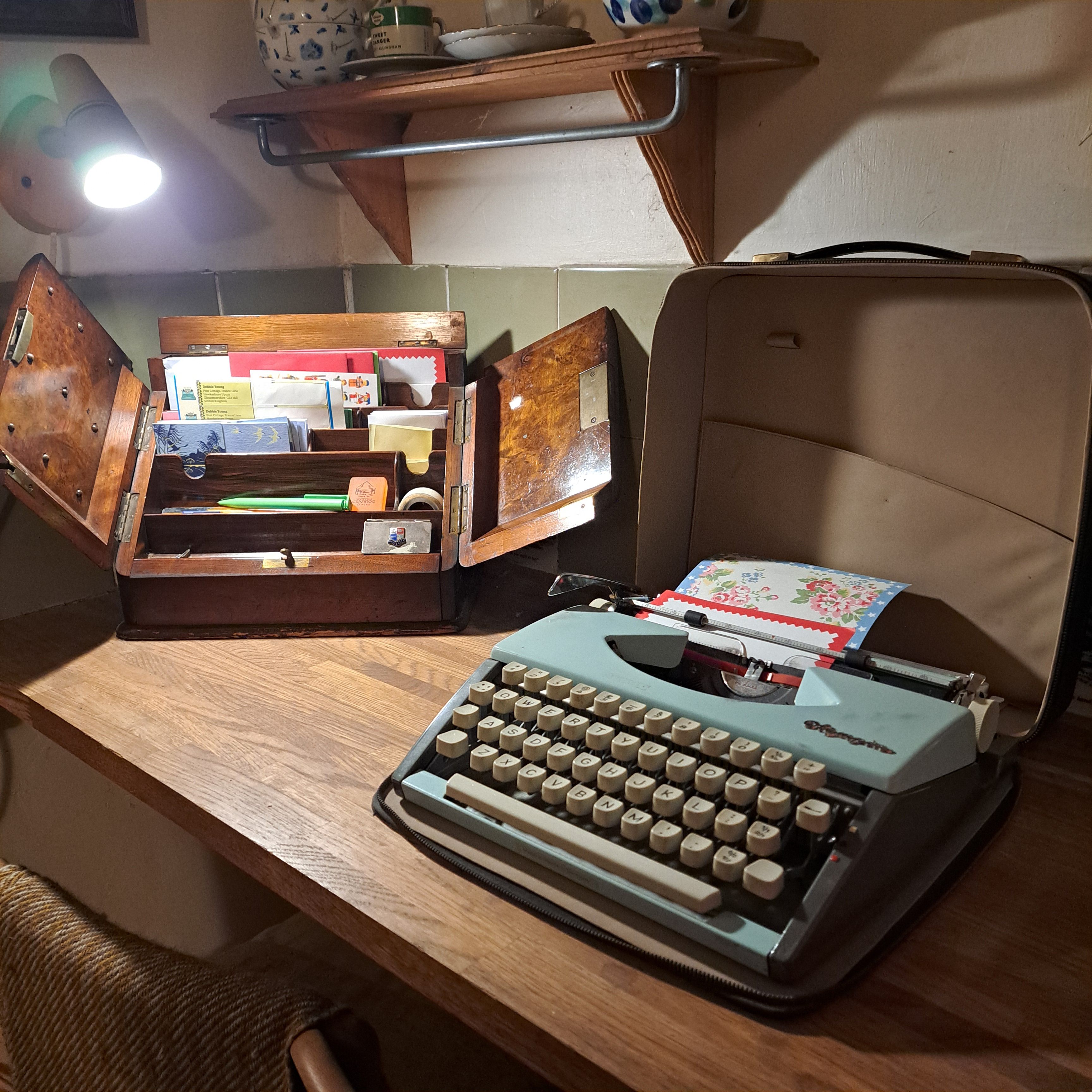
The recent gift of a vintage portable manual typewriter from kind friends set me reminiscing about old technology and, as the world wearies of constant connection to the internet, its place in our future.

I use a computer keyboard every day, but it’s been decades since I used a manual typewriter keyboard. Typing my first letter on my little machine jogged my memory about forgotten differences between keyboards ancient and modern.

Continue reading “In Praise of Old Technology”

Posted in Writing

In Conversation with Novelist Jane Davis About Her Latest Novel, “The Bookseller’s Wife”

headshot of Jane Davis with books
Jane Davis (photo by Matthew Martin)

Throughout 2024, my last blog post of each month will be a conversation with one of my author friends, talking about an aspect of their writing life that I hope will interest my readers too. 

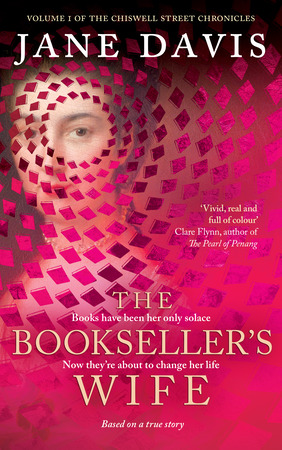
When I heard that my author friend Jane Davis was writing a novel about bookselling in late eighteenth-century London, I couldn’t wait to read it. I’m passionate about booksellers, intrigued by the book trade and its history, and I’m a Londoner – so I knew before I read it that I’d love The Bookseller’s Wife. I’m delighted to welcome Jane to my blog today to tell us more about the story behind the novel and the history of the bookselling trade.

Continue reading “In Conversation with Novelist Jane Davis About Her Latest Novel, “The Bookseller’s Wife””

Posted in Reading, Writing

The Many Roads That Lead to Effective Storytelling

A post about how apparently unrelated day jobs can help hone your writing skills

Debbie writing with a pen on paper
It’s never too late to start writing

In a recent WhatsApp discussion with some author friends, we were talking about starting writing relatively late in life. One kindly said to me, “Oh, but you’re a natural”, assuming that my capacity for storytelling had got off to a flying start without any training in 2017 when I published my first novel.

I explained to her that spending decades in a series of day jobs had honed my writing skills, giving me a head start when I began to write fiction. Composing news stories, features and articles as a journalist, and brochures, website copy and press releases in public relations provided a fine apprenticeship in writing prose. Oh, and my degree in English and Related Literature probably didn’t do me any harm either!

Being a lifelong voracious reader has also helped me learn better writing, almost by osmosis. Continue reading “The Many Roads That Lead to Effective Storytelling”

Posted in Writing

Originality and Ideas

This post is based on notes I wrote for my talk at the HULF Talk on Research and Inspiration at the end of September, but due to (as ever) trying to fit in more talks and readings than were feasible in the time allowed, I kept this bit back! So here it is for the first time now.

In the first part of my talk, I described where I get my ideas from, and gave a list of suggestions for aspiring authors who might be struggling to know what to write about. It’s a question that often comes up among novice writers.

Once I’ve come up with story ideas, or at least starting points for stories, they need to mature. Therefore I keep an ideas book in which I jot all my ideas down. Sometimes it will be a single line or phrase that’s triggered my imagination, or it might be a detail for a novel or short story that I already have planned. I keep separate ideas books for specific projects too.

Then I leave each idea simmering away, sometimes for years, until it’s fermented enough to turn into a short story or novel, leaving my unconscious to work on it.

I don’t believe in writers’ block, other than in cases where you try to write a story too soon, and the thing won’t come because it’s not ready.

Originality and Novelty

But must all ideas be new? Must they be things that only I have ever thought of?

That would really narrow down a writer’s possibilities! Fortunately, I don’t think they do have to be entirely new, because every author’s take on an idea is different. They see an idea through the prism of their character and their lived experience. It’s common at writers’ workshops to be given an object or a set of of words as writing prompts, yet every piece of resulting prose or poem is always very different. In the same way, if you asked six artists to draw a specific object, each picture would be unique.

It’s also evidenced by the entries I’ve co-judged on several occasions with organiser John Holland for the Stroud Short Stories spoken word event, in which we have to choose ten stories from over 100 entries to be performed at a live event. We recently announced the list of the ten stories we chose for this autumn’s event, which is on the theme of love and obsession. It was fascinating to see how very different each story was. Submissions ranged from laugh-out-loud humour to tear-jerkers, from happy-ever-afters to apocalypse.

Tickets are now on sale for the event, which takes place on Sunday 5th November – so if you’d like to come along and see the differences demonstrated, book your tickets here.

poster advertising Stroud Short Stories Love is Strange event
Click the image to order tickets from the Cotswold Playhouse


Originality and Theft

I’ve also just come across a fabulous book about art and theft written before the advent of AI in its current form. Steal Like an Artist by Austin Kleon explains the contribution existing ideas and art contribute to new work. Kleon and licenses you to seize what you love and build on it. Do read it – it’s quick and easy and he runs an interesting newsletter too. It’s very empowering, because it justifies what may have felt, wrongly, like a guilty secret.

cover of Steal Like an Artist by Austin Kleon
A fascinating, easy, quick read – highly recommended

Originality and Research

But why not just write what you know?

When you get to a certain age, doesn’t your life experience give you enough raw material? Wouldn’t that be easier than researching what you don’t know?

Well, yes – and my starting point in my writing is always what I know – the human condition, as lived by me, eg over thirty years of living in a Cotswold village and thirteen years of working at a boarding school. At some point, I plan to write about an as yet untapped part of my past, when I worked as a PR in the 1990s. I also plan to write stories with older female protagonists, having drawn largely on my younger life so far.

But research allows you to deepen a story and also to write about what you know less well, or what you don’t know but would like to. That’s an exciting experience as a writer. Over the last couple of years, I’ve enjoyed researching a story set not in the Cotswolds but in Mousehole, and I’ve learned so much about local legend, topography, history and all sorts.

This brings me to a buzzphrase that sometimes arises when people research topics is “cultural appropriation”. Although I have a small amount of Cornish blood via my great-grandmother, when I started my Mousehole project, I felt slightly uncomfortable. Did I really have the right to write about Cornwall. Then I decided, yes, I do – provided the central character and viewpoint is of an outsider. Although I try hard to get my facts right, I don’t pretend to be an expert or have the authority of a native. I don’t think Cornish nationalists will be after my blood.

My research in Cornwall has taken the form of staying in the cottage where my story is set, spending a lot of time wandering about absorbing the atmosphere, reading masses of history books, visiting the places that will be pivotal in the story, like the monument to the village’s last native speaker of Cornish.

Photo of memorial at Paul Church
Part of my research in Cornwall was to visit this memorial to Dolly Pentreath, Mousehole’s last native speaker of Cornish (taken in March, hence grey sky and bare branches)

Yes, I could have stayed at my desk and consulted Google and Wikipedia, but that’s barely scratching the surface and doesn’t allow you the full sensory experience of the place. It also only tells you whatever people have put online in the first place. Everything there is secondhand, and a significant amount of information online is likely to be inaccurate. But desk research can be a good starting place, especially if you click through to the links at the foot of Wikipedia to the original source materials.

If you’re a writer nervous of taking their first leap into fiction, and you crave licence to lay claim to an idea and make it your own, I suggest you read the kind of books that will give permission to lay claim to an idea and get writing. These include craft books such as Julia Cameron’s The Right to Write and Stephen King’s On Writing. The two books that made the biggest different to me were, very early on, Dorothea Brande’s Becoming a Writer and more recently Ray Bradbury’s Zen in the Art of Writing.

Meanwhile, my thirteenth novel, Driven to Murder, to be published by Boldwood Books in January 2024, taps into my lived experience – not of murder, you’ll be relieved to know, but for Sophie Sayers‘ experience of learning to drive when the village bus service is under threat of withdrawal – a threat that, coincidentally, arose in my real-life village as I was writing the book. It’s surprising how often a story you think you’ve just made up turns out to have at least an element of truth.

I’d love to hear your examples of fact proving larger than fiction. Do leave a comment if you’d like to share an example that’s happened to you.


In Other News

Fellow mystery author Kat Ailes and I will be in conversation about where we get our ideas, how to come up with an original angle for crime novels, and much more, on Sunday 12th November at Stroud Book Festival. We met for the first time last week and chatted for two hours about what we’d discuss in our one-hour talk, so you’re guaranteed a lively event!

banner ad for Cosy But Criminal talk at Stroud Book Festival with Kat Ailes

Book your tickets online here.