Posted in Personal life, Writing

Nominative Determinism, Pope Francis and Other Keywords I Have Loved

Pope Pius IX
Pope Pius IX – a name that states the obvious (photo: Wikipedia)

So, Pope Francis it is, then.

I love the fact that some religious institutions allow and even encourage their members to change their names. Names are generally chosen as symbols of what the involved parties hope the bearer will become. It’s not so much choosing a name as picking a personality or fate. This notion of nominative determinism is one reason why books of babies’ names continue to be top-sellers, year in, year out. It helps that there are always plenty of new babies to be named. Unlike popes.

I don’t blame the former Argentinian cardinal for choosing a name unprecedented for popes. I don’t think I’d fancy being just the next in a sequence of popes of the same name, like the interminable sequels of a Hollywood blockbuster (Pope Rocky VI, anyone?) I have always been fond of the new pope’s namesake, St Francis, especially since visiting his old stomping-ground, Assisi, as a teenager.

What’s in a Papal Name?

Of course, not all papal names were created equal. I wouldn’t mind being another Pope Boniface, which to me suggests a kindly, rotund, beaming Pope giving and receiving love in all directions. Pope Honorius sounds as trustworthy as you could get. Pope John-Paul was a pretty benign name, too, with a touch of Beatles-esque hip about him  – though I’m not sure Pope George-Ringo would have had the same cachet. And if you think that would have been a wacky name, how about Pope Sixtus III – how confusing is that? He put in 8 years’ service in the 5th century, just to add more numbers to the equation. I’m hoping the equally strangely named Pope Sisinnius had neither a lisp nor a stutter.

If you’re in the mood for more idle musings about papal names, there’s an engaging list on Wikipedia here. It’s the cardinal’s equivalent of the Parent’s Best Book of Babies’ Names.

Twitter Hashtag Fun

And if that isn’t enough to entertain you, pop over to Twitter and search under the hashtag that was the second most popular trending story at the moment the new pope was appointed. Right under the unsurprisingly top hashtag “#NewPope” came “#ReplaceMovieTitleWithPope”. The gems that cropped up here were enough to completely distract this atheist from the white smoke at that point still emerging from the Vatican chimney. Suggestions included “Dude, Where’s My Pope?”, “Jurassic Pope”, “The Pope with the Dragon Tattoo”, “Pope Fiction”, “Gone with the Pope”, “Dr Strangelove: Or How I Stopped Worrying and Learned to Love the Pope”, “The Pope Wears Prada”  and so on – you get the picture.

Of course, I quickly added my own contributions: “Mary Pope”, “Smokey and the Pope”, “The Pope, The Witch and The Wardrobe”,  “Pope Gordon” and “Flash Pope” (the last two in honour of my aggressively atheistic husband Gordon), to name but a few. It’s no wonder I didn’t get much work done that night.

Once A Pope

Pope Gregory XVI made gambling on papal electi...
Pope Gregory XVI made gambling on papal elections punishable by excommunication. Quite right too. (Photo credit: Wikipedia)

Actually, I don’t think it really matters what the Pope is called, any more than it matters what the Queen is called. The title alone is enough to conjure with. Who needs a name when your title is recognised around the globe?

Here’s an example. When my brother was a teenager, he belonged fleetingly to a band. He and his friends chose the band’s name by picking words at random from the dictionary. It is a time-honoured process for the unimaginative which worked a treat for the Wombles (eventually a rival band themselves, of course, as well as a bestselling children’s book). The Wombles used an atlas instead of a dictionary, hence a string of characters with melliflous names such as Orinoco, Tobermory and Great Uncle Bulgaria. What did my brother come up with? “Inedible” – ok, quirky. “Giant” – good, suggests impending megafame. And finally: “Pope”. Put them together: “The Inedible Giant Pope”. Well, band names don’t get more memorable than that.

Wombles Annual 1975
Remember you’re a Pope (Photo credit: Museum of Hartlepool)

So what if I were pope, (and I realise that is about unlikely a proposition as I will ever make on this blog), which name would I choose? Well, based on the principal of nominative determinism, I think I’d follow the new Pope Francis’s example and go for a name that suggested what I wanted to be. Pope Popular, Pope Ethical, Pope 21st Century – all a bit too obvious. But given the fact that by the time anyone becomes pope, their age will feature in both the “weakness” and “threat” sections of a SWOT analysis of their position, I have a simple but elegant solution, so obvious that I suspect you’ve arrived at it ahead of me. After all, what’s not to love about Pope Young? I rest my case.

Long live the Pope!

PS No Popes were harmed in the writing of this blog post. 

PPS I admit this post is something of an experiment, driven by the surprising revelation that “nominative determinism” – a phrase I have always adored – has been one of the most popular keyword phrases in my previous posts. I have absolutely no idea why. 

Posted in Personal life

Deliver Us From Tesco

Camberwick Green - idyllic village in the children's TV programme

Trying to free up some space on my over-crowded bookshelves, I take down an old ring-binder that hasn’t been moved for as long as I can remember. Admittedly these days that could be as little as five minutes, but the dust indicates a period of years.

The label on the spine has come adrift, so I have to open the ring-binder to find out what’s inside: a collection of unpublished articles I wrote 20 years ago, just after I moved to Hawkesbury.

I’m soon reliving my first impressions and reflecting that in some ways, very little has changed. Rather, it’s me that’s adjusted to village life. But one article startles me: the one about the many charming local retail services that were flourishing then, long before the supermarkets started delivering to our doors.

There was Charlie Orchard the fishmonger, for example, who every Friday slipped fresh fish through our letterbox while we were out. A fish and chip van stopped outside our house on Tuesdays. To signal we wanted to order, we left our curtains open. A wonderful Village Market offered home produced goods. It was like having a village fete every fortnight.

When I wrote the article, many such services thrived within our village. But while my ring-binder’s lain unopened, gathering dust, virtually all of them have quietly fallen away. Reading the article was a sobering trip down memory lane. I hope that in another 20 years’ time, we’re not talking in the past tense about the few local services that still remain, particularly our Village Shop, Post Office and pubs. We use them or lose them, folks. May Hawkesbury be delivered from dependence on faceless, charmless supermarket chains. Every little helps local shops too, you know.

You can read some of these old articles about Hawkesbury’s local delivery services under the Hawkesbury Tales – A Village Memoir tab at the top of this page. The one about the delivery services is called Who Will Buy?

This post was originally written for the March 2013 issue of Hawkesbury Parish News.

Posted in Personal life, Travel

On A Mission To Post A Parcel

Village post office in Hawkesbury Upton, Gloucestershire
Hawkesbury Sweet Hawkesbury Post Office (photo: Wikipedia)

Ash Wednesday finds me on the high street of a town that’s new to me,  searching for a Post Office in which I can post an important parcel.

I’m up against the clock, because I’ve left my husband and daughter parked in a restricted zone where the parking ticket for our camper van, in which we’ve come away for half term, is about to run out. I march purposefully through the pedestrian precinct, scanning the shop fronts on either side of me for the familiar red oval logo.

After a few minutes of fruitless searching, I’ve passed endless charity shops and poundstores, two pawnbrokers, a halal butcher and a surprising number of greengrocers displaying neat, open baskets of exotic fruit and vegetables, the kind that characterise Asian and Caribbean cookery. I’ve given a wide berth to ‘Jackpots’, a tacky arcade of slot machines offering prizes of up to £500, according to big signs in the window. Just 90 minutes’ drive from Tetbury, we might as well be in a different country. No cosy tearooms, antique shops or bookstores are to be seen. There’ll be no rich pickings in this high street’s charity shops.

A Lost Soul

With a glance at my watch, I give up trying to find the Post Office on my own. I am not my husband: I will ask someone for directions. But spotting a helpful looking person is no easier.

Everyone I encounter is pale, downcast, jaded and sad. Their clothes are cheap, dark and drab, with one exception – a podgy fellow in his twenties sports a black hoodie to the front of which are stitched brightly coloured, giant metallic dollar signs. From the rest of his ensemble, I infer that these indicate his aspirations rather than his bank balance. If I accost any of these passers-by, they look as if they might burst into tears.

Then at last, like buses, two friendly faces crop up at once. There on a street corner are two smartly dressed young men, standing quietly looking about them as if at a loose end. They are quick to make eye contact with me and flash me a smile. Emboldened, I approach them.

“Excuse me, can you please point me in the direction of the nearest Post Office?” I plead.

Their smiles broaden.

“No problem,” says one, “it’s right there.

Modern British Post Office logo
It must be a sign!

He points to the other side of the street. The Post Office, based within a shabby convenience store, is exactly opposite where I am standing. I’ve been too preoccupied with people-watching to spot it. About to mumble an embarrassed apology for my stupidity, I cast my eyes downward. They alight on the young men’s lapels, where I spot badges identifying them as members of a church known for sending young missionaries out into foreign parts. I do not envy them their task in this dismal town. It’s my turn to flash a smile.

“Thank you so much!” I beam. “You’ve been very helpful.”

I think they will need all the encouragement they can get if they are to make it through their duties today. If I can’t summon up the resolve to ask the locals for directions, how hard must it be to talk to them about saving their souls?

Mission Accomplished

But as I join the queue in the Post Office, I castigate myself for my arrogance. Though armed only with smart suits and old-fashioned haircuts, these pleasant young men are bolstered by a much greater force than my smile: their unshakeable belief in their god. Though I don’t share their faith, I hugely admire what they are doing. I am suddenly moved to pay tribute, and so, my own mission accomplished, as I march back to the car where my husband will be impatiently drumming the steering wheel, I determine to show some resolution of my own: I decide to give up alcohol for Lent.

Mysterious ways…

Can’t see the wood for the trees… (image: Wikipedia)

This article was originally written for the Tetbury Advertiser, March 2013.

If you liked this article, you might like these others about post offices:

The Power of the Postage Stamp – about my daughter’s new hobby

Who Will Buy? – a memoir about the change in our village shops and services

Posted in Writing

My New Philosophy of Flower Arranging

This weekend, my lovely friend Susanne, whom I’ve known since I was 11, presented me with a beautiful bunch of spring flowers – anemones and tulips (my favourite). As I stuffed them unceremoniously into the first vases that came to hand, (well, we were in the middle of my husband’s birthday party), I inadvertently conducted a floral  experiment that’s brought out the philosopher in me. Or should that be the flowerosopher? I think I’ve just invented a whole new school of thought. Florists, philosophers – you decide….

Sometimes it’s good to be in solitary splendour, regardless of what anyone else is doing – but it can get a bit lonely.

Single anemone in a green IKEA vase
1) Standing, strong, alone.

Other times, there’s safety in numbers, all standing together, disciplined and firm.

Tulips and anemones stuffed tightly into a glass vase
2) Looking pretty but with no room for manoeuvre.

Best of all is when you can be together, but enjoy the freedom to be who you want to be and to go where you want to go in life.

Tulips and anemones loosely placed in a glass vase, arrange themselves
3) With room for manoeuvre, these flowers arranged themselves to perfection.

I know which I prefer.

Thank you, Susanne – you and I definitely belong in vase number 3!

Posted in Family, Writing

The Sixpence That Changed Into a Swimming Pool

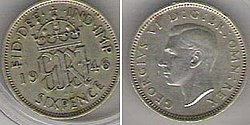
King George VI sixpennny piece, seen from either side
Just an ordinary sixpence – or is it? (Photo: Wikipedia)

This post has been written in response to MoneySupermarket.com’s “Pocket Some Extra Cash” challenge, inviting the country’s top bloggers to describe how they’d spend a £20 windfall to put a smile on someone’s face. To oil the wheels of our imagination, they’ve kindly given us £20 each. This is my story…

When I was about 10, my grandmother bought me a wonderful book called The Sixpence That Changed Into A Swimming Pool. It was part of the Judy Picture Story Library, a series of slim shilling novels published as a spin-off from the popular girls’ comic of that name.

On first glance, I thought it was going to be the tale of a girl with a magic coin that she could transform at will into her own private leisure centre. But it turned out to be a much more interesting and satisfying tale.

Inspirational Investment

Cover of the Judy annual, 1967
Comic annuals – such a treat

The heroine, a schoolgirl of around my own age, (let’s call her Sally, as I’ve forgotten her name), has a sister confined to a wheelchair, suffering from a disability for which the only hope of a cure was to have unlimited access to her own swimming pool. Like all Judy‘s heroines, Sally is a resourceful type, keen to help her sibling, but has only sixpence to her name. Determined to save the day by somehow acquiring a swimming pool, she invests her sixpence wisely to turn it into a shilling. I forget exactly how – probably by buying six things each costing a penny and selling them on for tuppence each. She then acquires a shilling’s worth of something to trade for half a crown or so.

And so the tale continues, providing a handy introduction to the concept of compound interest along the way. It’s not only her money that snowballs, but also her goodwill. Other people inspired by her tenacity muck in to help her run jumble sales and other fundraising events. Satisfyingly, on the final page, Sally unveils the new pool to her sister, to the pride and admiration of her family and her sister’s eternal gratitude.

It was a salutary lesson for any child whose first instinct on finding sixpence would be to spend it all on sweets. (My grandfather claims my early mastery of mental arithmetic sprung from his habit of taking me to the sweetshop every Saturday with sixpence to spend.)

Rising Prices, Raising Smiles

Now I’ve been set a similar challenge, but the sum in question is not sixpence but £20. Well, that’s 40+ years of inflation for you.

The challenge has been set by MoneySupermarket.com, whose research revealed that even a small windfall like this can put a smile on the face of the recipient. I’m allowed to spend it however I like – or indeed to save it – to make the most of the opportunity.

On reading the brief, the story of the sixpence and the swimming pool immediately sprung to mind. A little while ago, I befriended online, via Mumsnet, a lovely lady with six children, one of whom has been severely disabled from birth, confined to a wheelchair and often in unbearable pain. Sadly her condition wouldn’t be cured by the acquisition of a swimming pool, even if I had the time and stamina to grow the £20 into one. But I do know that her mother longs for driving lessons which would give her and her daughter more independence and mobility and greatly improve their quality of life.

I’d therefore like to forward the £20 to her, to start off her driving lesson fund. I hope I could also count on the snowballing of goodwill here, as in Sally’s story. For example, a friendly local driving instructor might decide to join in by offering a specially discounted rate for her lessons. A bigger driving school might donate as many free lessons as she needs to pass her test. And is it too much to hope that some kindly motor manufacturer might chip in with a wheelchair-adapted car?

Well, it’s the sort of thing that might happen in Judy‘s world. But even if it doesn’t, I’m sure just the gift of the £20 will put a smile on my friend’s face. And she does have a very lovely smile. I think Judy would approve.

backyard swimming pool
Oh look, a swimming pool! (Photo credit: Wikipedia)

Post script: Shortly after this post was published, a kind reader offered to donate an additional £20 as her “first random act of kindness of the month”! If anyone else would like to do this, please send a cheque payable to “D Young” to me c/o my work address (I’m slightly nervous of putting my home address up here!):

Debbie Young, c/o Read for Good, 26 Avening Road, Nailsworth, Gloucestershire GL6 0BS

If you prefer to pay by BACS, please contact me and I’ll send you my bank details.

I’ll bank them myself and transfer the total to Jo by BACS, to avoid creating any extra work for her, and I’ll post the total up here in a few weeks.

STOP PRESS! (Thursday 14th March)

I’m delighted to announce that this evening I was notified that this blog post has been chosen as the competition winner! My prize is £200. Needless to say, that’s going into the driving lesson fund. The swimming pool is filling up…