

Throughout 2024, my last blog post of each month will be a conversation with one of my author friends, talking about an aspect of their writing life that I hope will interest my readers too.
When I heard that my author friend Jane Davis was writing a novel about bookselling in late eighteenth-century London, I couldn’t wait to read it. I’m passionate about booksellers, intrigued by the book trade and its history, and I’m a Londoner – so I knew before I read it that I’d love The Bookseller’s Wife. I’m delighted to welcome Jane to my blog today to tell us more about the story behind the novel and the history of the bookselling trade.
Debbie: Jane, what was your inspiration and starting point for the story?
Jane: In September 2022 I took a small research trip to the ancient church of St Mary’s in Merton. Small, because it’s only a ten-minute walk from the house I grew up in. My intention was to visit the place where Nelson worshipped and see his custom-made bench, now heavily alarmed, but which one of my aunts was given special permission to sit on when she was a seven-year-old bridesmaid at her sister’s wedding. Walking among the gravestones, one caught my eye.
DORCAS, WIFE OF J LACKINGTON
Bookseller, Finsbury Square
Died January 27th 1795, aged 46 years.
What could be more intriguing? I read in the church guide that Dorcas was an avid reader of novels and took a leading share in running her husband’s book shop – The ‘Temple of the Muses,’ Finsbury Square. I had to know more!
Debbie: Bookshops are a perennially popular topic for fiction, both contemporary and historical – which I’m glad about, because I love reading (and writing) about them!
Jane: I think that when people think of books about bookshops, the first that springs to mind is 84 Charing Cross Road by Helene Hanff. But there is certainly a spate of novels riding high in charts. The Bookseller of Kabul by Åsne Seierstad and The Bookseller of Inverness by S.G. MacLeanthe are two examples.
(You’ll find a long list of such books at the foot of this post).
Debbie: But you write of an era when bookshops were very different to how they are now. What are the biggest differences?
Jane: Bookshops were multi-faceted. Some booksellers were also publishers. Reprinting bestsellers that were out of copyright was a low-risk strategy and gave them a ready supply of stock.
Debbie: Interesting – there are quite a few publishers doing that now on Amazon too! Plus ça change….
Jane: But through their own taste and a sense of what their customers wanted, booksellers also bought manuscripts and published new works, which they sold alongside second-hand books. Some shops also incorporated circulating libraries and if they didn’t, then they might loan books to readers for a small fee. In fact, in an age when books were expensive and customers expected to be offered credit, it was this ready-money (cash) side of the business that kept many a bookseller afloat.
Debbie: We always like to think that our age is the most advanced, and our generation probably considers the rise of the ebook and of digital printing and delivery as the most important breakthroughs in twenty-first-century bookselling . What was cutting edge in terms of books and printing in the late eighteenth-century, when your book is set?
Jane: With population and literacy rates increasing over the course of the century, there was a growing audience for books.
Although the term ‘novel’ had been in use since the sixteenth century, it is the eighteenth century that’s associated with the birth of novel.
Before then, there had only been a scattering of publications that modern readers might recognise as novels. It wasn’t until 1799 that one hundred novels would be published in a single year.
Note that the rather sniffy definition Dr Johnson offered of ‘novel’ for in his famous dictionary was ‘a small tale, generally of love,’ suggesting that the serious-minded reader might prefer histories or tales of travel.
But there had also been a trend for the publication of private dairies and letters, sometimes to scandalous effect. It is no accident that writers like Aphra Behn wrote novels in the form of letters, claiming that they were ‘found text.’
Debbie: In our time, books are pretty affordable for everyone, whether buying ebooks, print, audio, or second-hand. There are even free community libraries, as inspired by the Little Free Library movement. (As you know, I have one of those on my front garden wall and in my village bus stop!) How common was book ownership in the era of your book’s setting?
Jane: The cost of new books was beyond most people’s reach. If we compare it to the cost of a week’s rent on a room – one shilling and six pence – to buy all volumes of a single novel might cost 12 shillings. At between 12 and 21 shillings a year, even the cost of subscribing to a London circulating library was prohibitive.
Attempts were made to make new books affordable by publishing them as collectable volumes, and just as today, after initial print runs had sold out, cheaper duodecimo (12 pages to a printing sheet) editions might be issued, but they would still cost a month’s rent. Readers might opt for abridged or pirated versions, or one of the numerous unofficial spin-offs.

But novels such as Robinson Crusoe and Moll Flanders were also serialised in newspapers and magazines, and it was possible to go to a coffee-house and read – although coffee-houses didn’t tend to welcome women.
There was also a flourishing trade in second-hand books. James Lackington – the bookseller in my story – tells us in his memoir that when he was a journeyman shoe-maker he would often forego meals so that he could buy books. This tells us that working people could own books, but they would have to make sacrifices to do so.
Debbie: Dorcas’s background explains her love of books and the access she’s had to them from a young age – but what was the level of literacy like in those days for men and women?
Jane: Because the definition of literacy was a person who could read and write their own name (wow! – D.), we only have best estimates of what we would consider as literacy. Rates would have been far higher in London than elsewhere, but David Cressy estimates that in 1740, 58% of men and 32% of women were literate, and by 1800 this had increased to 60% of men and 40% of women.
Since there was no state school provision, the majority of children were reliant on charity schools or Sunday Schools, which enjoyed a surge in the second half of the century. But like James Lackington, others were self-taught or taught by their first employers.
That said, stories have always been with us and story-telling was a social activity. What we see is a change from the oral tradition to reading aloud. All that was needed was one child who could read, and the whole family could benefit.
There is a rather nice anecdote about a blacksmith who read Richardson’s “Pamela” to a large audience of villagers, and when he reached the part where the hero and heroine were brought together his audience was so delighted that they rang the bells in the village church.
Debbie: As a bell ringer myself, I can relate to that! What fun! So how did you undertake your research? What most surprised/shocked/delighted you about what you discovered?
Jane: As always with historical research, it’s easier to find information about a man than a woman, and so I turned first to her husband. James Lackington left us with two memoirs, written primarily to promote himself as a successful entrepreneurial innovator in the world of bookselling. While his writing must be taken with a liberal pinch of salt, there is substance in dates and key events.
James Lackington’s memoirs tell us that Dorcas’s mother, Jemima Turton, was grand-daughter of the Honourable Sir John Turton, Baron of the Exchequer and Justice of the King’s Bench.
She was so proud of her lineage that she kept her maiden name in the only way a woman could – by marrying a man with the same surname, possible a cousin.
Since Dorcas’s father Samuel Turton had a fortune of his own, the family should have been comfortably off, but owing to ‘an unhappy turn for gaming,’ he was forced to turn to trade. Even after setting himself up as a saddler’s ironmonger, he couldn’t give up gambling. These days we would recognise addiction rather than weakness of character.
Jemima Turton didn’t live to see her husband’s financial ruin, dying in early 1773. Dorcas then supported her father, setting up a day-school for girls and taking in needlework. Once I read that, I could see this very strong character emerging.
Debbie: How revolutionary was Dorcas’s attitude to women’s education?

Jane: I have no evidence that Dorcas championed women’s education. What I do know is that her lived experience mirrors Mary Wollstonecraft’s, and Mary published her Thoughts on the Education of Daughters which was considered radical. I don’t think it is too far a stretch of the imagination that Dorcas would have shared her views. Mary was by no means the first to advocate for education for women.
A seventeenth century Dutch woman Anna Maria Schurman, who was allowed to attend Utrecht University as long as she sat behind a curtain (!), wrote “Whether a Christian Woman Should Be Educated” arguing in favour.
But we have to remember that it wasn’t a simple distinction between education for sons and daughters. This was a time when the idea of free education for all was radical. The majority believed that children should only be educated as far as was necessary for their station in life (which was, of course, fixed at birth). Some went as far as to say that it was cruel to teach children more.
Debbie: You usually write standalone books, but you’re already working on the sequel to this one – what compelled you to continue Dorcas’s story?
Jane: Simply that there is more to tell.
Debbie: I can’t wait to read the next instalment! Thank you very much, Jane, for being my guest today.
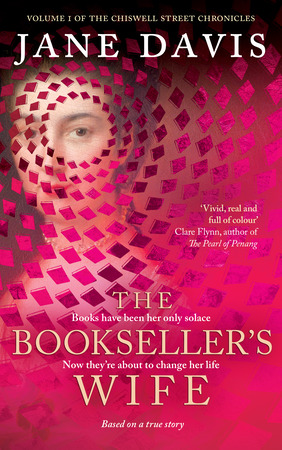
More About The Bookseller’s Wife
 London, 1775: The only surviving child of six, Dorcas Turton should have been heiress to a powerful family name. But after her mother’s untimely death, she is stunned by the discovery that her father’s compulsive gambling has brought them close to ruin. With the threat of debtor’s prison looming large, she must employ all her ingenuity to keep their creditors at bay.
Fortunately, ingenuity is something Dorcas is not short of. An avid reader, novels have taught her the lessons her governess failed to. Forsaking hopes of marriage and children, she opens a day-school for girls. But unbeknown to Dorcas, her father has not given up his extravagant ways. When bailiffs come pounding on the door, their only option is to take in lodgers.
The arrival of larger-than-life James Lackington and his wife Nancy breathes new life into the diminished household. Mr Lackington aspires to be a bookseller, and what James Lackington sets out to do, he tends to achieve. Soon Dorcas discovers she is not only guilty of envying Mrs Lackington her strong simple faith and adaptable nature. Loath though she is to admit it, she begins to envy her Mr Lackington…
Based on a true story, Jane Davis’s latest historical novel is for book-lovers everywhere, delivering unforgettable characters, a portrait of Georgian London on the brink of change, and a love song to the life-changing power of the written word.
More About Jane Davis
Jane Davis’s first novel, Half-Truths and White Lies, won a national award established with the aim of finding the next Joanne Harris. Further recognition followed in 2016 with An Unknown Woman being named Self-Published Book of the Year by Writing magazine/the David St John Thomas Charitable Trust, as well as being shortlisted in the IAN Awards, and in 2019 with Smash all the Windows winning the inaugural Selfies Book Award. Her novel At the Stroke of Nine O’Clock was featured by The Lady magazine as one of their favourite books set in the 1950s, selected as a Historical Novel Society Editor’s Choice, and shortlisted for the Selfies Book Awards 2021.
Interested in how people behave under pressure, Jane introduces her characters when they are in highly volatile situations and then, in her words, she throws them to the lions. The themes she explores are diverse, ranging from pioneering female photographers, to relatives seeking justice for the victims of a fictional disaster.
Jane Davis lives in Carshalton, Surrey, in what was originally the ticket office for a Victorian pleasure gardens, known locally as ‘the gingerbread house.’ Her house frequently features in her fiction. In fact, she burnt it to the ground in the opening chapter of An Unknown Woman and in Small Eden it was the gardener’s cottage.
When she isn’t writing, you may spot Jane disappearing up the side of a mountain with a camera in hand.
- Find out more about Jane on her website: www.jane-davis.co.uk.
- If you join her mailing list there, you’ll receive a free ebook of I Stopped Time.
Order The Bookseller’s Wife from your preferred store here
Other Novels about Bookshops and Booksellers
- The Love Island Bookshop by Kate Frost
- The Bookshop Murder by Merryn Allingham
- A Wartime Welcome from the Bookshop Girls by Elaine Roberts
- Can’t Take My Eyes Off You by Aimee Brown
- Summer at the Santorini Bookshop by Rebecca Raisin
- The Missing Bookshop by Patricia McBride
- The Hopes and Dreams of Libby Quinn by Claire Allan
- Love Blooms at Mermaid Point by Sarah Bennett
- Murder in the Bookshop by Anita Davison
- It Started with a Book by Camilla Isley
- The Girls Next Door by Anita Waller
- An Enchanted Moment on Ever After Street by Jaimie Adams
- Just for the Summer by Fay Jessop
- A Bookshop Christmas by Rachel Burton
- The Christmas Bookshop by Jenny Colgan
- Slightly Foxed by Jane Lovering
- To the Fair Land by Lucienne Boyce
- The Mayfair Bookshop by Eliza Knight
- The Bookshop by Penelope Fitzgerald
- The Bookseller of Kabul by Åsne Seierstad
- The Bookseller of Inverness by S.G. MacLean
- The Bookshop on Primrose Hill by Sarah Jio
- Death of a Bookseller Alice Slater
- A Bookshop in Paris by Ellen Feldman
- The Bookbinder by Pip Williams
- Yellowface by Rebecca F Kuang
- Bookshops & Bonedust by Travis Baldree
- The Door-to-Door Bookstore by Carsten Henn
- The Lost Bookshop by Evie Woods
- The Paris Bookseller by Kerri Maher
- Mr Penumbra’s 24-hour Bookstore by Robin Sloan
- Days at the Morisaki Bookshop by Satoshi Yagisawa
- The Lost Bookshop by Evie Woods
- The Bookseller’s Tale by Ann Swinfen
- The Bookseller by Cynthia Swanson
- The Bookseller’s Daughter by Pam Rosenthal
- The Bookseller’s Daughter by Daniela Sacerdoti
- The Bookseller’s Daughter by Christine Stables
- The Bookseller of Dachau by Shari J. Ryan
- The Wartime Bookshop by Lesley Eames
- The Last Bookshop in London by Madeline Martin
- The London Bookshop Affair by Louise Fein
- The Forgotten Bookshop in Paris by Daisy Wood
- The Mayfair Bookshop by Eliza Knight
- Diary of a Tuscan Bookshop by Alba Donati
- The English Bookshop by Janis Wildy
- The Printed Letter Bookshop by Katherine Reay
- Welcome to the Hyunam-dong Bookshop by Hwang Bo-reum
- The Bookbinder’s Daughter by Jessica Thorn
- The Bookbinder of Jericho by Pip Williams
- The Bookshop of Secrets by Mollie Rushmeyer
- The Bermondsey Bookshop by Sarah Gibson
- The Bookseller’s Secret by Michelle Gable
- The Banned Bookshop of Maggie Banks by Shauna Robinson
- The Haunted Bookshop by Christopher Morley
- The Printed Letter Bookshop by Katherine Reay
- The Left-handed Booksellers of London by Garth Nix
- The Bookseller by Cynthia Swanson
- The British Booksellers by Kristy Canbron
- The Bookseller of Florence by Ross King
- The Bookshop on the Shore by Jenny Colgan
- Bloomsbury Girls by Natalie Jenner
- The Forgotten Bookshop of Paris by Daisy Wood
And many more… including my Sophie Sayers Cozy Mystery series, all of which feature the village bookshop where Sophie works, Hector’s House, and its proprietor (and eventually Sophie’s boyfriend) Hector Munro:

- Best Murder in Show
- Murder at the Vicarage
- Murder in the Manger
- Murder at the Well
- Springtime for Murder
- Murder at the Mill
- Murder Lost and Found
- Murder in the Highlands
- Driven to Murder
How many of this list of books about bookshops have you read? Can you think of any more? We’d love to know!

What a great interview, Debbie and Jane! I loved The Bookseller’s Wife and cannot wait for the sequel. (Im so glad there is going to be one). I had no idea there were so many books about booksellers. I’ve recently read The Bookshop Affair which I loved, and at the moment I’m reading Yellowface which, as a writer, I find a little depressing so far. Thank you for the list – very useful and inspiring.