I always enjoy my piano tuner’s annual visit. No matter how much dust has gathered on my bookshelves, or how much laundry is piling up in my utility room, I know he’ll restore at least this one small corner of my house to perfect order.
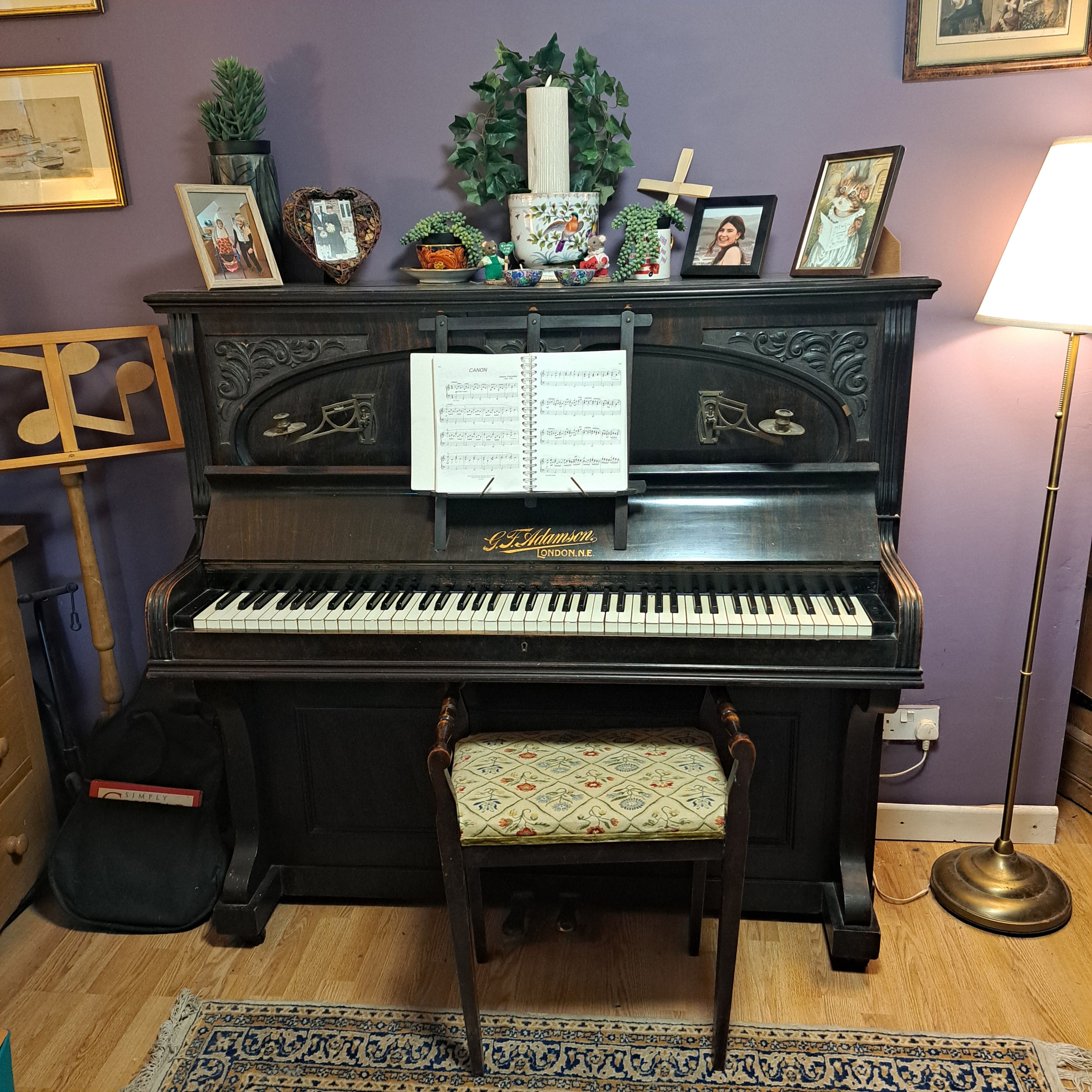
I always enjoy my piano tuner’s annual visit. No matter how much dust has gathered on my bookshelves, or how much laundry is piling up in my utility room, I know he’ll restore at least this one small corner of my house to perfect order.

The Japanese have a word for it: tsundoku*.
That is, buying more books, even though you haven’t read all those you have at home. To Western ears, that term may sound like criticism, but in the Far East it’s regarded as reasonable.
I’m clearly living in the wrong country. Despite being a speedy reader, I buy books faster than I read them. My to-read list never stops growing.
Compounding the problem is my delight in rereading old favourites. I often choose old over new.

An extreme example is rereading children’s books, which I often do. Revisiting E Nesbit’s The Railway Children last year, I identify now with the children’s mother.
As a child, I empathised with Phyllis. As the youngest of three siblings, my sympathies naturally gravitated towards the smallest child in stories. Having recently read the author’s biography added fresh insights into her fiction.

Even when we buy books with the best intentions, sometimes we grow out of them before we can find time to read them. There’s no shame in disposing of books you’re never likely to read, and there’s no shortage of good homes for them. Look no further than the bus stop in Hawkesbury Upton High Street, where a new, larger shelf unit built by my husband is about to be installed, thanks to the Parish Council’s kind grant for materials.
How many books are too many to have in your home?
In her debut self-help book, Japanese decluttering guru Marie Kondo recommended owning no more than 30. Never hesitate to part with books, she advised, because in the age of the internet, if you change your mind, it’s easy to track down a replacement.
At least, that’s what I think she said. I can’t check, because, I confess, my copy of The Life-Changing Magic of Tidying has long since left the building. The Japanese have a word for that too. I I just looked it up online. It’s 皮肉.* Pronounced: ai-ron-i.
*The Japanese characters making up this word literally mean “skin-meat”, but its meaning as well as its pronunciation is the same as our irony.
(This article first appeared in the June 2025 edition of the Hawkesbury Parish News.)

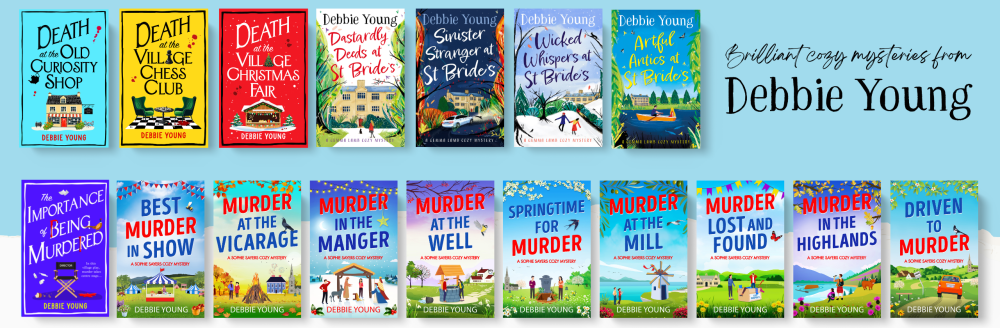
Behold – the official unveiling of my next book, Death at the Village Christmas Fair, which will be launched on 16th August, in plenty of time for Christmas. I had great fun writing this one, with the suspect playing hard-to-get in a Santa Run, in which everyone is dressed as you-know-who! It also gave me lots of opportunities to write about knitting, one of my favourite hobbies. Yes, there is a connection between the Santa Run and knitting – but you’ll have to read it to find out what it is!
This is third book in the Cotswold Curiosity Shop series, the first two being Death at the Old Curiosity Shop and Death at the Village Chess Club. Both of these have been Amazon Bestsellers, so I’m crossing my fingers for this one to join that heady status.
In the meantime, I’m wondering what to write next – another adventure in one of my series (the others are the Sophie Sayers and Gemma Lamb cosy mysteries), a new stand-alone story, or a novelisation of my first play, which debuted in April, The Importance of Being Murdered.
My involvement with the Badminton Benefice Festival of Music (see previous post) is also making me hanker after writing a series of mysteries in musical settings.
I’m sending several outlines to my publisher, Boldwood Books, for them to choose. If you have a preference, do tell me, and I’ll pass it on to Boldwood. I’ll be sure to let you know what they decide.
“If you want something done, ask a busy person.”
That may be one reason that I’ve found myself helping behind the scenes with a wonderful new music event founded by Badminton Benefice Music Director Ben Humphries. Badminton Benefice – part of the Diocese of Gloucester – contains ten ancient and beautiful rural churches, each in an idyllic, timeless setting. Sharing one vicar between them, the Reverend Richard Thomson, there is a limit to how many church services they can host each month.
One of the aims of the Festival is to provide occasions for more people to visit the churches and to enjoy these historically significant settings which are such a rich part of our local heritage. The other aim is to create live, accessible music events to the local community. All of the events are free to attend, but donations towards the maintenance of the churches and to the music charity Youth Music, which gives young people the chance to transform their lives through the power of music.
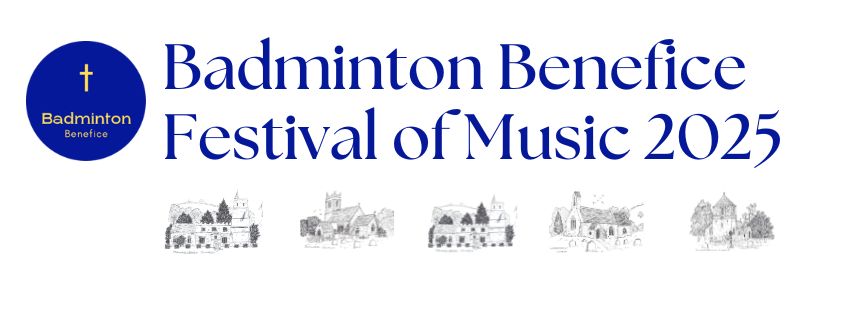
Each event will be different, resulting in a glorious mixture of musical offerings, some with art and/or flowers, and always refreshments, to be held on Sunday afternoons, one each month, from May to September. The event poster provides a handy summary of the programme:

The charming line drawings of each church are by Gillian Dawson, a former member of Hawkesbury Choir.
My role in the Festival has been as part of a small team behind the scenes, helping to raise awareness of the concert series and to attract an audience. I sang in the first event, which took place last month at my home church of St Mary’s, Hawkesbury.

The Come & Sing! event, directed by the brilliant singing teacher Amy Garry of Voices Together, also inspired me to write the following article for the May issue of the Hawkesbury Parish News. Even though the event has happened now, I thought you might still like to read it.
One of the highlights of primary school for me was the daily assembly, in which we’d all sing together in the school hall.
Days Lane Primary School, in Sidcup, Kent, was actually two schools in one, a single-storey brick quadrangle built in the 1920s. The infants were in one half, the juniors in the other, each with their own school hall and head teacher.
The daily assembly included two hymns from the pale blue Songs of Praise book and a few thoughtful words to inspire us. Every Tuesday, the Juniors stayed on after assembly while the teachers went back to their classroom (or maybe to drink coffee and smoke in the staffroom), leaving our jovial headmaster, Mr Bowering, to lead the whole school in hymn practice. From his lectern on the stage, accompanied by a pianist, he taught us new hymns. He also insisted on a rousing weekly rendition of ‘Jerusalem’. I still remember the words and numbers of my favourite hymns.

I loved this vibrant act of community – the only occasion that all the pupils were engaged in the same activity. How Mr Bowering must have enjoyed conducting our singing in one roof-raising voice as we gazed up at him.
I also loved the sense of place. A simple map of the globe hung above the stage, making us feel like citizens of the world. Tiny lightbulbs picked out the capital cities of the most important countries. Mr Bowering controlled them from a box of switches beneath his lectern. When he lit up a city, we’d have to shout its name.
I miss those Tuesday mornings. That’s one reason I joined Hawkesbury Choir. Like those school hymn practices, weekly choir practices have become an important fixture in my calendar. I count them as an act of self-care, good for my well-being mentally and physically. I even managed to persuade my GP they count as exercise. (He gave me another tick for bell ringing practice.) I’ve been lucky enough to sing with Hawkesbury Choir not only in our own ancient parish church, but also in the beautiful parish churches of Badminton, Cirencester, Didmarton, and Leighterton.

While community singing can make everyone feel better, hymns aren’t everyone’s cup of tea. So, it’s great news that a fun, free, secular singing event, COME & SING, will take place on Sunday 18th May at St Mary’s Hawkesbury, and it’s open to all ages from 9 to 109. Although it’ll take place in the church, we’ll be singing popular contemporary music rather than hymns. Think ‘Mamma Mia’ rather than ‘Ave Maria’, although I can’t promise Abba will be on the agenda.
All of this is free of charge, although donations will be welcome. Any profit will be shared between St Mary’s PCC and the music charity Youth Music.
COME & SING! is the first in a series of musical events in the new Badminton Benefice Festival of Music to be held this summer in churches throughout the Benefice. All of the events will be free to attend, apart from the grand finale at Great Badminton in November featuring the newly restored organ. More information and dates will be shared on the Benefice website as details are confirmed.
In the meantime, you know what to do… COME & SING!
(This article first appeared in the May 2025 issue of the Hawkesbury Parish News.)
While it’s too late for you to join in the COME & SING! event described above, if you’re within striking distance of the Badminton Benefice, you might like to come along to our June event, an uplifting recital by students of Westonbirt School at Sopworth’s Church of St Mary the Virgin. (In all, five of the Benefice churches are St Mary’s!) It will take place on Sunday 22nd June, starting at 2.45pm. Yes, that is an unusual starting time, but it’s carefully chosen to fit in between the students’ Sundy lunch and their rehearsals later in the day for the school’s annual musical production! 
For more information about the Badminton Benefice Music Festival, visit its website page at www.badmintonbenefice.om/festival-of-music

Yesterday I met my friend Caroline Sanderson, author and books journalist, for lunch, and I was delighted to hear all about her plans for the launch of her new book, which is on a musical theme.
The title, Listen with Father, is a nod towards those of us old enough to remember the daily children’s BBC Radio programme, Listen with Mother, heralded each week by the delightful theme tune, the Berceuse from Fauré’s “Dolly Suite“. However, the subtitle, How I Learned to Love Classical Music, alludes to Caroline’s father’s legacy – a lasting love ot the classics. Caroline’s publisher, Unbound, describes her book as follows:
Listen with Father is a book about the transformative power of listening, and about how we remember those we have loved and lost.
At four years old, Caroline Sanderson fell in love with the music of Mozart after listening to it with her father. At eight, she fell even harder for the songs of David Bowie. Her dad made many gentle attempts to persuade her back to his world of classical music, but it wasn’t until after he died that she returned to it, in memory of him.
In a beguiling blend of memoir and biography, we follow Sanderson as she set out to listen, with great care and attention, to the music her dad loved, to work out why he so appreciated it and whether she could too. From hearing Mozart recitals in Salzburg to visiting Sibelius’s house near Helsinki and playing Robert Schumann at home on the piano, this is a beautifully touching and absorbing story of a beloved father, told through the classical music he cherished.
Order your copy in paperback or ebook from the publisher’s website here.
Meanwhile, there is lots of pending news about my books, but some of it’s embargoed until next week, so watch this space!
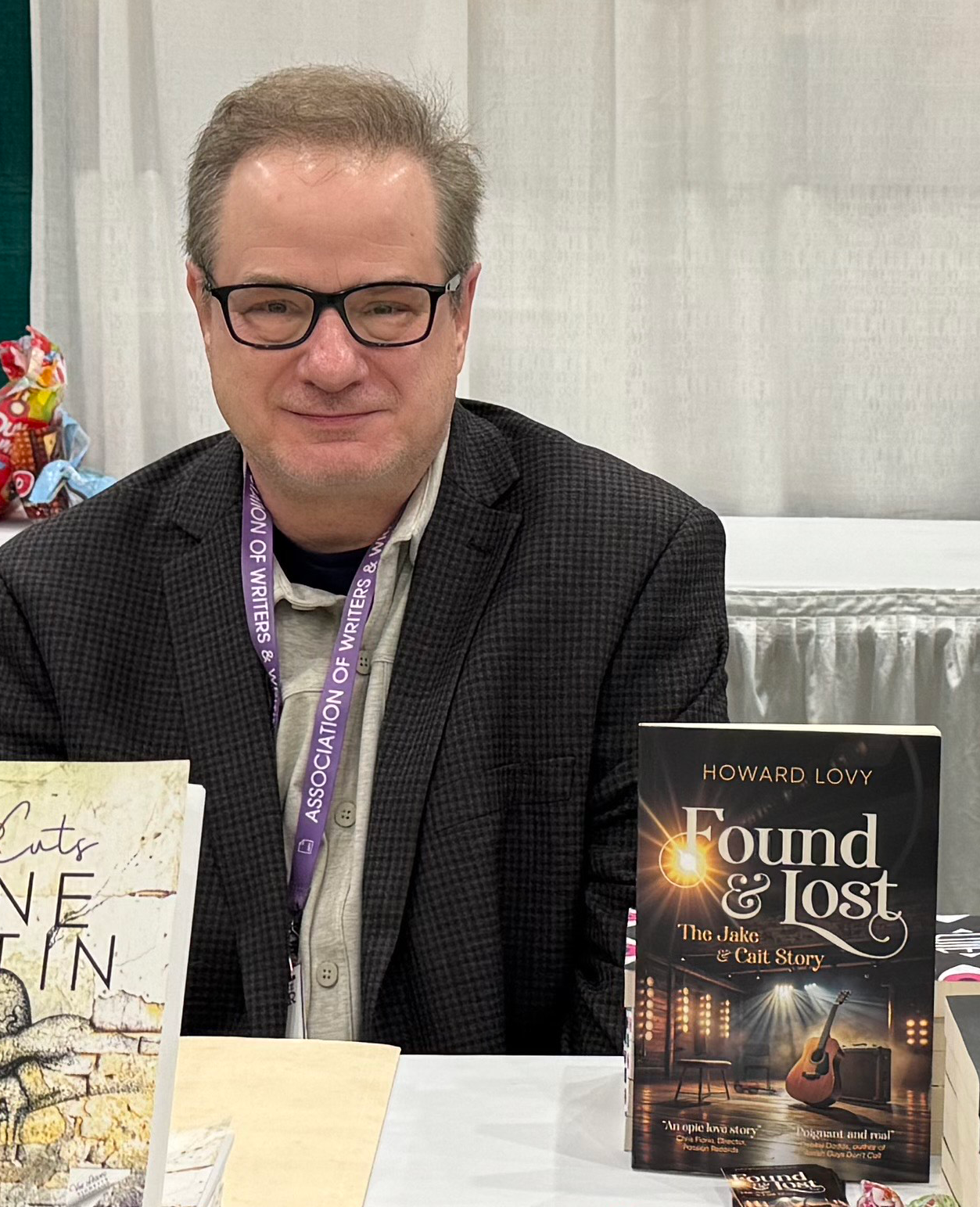
 I’ve known Howard Lovy, American journalist, podcaster, and editor for eons, through our work for the Alliance of Independent Authors. I was surprised and delighted for him when he told me he was also about to become a published author. His debut novel, Found and Lost: Jake and Cait’s Story, was published by Vine Leaves Press, run by another longstanding author friend of mine, Jessica Bell. As Howard’s novel focuses around the music industry, and the multi-talented Jessica is also a singer/songwriter, I knew the story would be good.
Sure enough, when I received an advance review copy, I was gripped – and as soon as I’d finished it, I invited Howard to be this month’s guest on my blog, to tell us the story behind the story.
Debbie: You came to novel writing relatively recently, via a long path of all kinds of writing. Please briefly describe your journey to becoming a published author.
Howard: Okay. Let’s see if I can do this briefly, because it’s been a forty-year journey.
I spent the first half of my career as a journalist, beginning with small weekly papers, then big-city dailies and then international wire services and magazines. I covered everything from politics and business to science and religion.
Then, the news industry changed and I needed to adapt in order to make a living. I’m proud to say that I launched a pioneering blog covering nanotechnology in the early 2000s that was read by Congress and the White House!
That led to gigs writing about business and technology for Wired magazine among other publications. I got into the publishing world when I became executive editor of Foreword Reviews, which covered and reviewed books from independent and university presses, along with self-published authors.
After that, I was hooked on indie publishing and launched my own editing business in addition to podcast production and hosting for the Alliance of Independent Authors.
A throughline through all this has been my interest in Jewish issues, which I’ve covered for Publishers Weekly, the Jewish Telegraphic Agency, the Jerusalem Post, and many other publications. I’m also nonfiction editor for a Jewish literary publication called Judith Magazine.
Debbie: And then you wrote a novel about music! It’s notoriously tricky to write novels about music because of copyright issues, so presumably you had to write the song lyrics that appear in the novel. Are you also a songwriter and/or musician, or was this a new experience for you?
Howard: Other than the clarinet in middle school, I’m not a musician. However, I am knowledgeable about music, all kinds of music, and know how to appreciate great musicians. And I ran this by real musicians, who told me that I really captured what it feels like to play for an audience.
As an editor, I advise clients not to include song lyrics in their books, so I knew that if I were to include them, I’d have to write them myself. This was a new experience for me, but I found that writing lyrics was simply an extension of storytelling.
I don’t know if I could write lyrics “as me,” but I could imagine the lyrics that the teenage versions of my protagonists, Jake and Cait, would write.
How would Cait write a song from her Christian religious point of view? How would Jake contribute lyrics in his character as a secular Jew who is more cynical, and how could those words meld into songs that go viral forty years later? What I came up with seemed to be successful. A couple of reviewers said they could almost hear the music as they read the book and they wished Jake and Cait were real.
Debbie: Praise indeed! Howard, you are well known as a writer on Jewish matters, but you chose to write about an interfaith relationship in your novel, and you did so in a very even-handed way. What were the challenges, risks and rewards of tackling this sensitive area?
Howard: When I wrote this novel, I was taking a quick break from writing about antisemitism and other Jewish issues. I was a little burned out. So, I decided to get out of my comfort zone and write this piece of fiction. This was before October 7, 2023, when the world changed for many Jews, including me, and frankly I don’t know if I could have written this kind of optimistic book in the last year-and-a-half.
I’m very glad that reviewers are calling it even-handed when it comes to faith. I’ve always been a student of religion—all major religions—not necessarily out of belief, but because I think it’s important to learn what motivates people. I try not to fall into the trap of caricature.
Religion is a powerful motivator for people, and it is for my protagonists, Jake and Cait.
There are many reasons I chose an interfaith couple, and there are risks in doing this, but I thought it was important to the story I was telling. They’re opposites—Jake is Jewish and rough around the edges; Cait is a classically trained Christian violinist searching for a simpler kind of faith. But when they play music together, it’s magic. They finish each other’s musical sentences. The way they make music together overrides everything else.
That idea of opposites finding connection—of working through regret, misunderstanding, and difference to make something beautiful together—feels especially meaningful right now. There is a Yiddish expression for this. It’s called beshert, or destiny. It’s usually used interchangeably with the English word “soulmate.”
But my book asks the question, what if your beshert is not exactly what you expected?
Debbie: You follow an interesting route with the timeline in the novel, not only combining flashbacks and present day, but continuing some years beyond the publication date. That took me by surprise! I admire your boldness there. Why did you choose such a far-reaching timeline rather than stopping at the present day, and what were the challenges of projecting that far ahead?
Howard: Among the themes in my book is a look at the culture of fame and also the morphing shape of memory. I’ve always been fascinated by books and stories that look at what happens to people over time. In the documentary about their lives, Jake and Cait look at their experiences through the lens of forty years.
We are all unreliable narrators of our own stories. Sometimes, we remember only the bad or only the good and choose to forget the memories that contradict the story we’ve told ourselves. In the “flash-forward” scenes toward the end of the book, I imagined this unreliable memory on a societal scale as it applies to the musical phenomenon of Jake and Cait. People remember them through the lenses of their own political, religious, or societal points of view.
Plus, “Time” is practically a character in this novel, so I thought I’d give it a little more room to develop.
Debbie: The novel is set in Michigan. To what extent is it a hymn to your homestate?
Howard: Well, they say to write what you know, and I know Northern Michigan very well.
I’m hoping the setting is a character in itself—both Interlochen, Michigan, in the present day and as the way I present it in memory.
Many people visit Northern Michigan on vacation and have childhood memories of it. To me, my memories of Interlochen Arts Camp took on this kind of mythic quality. It’s strange, just going to the camp now to promote the book. There is a mixture of things I remember from 40 years ago, and things that exist today. So, I walk through it all in a haze of reality and memory. And that’s what I wanted to show for the characters, too: There’s what they knew in 1985, and the reality of 2025 along with all the baggage that goes with it.
I also set part of the book in New York City, though, where I’ve also lived.
Debbie: The book is flying high in the Jewish fiction charts, but what other genres does it fall into?
Howard: Yes, I was very pleasantly surprised that it reached, at one time, the top three in Jewish American Fiction, even though Judaism is just one of many themes in the book. It helped that the Jewish Book Council ran a favorable review. Amazon also has it listed under “Literary Sagas,” and “Contemporary Literary Fiction“. Frankly, I just think of it as a good book.
Debbie: What does the interfaith element add to the story, and why would the book be less effective if faith didn’t come into it?
Howard: My original vision for the book had age more as a factor than faith—both their youth and their middle age—but as I developed the backstories for these characters, I found the faith angle to be more compelling.
Jake’s Judaism and Cait’s Christianity are not just aspects that stand alone as part of their characters, but they are wholly ingrained in who they are.
Their relationship with music, with the world, and with one another would not be the same without the dynamic of faith and how they can both clash and harmonize. It wouldn’t be the same book without that element.
Debbie: Late-in-life renewals of old romances are popular in fiction. How does your book go beyond the norms for this sub-genre of romance?
Howard: When I wrote the book, I had no idea that some would consider it a romance novel. In fact, it could be a subgenre called “second-chance romance.” I’m completely ignorant of all the tropes involved, though, so any regular romance readers might be disappointed—or maybe even angered—that I broke some of the rules. To say more would be a spoiler!
Debbie: This is your first novel. What’s next for you in your fiction writing life?
I found fiction to be very freeing. I could say more about “reality” through made-up characters than I could in my nonfiction work. I don’t think I’m quite done with what I’ll call the “Jake and Cait Universe.” I picture two more books in the series, the first one imagining what happened during that 40-year gap. It’s not a prequel or a sequel. I’ll call it a “middle-quel“.
Debbie: How interesting – I don’t think I’ve come across a middle-quel before! Now, if readers like (insert other author name here), they’ll love Howard Lovy.” Please fill in the blank!
Howard: Taylor Jenkins Reid, Ann Patchett, and Jennifer Egan
Debbie: Your publisher is Vine Leaves Press, a thriving small indie publisher, Why are you especially pleased that they picked up your book?
Howard: I have nothing but wonderful things to say about Vine Leaves Press! They’ve been incredibly communicative and supportive throughout the editing and publishing process. I’ve enjoyed working with them—especially publisher Jessica Bell’s amazing cover design.
Debbie: Finally, Howard, could you please provide a brief extract to give readers a flavour of your novel.
As it turned out, they would record “Love Moves On” a few months later in a place far away from the tall grass, hemlock, and pine of Northern Michigan. Then the song would sleep for forty years before awakening into the ears of millions in a nuclear explosion that would change their lives forever and wreak untold collateral damage.
And that was only their first song.
 Howard Lovy is a veteran journalist, book editor, and author with 40 years of experience covering topics ranging from science and technology to Jewish issues. His work has appeared in Publishers Weekly, Longreads, The Jerusalem Post, and many more. A former executive editor of Foreword Reviews, he also hosts a podcast for the Alliance of Independent Authors. Howard lives in Northern Michigan with his wife, Heidi, and their dog, Henry. You can find him at https://howardlovy.com/
 I was pleased to receive an advance copy of Howard Lovy’s debut novel, having enjoyed his podcasts and journalism, but I wasn’t sure what to expect – and this gentle, slow-burn romance surprised me in the best possible way.
It’s a gentle, sensitive tale of youthful love forged by a shared musical talent, which ends in a sudden break-up unexplained until the end. Forty years later the revival of the couple’s music as a viral internet sensation – written long before viral social media posts were a thing – brings them back together in a storm of supportive publicity.
Although bound by an almost telepathic ability to play so well together, the young couple face other challenges brought about by their differences. She is a sincere Christian investigating different kinds of belief and he a Jew; she is a classically-trained, highly-educated musician, he is self-taught.
The unusual structure of the story is not only divided by two timelines decades apart, but also by the interspersal of transcripts of a TV documentary delving into their past as they reunite after 40 years apart. The insights into the music industry, past and present, and the occasional appearance of real-life musicians and producers such as the great Suzanne Vega add further depth and interest to this rewarding novel.
Highly recommended to anyone who enjoys clean romance reuniting past lovers, or who likes intelligent and original feel-good fiction.
Found & Lost: The Jake & Cait Story can be purchased through Vine Leaves Press here or on Amazon here.
(Please note: This post replaces an earlier version that was somehow jumbled in the transmission – I’m hoping it will read in the right order this time!)
After emerging from a frantic period of activity, I’m just trying to catch up with myself, and have realized to my horror that I haven’t posted on my blog here since 8th April. So today I’ve decided to do a bit of catching up before it all gets completely out of hand.