Actually, there are very many reasons that I love public libraries, and I’ve written about them before on this blog. I’ve also written two short stories inspired by public libraries, published in my flash fiction collection, Quick Change. But each January, I have an extra reason to be glad they exist: the annual issue of author payment statements for books borrowed by public library members.

Thanks to a scheme called Public Lending Right (PLR), in the UK, authors get paid when public library members borrow their books – something I didn’t know until I became an author myself.
Also in receipt of PLR are illustrators, translators, editors, and audiobook narrators, provided their names appear on the book’s title page. (See also Sarah McIntyre’s excellent #PicturesMeanBusiness campaign for recognising illustrator’s contributions to books).
What is PLR Worth?
The amount per book, currently 12.4p per loan, is shared between those who created it. Thus for a novel entirely written by a single author, the author claims 100%, but for an illustrated book, the payment will be split in appropriate proportions between author and illustrator. Of course, that’s a lot less earned per book than if someone actually bought it – but it’s surprising how quickly the borrows mount up into a significant sum and a useful bonus.
How Authors Claim PLR
To receive PLR for a book, the author or publisher has to register their claim online, which the British Library will verify. (If you’re an author not yet registered, you can do so here: https://www.bl.uk/services/plr#registration_)
Other countries run similar schemes, but here in the UK, the British Library adminsters the distribution of PLR royalties, using £6.6m provided by the Department of Digital, Culture, Media and Sport. That may sound like a vast sum, but there are an awful lot of books and authors who must share it. This year, my PLR share is my best ever, hurrah!
How Does the British Library Do It?
I used to wonder how on earth the British Library managed to keep track of all the borrows nationwide, but I’ve since discovered that they monitor only a representative selection of libraries. Your payment depends partly on luck: whether your books are stocked in the libraries in their sample. However, we have no way of knowing which those libraries are, and the selection changes every year.
But PLR statements do tell us how many times each of our books has been borrowed in its various formats, which is interesting to know. In 2024-2025, my most borrowed books were:
#1 Death at the Old Curiosity Shop

#2 Murder at the Vicarage (Sophie Sayers #2)

#3 Driven to Murder (Sophie Sayers #9)

So if you’ve ever had any qualms that borrowing books from public libraries deprives authors of income, you can stop worrying.
The annual PLR statements make authors very happy!
In Other News
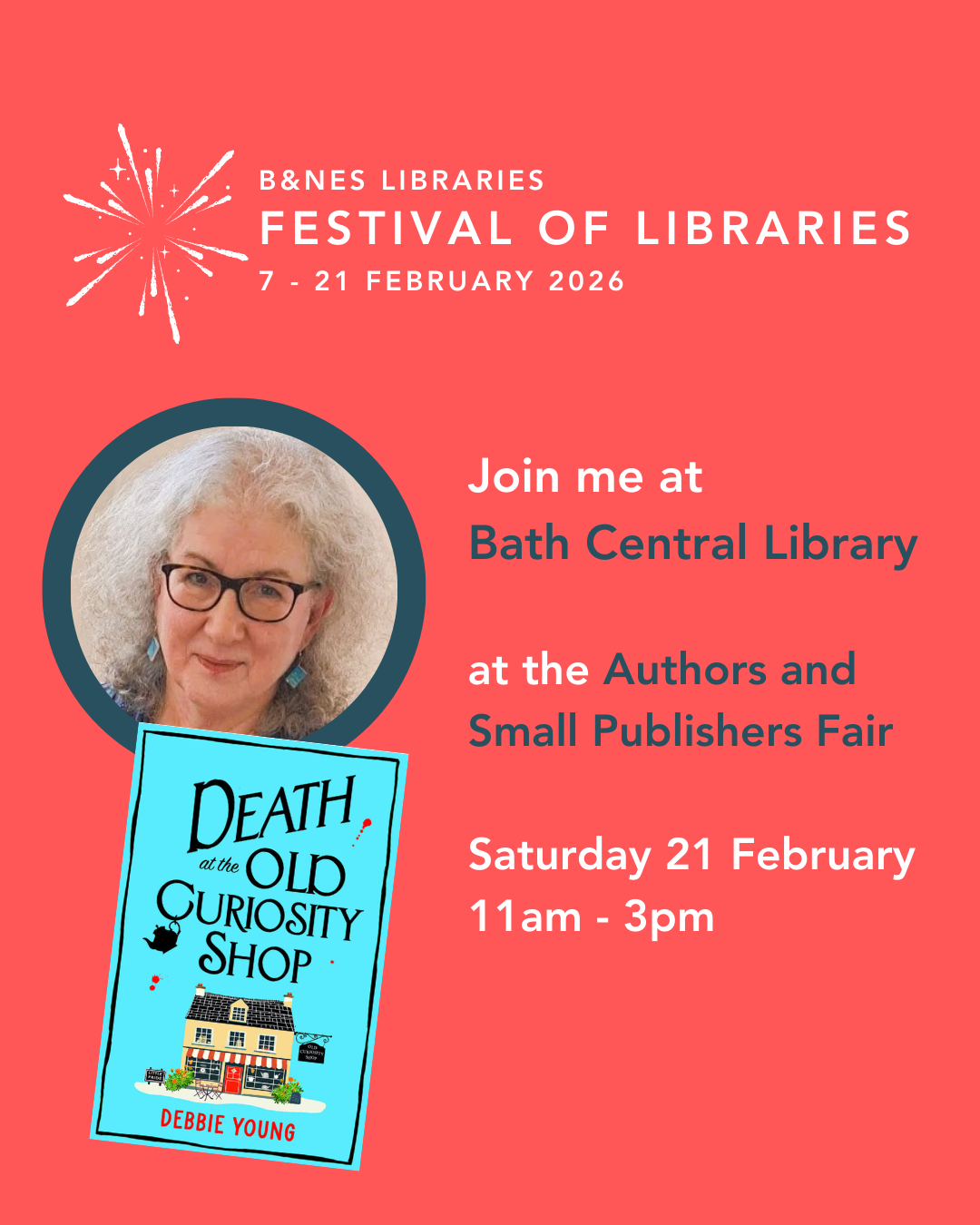
New Event at Bath Central Library (Saturday 21st February)
By coincidence, my first public event of 2026 will be at Bath Central Library, alongside a fantastic group of authors and publishers selling their books at the Local Authors and Small Publishing Fair as part of the Bath & North East Somerset (B&NES) Festival of Libaries. Between 11am and 3pm, visitors can meet authors and publishers informally on their stands, where we’ll be selling signed copies of our books. With tea and cake also on hand, it’ll be a relaxed and inspiring day in a creative environment. I’m really looking forward to meeting lots of readers as well as local author friends.
***Free admission***, so you can spend your money on books, tea and cake instead!

What I’m Reading
January definitely calls for cosy reads – and so far this month I’ve picked two from my collection of British Library Crime Classics. So that’s another reason to love the British Library – they publish mysteries first published during the Golden Age of Detective Fiction between the two World Wars. Some of the novels are better than others, as you’ll see from my reviews below, but they all have stunning covers, look beautiful on the shelf, and are giving a new lease of life to many authors too long out of print.
~~~~~
 Weekend at Thrackley by Alan Melville
Absolutely cracking Golden Age fare, and I raced through it. Classic isolated country house set-up featuring a fun assortment of vivid characters thrown together in intriguing circumstances. I confess I guessed one of the details revealed at the end, but that didn’t diminish my enjoyment.
Poignant detail that the central character is a young man at a loose end after serving in the First World War, battle-scarred but with no employable qualifications, as so many must have been, which made me extra glad that he arrived at a happy ending in the story.
Told with a light, wry touch – although narrated in third person, includes lots of witty throwaway and judgmental comments that added to the fun. The nostalgic cover illustration, taken from a vintage travel poster, is just right.
~~~~~
 Scarweather by Anthony Rolls
Well, this was an oddity. Although endorsed by Dorothy L Sayers, it broke many of the rules that apply to the genre. I wouldn’t even term it a murder mystery, as there was very little mystery about it. The sense of place, the characterisation, and the writing style were all great – but coming to expecting a rollicking good classic mystery, I felt shortchanged. Could have been very much better, and I’m puzzled as to why the author (and the original publisher) let it go as it is. A good structural editor, with a few strategic tips and tweaks, would have made it very much more satisfying. Shame.
~~~~~
Read more about the Golden Age of Detective Fiction in this post from my blog archive:
The Golden Age of Detective Fiction