Posted in Family, Travel

When in Belgium, Drink as the Belgians Do (In Praise of Oxo)

(The next installment of our Easter trip to Luxembourg, via France and Belgium, with a quick dip into Germany too)

Laura on the Dinant Citadel steps
The funicular railway was due to open the following week. Of course.

Recovering from climbing up (and down) the 408 steps from the Belgian town of Dinant to the citadel that looms over this small riverside town, we head to a cafe to rehydrate.

Perusing the menu, my daughter plumps for Coca-Cola Light (that’s Belgian for Diet Coke).  I favour the fizzy mineral water Apollinaris, to echo the Roman theme of the engaging thriller I’m reading – Inceptio by Alison Morton.  My husband, not being female and therefore not just glowing from our recent ascent, homes in on a drink to replenish lost salts: an Oxo.

The Oxo Tower, Lonodn
The beautiful Oxo Tower (photo: Wikipedia)

Although this menu does have an international aura, I’m surprised to see Oxo listed. Rightly or wrongly, I associate it inextricably with my home country, having grown up just a few miles from the famous Oxo Tower in London.

OXO & ME

The Oxo Tower, now a fancy restaurant with panoramic views across London,  was a familiar landmark on the commuter railway from our suburban home in Sidcup to Charing Cross. At secondary school, tasked with painting a city skyline, I incorporated a meticulous rendition of the Oxo Tower. I was incredulous when my elderly art teacher, Miss Barbara Snook, objected. What was not to love about the Oxo Tower? Not only was the architecture Art Deco, but the lettering was pleasingly palindromic.

Miss Snook admitted that she loved the Oxo Tower; I suspected they’d shared their heyday. But then she memorably explained her reasoning:

“In any painting, try not to include words, because the eye is automatically drawn to the text to read it and is diverted from the rest of your picture.”

She was right. I’ve often recalled her advice in art galleries, distracted by labels, and wished I’d shown more respect for her wise words at the time. It was only after leaving school that I discovered that she was also a world authority on embroidery. Years later, as a belated tribute to her wisdom, I bought from a secondhand shop a book that she’d written about needlework; I treasure it still.

And again, decades later in a cafe in Belgium, I sit recalling her sagacity as we wait for the waiter to bring our unlikely assortment of drinks.

Old Oxo ad from the Oxo website
Originally endorsed for its health-giving properties by Florence Nightingale, apparently. Coincidentally, my Auntie Nellie’s full name was also Florence. (Image: http://www.oxo.co.uk)

I realise that the only other setting in which I’ve come across people drinking  Oxo as a beverage rather than adding it to a casserole or gravy is my grandmother’s house (in Sidcup again), where she and my Great Auntie Nellie favoured it as a fortifying mid-morning pick-me-up. This was the same Auntie Nellie who enjoyed salt-and-pepper sandwiches, so I’d assumed her Oxo habit to be a measure of frugality, acquired during war-time rationing, rather than a treat meriting this menu’s price of 2 Euros 30 cents.

AN OXO EXTRAVAGANZA

When our drinks finally arrive, my Apollinaris is pleasingly labelled “The Queen of Table Waters” . Despite its Romanesque name,  it is served in true Belgian style with a tiny dish of bar snacks. But if my drink is the Queen, my husband’s is surely King. Presented in a glass on its own silver platter, it is accompanied by a plastic-wrapped melba toast, a grinder of mixed spices and a bottle of Lea and Perrin’s Worcester Sauce. Getting as close as he ever does to cooking, my husband assembles all the components (they really should serve this drink in Ikea cafes). After the first  sip, he breathes out a big steamy sigh of contentment.

“Aah, this is nice!” he declares emphatically. “I ought to drink this more often.”

I’m about as likely to drink a mug of Oxo as a cup of Bisto, but being the dutiful wife that I am, I buy a box of it at the supermarket on the way back to our camper van. The irony is not lost on me that our next destination will be the picturesque riverside town of Bouillon. Better not mention the Oxo.

Posted in Family, Travel

Just When We Thought It Was Safe To Go Back Into La Piscine (Swimming Pool)…

French style swimming costume for men
Un slip de bain, 1925 style – not modelled by my husband (photo: public domain)

(A post about our Easter 2013 trip by camper van to Luxembourg)

Two summers ago, when touring France in our camper van, my husband discovered for himself (because he wouldn’t listen to my advice) that, for some reason we couldn’t fathom, swimming trunks are not permitted in French swimming pools. “Les shorts sont interdit“. Instead, for men, a slip de bain – the tight-fitting, lycra style of swimwear – is compulsory. (The full story of that episode is in my earlier blog post, Many a Slip Between Piscine and Dip.)

This year, he felt it would be safe to return to la piscine without fear of such ritual humiliation. Naturally, he’d forgotten to pack his French slip de bain, so in the pleasing Belgian town of Mons we hit C&A to acquire a new swimming costume for him. Thus armed, we advance on the municipal swimming pool of a small town we’re passing en route to Luxembourg. Swimming is not just a sport on our camper van trips – it’s a welcome supplement to the limited washing facilities available in our small motorhome.

Taking The Plunge, Belgian Style

By chance, we arrive a few minutes before the pool is due to open for its only public swimming session of the day. We approach the receptionist and ask confidently for our tickets.

“Deux adultes et un enfant, s’il vous plait.”

The woman behind the desk looks distrustful.

“Vous avez un slip de bain?” she asks my husband warily. “Pas de shorts! Pas de shorts!”

She wags her finger in admonition. She’s clearly encountered British customers before.

My husband and I exchange knowing looks. Really, how could she doubt us?

“Encore vingt minutes!” 

She points at the clock, speaking loudly to make sure we understand. It’s not just we British who do this with foreigners.

“Mais oui, madame! Ca va!”

British Olympic champion runner Mo Farah executes the Mobot
The Mobot (photo: Daily Telegraph)

Clearly still not satisfied, she asks another question. This time we do not understand. She responds to our blank looks with a mime. She raises both arms upwards and outwards, as if showing off her upper arm muscles, like a bodybuilder. We are perplexed. Is the inviting us to while away the time till the pool opens by joining a weightlifting class? We shake our heads blankly. She repeats the action, raising her arms higher till her hands nearly meet above her head. Is this meant to be a tribute to the 2012 London Olympics, via the renowned Mobot pose of champion runner Mo Farah?

Suddenly her words crystallise into sense for me.

“Avez vous des bonnets? Les bonnets sont obligatoire.”

Our new French swimming caps
“Les bonnets sont obligatoire, Madame”

Bonnets are compulsory, it seems. Bonnets? Really? Is she having a laugh? She points to the vending machine behind us. Bonnet, I realise, is French for swimming cap. We can get them from the vending machine for 3.50 Euros apiece – more than it’s just cost us to buy our swimming tickets. Foiled again!

We while away the rest of the 20 minutes before the pool opens by deciphering the instructions on the front of the machine, sorting out our small change and acquiring trois bonnets.

Like So Many Smurfs

“Why do we have to wear bonnets, Mummy?” my daughter quizzes me as I wrestle her long, thick plaits into the embrace of blue polyester.

“Probably to stop hair clogging the pool filter,” I improvise.

Entering the pool, we find an unnerving array of polyester-headed people already in the water, their bonnets all in discreet, dark colours, except an eye-catching scarlet and white striped  one of a man who, I am sure, is entirely bald. He ploughs his way up and down the pool, beaming, clearly enjoying this opportunity to feel he numbers among the hirsute.

There is something disconcerting about so many swimming-capped people in one place. It is depersonalising. It takes us a while to spot my husband who is already in the water. The only bare  heads in the hall are those of the lifeguard and a male aquaerobics instructor who is prancing up and down on the poolside leading eight semi-submerged, serious, polyester-hatted ladies through their exercise routine. If you saw his movements out of context, you’d swear he was just pretending to dance like a girl.

Once our swim is over, it comes as a tremendous relief to discard my blue bonnet and wash my hair in the poolside shower. I feel like I’m shampooing my personality back in. I haven’t worn a swimming cap since primary school and I hate it with a passion. But at least I don’t have to wear a slip de bain.

  • If you enjoyed this post, you might like the full story of our initial slip de bain incident here: Many a Slip Between Piscine and Dip. (It’s a good thing my husband doesn’t read my blog.)
  • In case you missed it, the post about the first stop on our 2013 Luxembourg tour is here: A Holiday from Books.
Posted in Family

What A Difference A Day Makes

Humorous leap year postcard postmarked in 1908...
Humorous leap year postcard from 1908 (Photo credit: Wikipedia)

Hurrah! At last February is on its way out, and I’m so glad it’s not a leap year. This means that March – and Spring – will arrive one day earlier this year. 

There’s a world of difference between the last day of dreary, chilly February and the first day of daffodilly, Easter eggy March. Even more so for my husband, because the first day of March happens to be his birthday.

How frustrating leap years must have been for him when he was a boy, making him wait an extra day for his birthday. But this year I’d been expecting him to hanker after a 29th of February, to put off the dawn of an alarmingly significant  birthday.

60 – The New 40

Yes, I know that 60 is often considered the new 40, but for me, 60 absolutely spells old age. (I say that from the safe perspective of someone still many years away from their own 60th birthday.) This is because my grandmother was born exactly 60 years before me, and for me she was the archetypal old lady. I thought that 60 years was the perfect gap between a grandmother and her granddaughter. I’ve always liked a neat round number.

To anyone who doesn’t know my husband, you might think me cruel to have bought him a watch for his 60th birthday. You might be concerned that every time he looks at it, he’ll be reminded how quickly life is passing him by.

But is he downhearted? Oh, no. He’s positively chirpy. He’s even requested we celebrate  with a party, although he’s not usually a party animal. I don’t think I’ll be feeling as cheerful when it’s my turn to leave my 50s behind.

This is a complete role reversal.  Usually, I am renowned for my optimism, ever the Pollyanna. For Gordon, not only is the glass half empty – it’s also got a crack in it. So why the sudden about-turn?

Saving Grace

The reason is, he’s a Scotsman. He appreciates the opportunity to conserve his spending. As a child, he and his sister set up a club in their loft, of which the key rules were pinned to the wall: “No smoking, no swearing, save money”. Although he has a generous heart and is capable of acts of extraordinary kindness, he is also very fond of opportunities to economise. And so as February closes, bringing old age closer by the second, he’s  preoccupied with  the financial advantages that turning 60 will bring him: his civil service pension, his free bus pass from the council, discounted entry to museums, and 10% off on Tuesdays at B&Q.

I don’t think such rewards will buoy me up when I turn 60. Instead I’ll be clinging desparately to my faith in the powers of nominal determinism. (Oh, how I love to slip that phrase into a conversation!) Because, after all, by marrying Gordon, I became Mrs Young. We have no intention of ever getting divorced, and so, no matter what my age, I will be forever Young. If that’s not a good reason to marry someone, I don’t know what is.

Happy 60th birthday, Mr Young!

Badge saying "60 Years Young"

Posted in Family, Writing

The Pencil Mightier Than The Sword

An array of colored pencils, these pencils are...
An array of colored pencils, these pencils are made by Crayola. (Photo credit: Wikipedia)

I have a penchant for pencils. And biros and felt tips and roller balls. Whenever we visit a museum or other tourist attraction,  the first thing I check out in the gift shop is their range of  pens. To me there is no finer souvenir of an enjoyable family day out than a pen with the name of the venue on it.

Provided, of course, that the shop’s stock matches my high standards. The perfect souvenir pen must write a fine line in blue or black ink, have a durable casing in a tasteful colour, and sit comfortably in my hand. It must have a slogan or logo that I’m not ashamed to be seen with, although in a moment of weakness I can be persuaded to invest in one of those with a small perspex chamber, filled with liquid, in which something moves up and down – a boat afloat on a river, perhaps, or a soldier on parade outside a palace.

photo of three plastic souvenir pensI have been known to seek out a National Trust shop specifically to buy one of their Biros. Anything rather than use the cheap, scratchy pens that Gordon, my husband, picks up free from the bank, or worse still, an Argos midget.

A merry band of souvenir pens permanently inhabits my handbag, segueing slowly into a different mixture as one after another runs out of ink, to be replaced next time I visit a museum. (And I visit a lot of museums.)

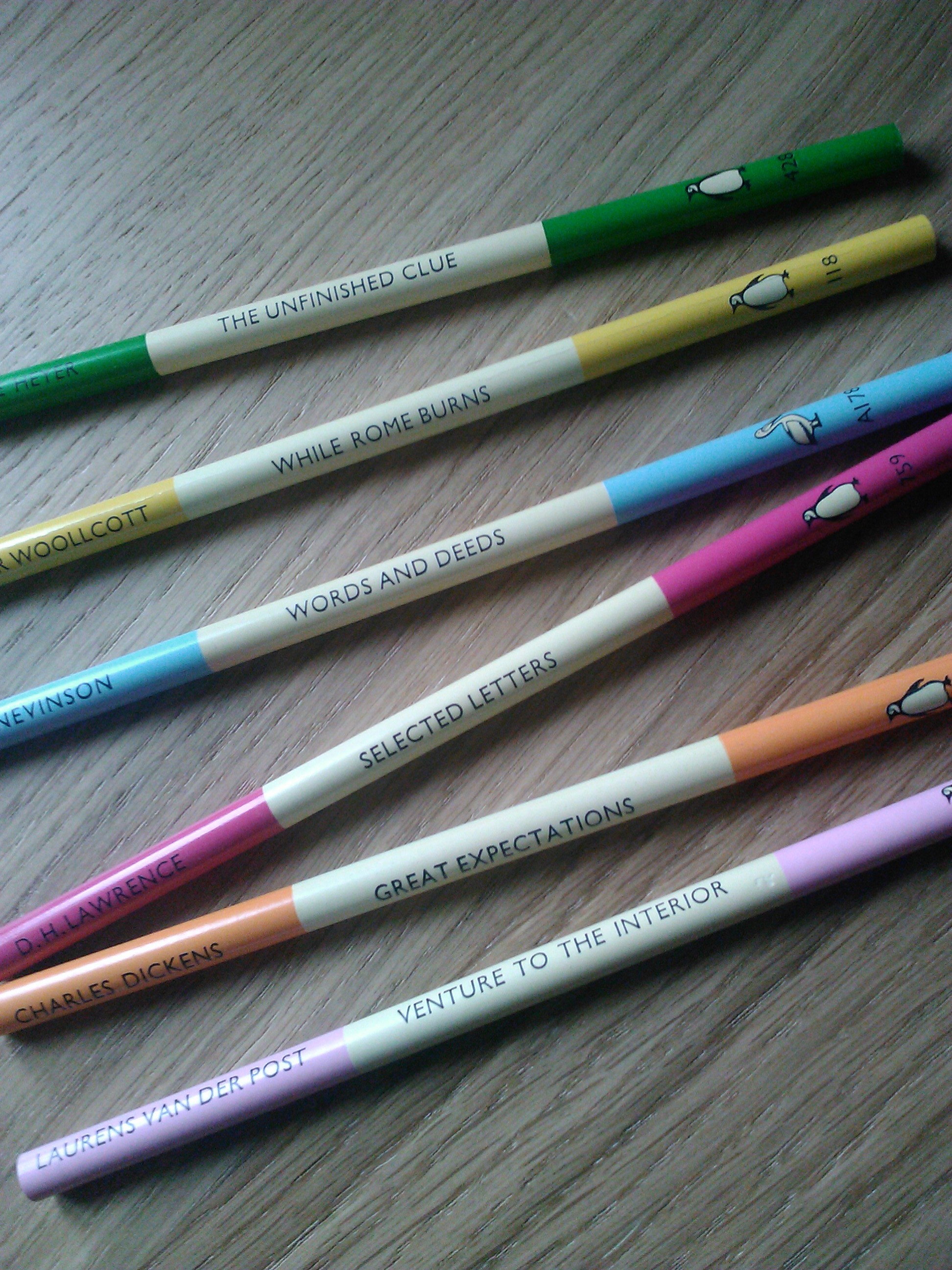
photo of a set of Penguin pencilsThe cheering power of the pen is not limited to those from famous places. Lately I’ve been particularly fortified by a beautiful set of Penguin branded pencils that I won in a raffle. I love classic, simple branding, and Penguin fits that bill (or should that be beak?)   Each is in a different, mouthwatering colour and bears the title of a great book in an elegant, spare typeface.

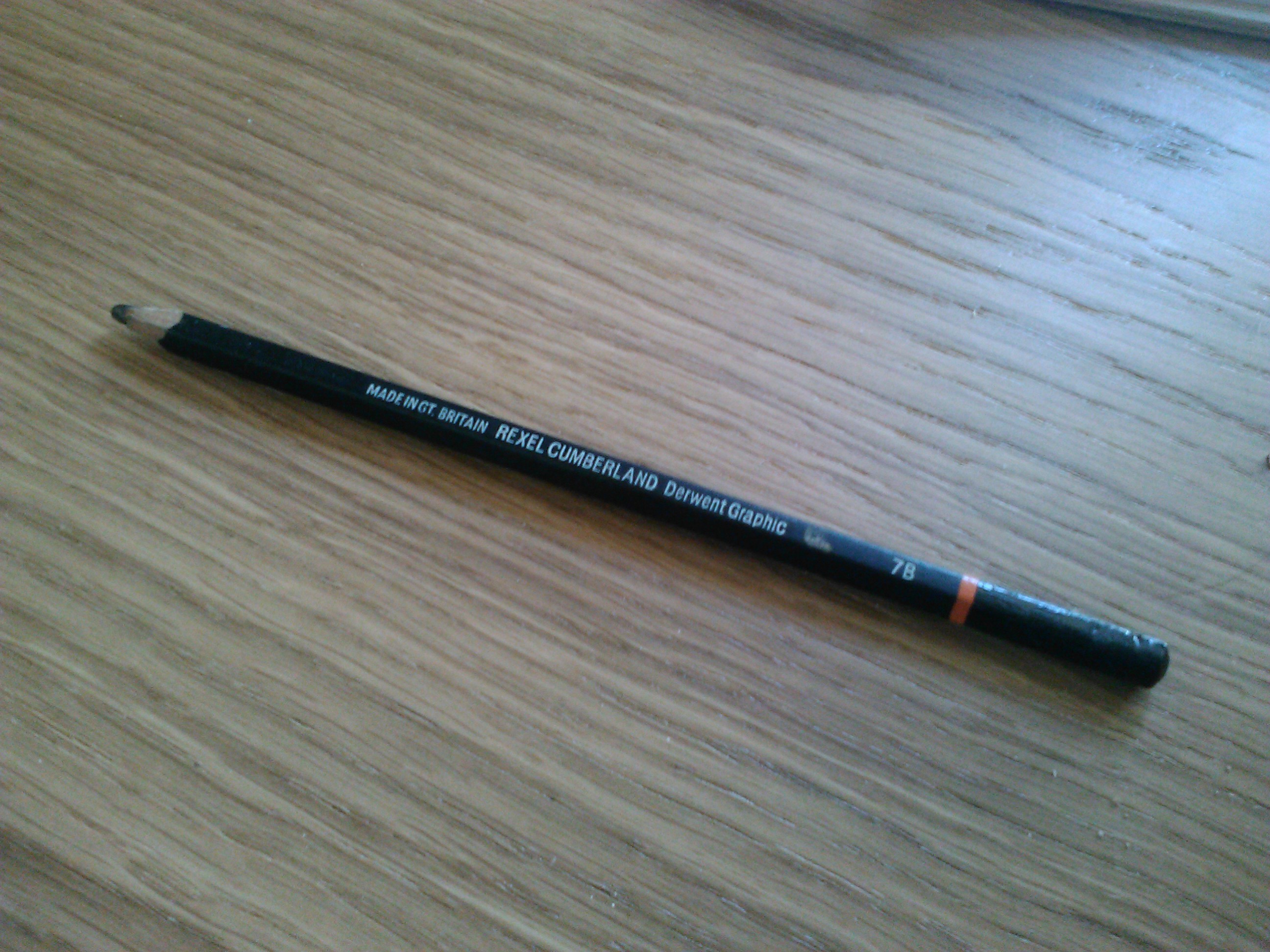
But today an unbranded pencil stops me in my tracks. I pick it up at random from one of the many pencil pots that populates our desk-heavy house (five desks for three people), to scribble an addition to my Ocado shopping list. It makes an annoyingly thick line on my tiny square of paper; it’s like writing with molten lead. (And yes, before anyone points it out, I do know they put graphite, not lead, in pencils these days.) I stare accusingly at its shaft, wondering where it has come from. And then, for a second, my heart stops. For it’s an artist’s 7B, bought by my first  husband John.

John died twelve years ago, ten days into the new millennium – but here his pencil remains. Who’d have thought it? To be outlived by a throw-away item that cost him less than a pound.

Colors by Pantone Português: Cores produzidas ...
Colors by Pantone (Photo by Wikipedia)

John’s addiction to graphic designer’s accoutrements was as entrenched as my own to the writer’s tools.  His desk was littered with Rotring pens that had to be used at a precise 90 degree angle to make the ink flow properly; crispy,ancient half-used sheets of Letraset; chilly metal rulers, used with a Stanley to cut a perfect line in a piece of paper. (Oh, how he’d have loved the new Pantone Hotel that was recently featured in the Independent’s Traveller supplement!) Here was a man who really appreciated the precise gradations of Hs and Bs in pencils. He always found the commonplace HB an unsatisfactory, sad compromise: it was neither one thing nor another.

I resist the urge to take my revenge on the poor pencil by sharpening it away to nothing in my battery-powered pencil sharpener. (Who doesn’t love those?) And then I realise with a start that as my need to write anything in 7B is very rare, this wretched pencil will probably outlast me too.

I cast it aside and grab from my handbag one of my faithful museum biros. Ah, the one from the SS Discovery! Now that was a lovely day out. I resume my shopping list, a little calmer now. But deep down, I’m wishing that Ocado could deliver an elixir of eternal life.

It’s not just the pen that can be mightier than the sword.

photo on a 7B artist's pencil

Posted in Writing

The Lost Art of Letter-Writing

English: Engraving of printer using the early ...
There has to be an easier way. (Image via Wikipedia)

I arrive home to find my husband agitated, clutching an empty envelope.

“I need you to print a letter for me, urgently.”

I remind him I’m due at the hairdresser’s in ten minutes.

“But I have to get it in the post today. It’s a legal document. It must be postmarked with today’s date.”

His printer, it emerges, has packed up again. But producing his letter on my machine will not be as simple as he assumes, because I’ve just acquired a new computer. First I must  install the printer software. Which means finding the disk.

The edge is taken off his urgency by the revelation that he doesn’t have a stamp to put on the envelope.

The hairdresser calls. I have my priorities.

“I’ll do it when I come back,” I promise.

On my return, to my surprise I find the software disk in the first place I look for it and slip it into the disk drive, but even so, the installation is not the work of moments. A series of tedious prompts pop up on the screen as the disk drive chugs away. After a few false starts and the  emission of copious blank pages (I realise afterwards that I’ve been pressing “photocopy” instead of “print document” and  have inadvertently copied lots of nothing), the computer tells me to reboot.

By now I’m beginning to glaze over. The motto of a former colleague, the late, laconic Bristolian IT manager John Hamilton,  is echoing in my brain: “Lack of planning on  your part does not constitute an emergency on my part”. (I don’t suppose there are many IT guys these days who can get away with calling all their female clients “Flower”.)

I’m gazing unseeingly at the screen when the printer finally spits out two copies of Gordon’s letter, accompanied by much whirring and clunking. “This document contains 69 words,” the monitor informs me, a propos of nothing. All that fuss and effort for just 69 words!  It hardly seems worth the bother.

I scoop up the two sheets of paper and ferry them downstairs to my husband who is busy on the sofa watching telly with his feet up.

Madeline Breckinridge, full-length portrait, s...
Image via Wikipedia

“You know,” I say slowly, “there is another way your could have dealt with this. You could have written the letter out by hand.”

There is a beat.

“I didn’t think of that,” he confesses.

 Note to self for future reference: for all our technological advances, in this digital age, the pen is still mightier than the computer. Long live the pen.