Posted in Family, Personal life

Who Says Men Make the Best Chefs?

"Rhodesian Cave Man" from Scientific...
Caveman doing the grocery shopping - Image by Wyoming_Jackrabbit via Flickr

“Mummy, when I get married, I’m going to choose a man who likes to do all the cooking,” declared my daughter Laura the other day.

Her assertion surprised me because we’ve recently made a very successful batch of cookies together. Her schoolfriends requested she bring more to school in her next day’s packed lunch.  She also enjoys Let’s Get Cooking Club at school, which I’d hoped would set her on the right track to self-sufficiency in the kitchen.

It’s not that she’s hoping to marry a man like her father.  In ten years of marriage, he’s only ever cooked me three meals.  The first, on our second date, was a stew.  I later discovered it was a blend of everything edible that he could find in his kitchen.  Considering evidence I collected later, I had a lucky escape that night.  Usually, a mutual friend told me, his was the typical bachelor’s fridge, containing only mouldy fruit, bought in a fit of resolve to eat more healthily but never actually consumed, and beer.

The second meal was a frozen supermarket ready meal.  Maybe this was to stop me thinking that this cheffing lark might become a habit.  Then, eight years later, came his third dish: a poached egg on toast, when I was ill with flu in bed.

The poached egg has recently become his signature dish – much as an X becomes the signature of a man who cannot write.  More as a technical enquiry than with the intent of using it, he asked me a little while ago how the egg poacher worked.  To my surprise, he was sufficiently intrigued to try it out.  After many repetitions of the instructions, he finally mastered the art.

I was shocked.  In our household, we have a pretty traditional division of labour: I do the cooking, the food shopping and the laundry, and he does the DIY.  I don’t object, as it gets me off the hook for decorating, and he’s a lot better at it than me.  So I wondered whether his embrace of this tiny corner of catering precipitates a subtle shift in our balance of power.  Suddenly, I was no longer needed to cook his breakfast in the morning: he could make it himself.

Until this point, he’d always been proud of his lack of prowess in the kitchen, citing it as an indication of his descent from stone age man.  Apparently, he-men evolved to operate only on a grand scale in providing food for his family, tracking down wild animals and dragging them back to his cave.  After all that hunting, he’d need to receover his strength while the female of the species prepared his kill for the oven. He claims that’s also why he’s not good at finding things around the house – his glasses, his car keys, his slippers – because men are programmed to find big things far away – like mammoths.

It’s always amused my colleagues that the only phone calls I ever get from him while at work are requests to help him find things: his swimming trunks, his measuring tape, our daughter.  And just last week I had another plaintive call from home.

“Debbie, I can’t find the egg poacher.”

It seems there’s no danger that I’ll be made redundant in the kitchen just yet.
Posted in Family, Travel

Bubble Mum

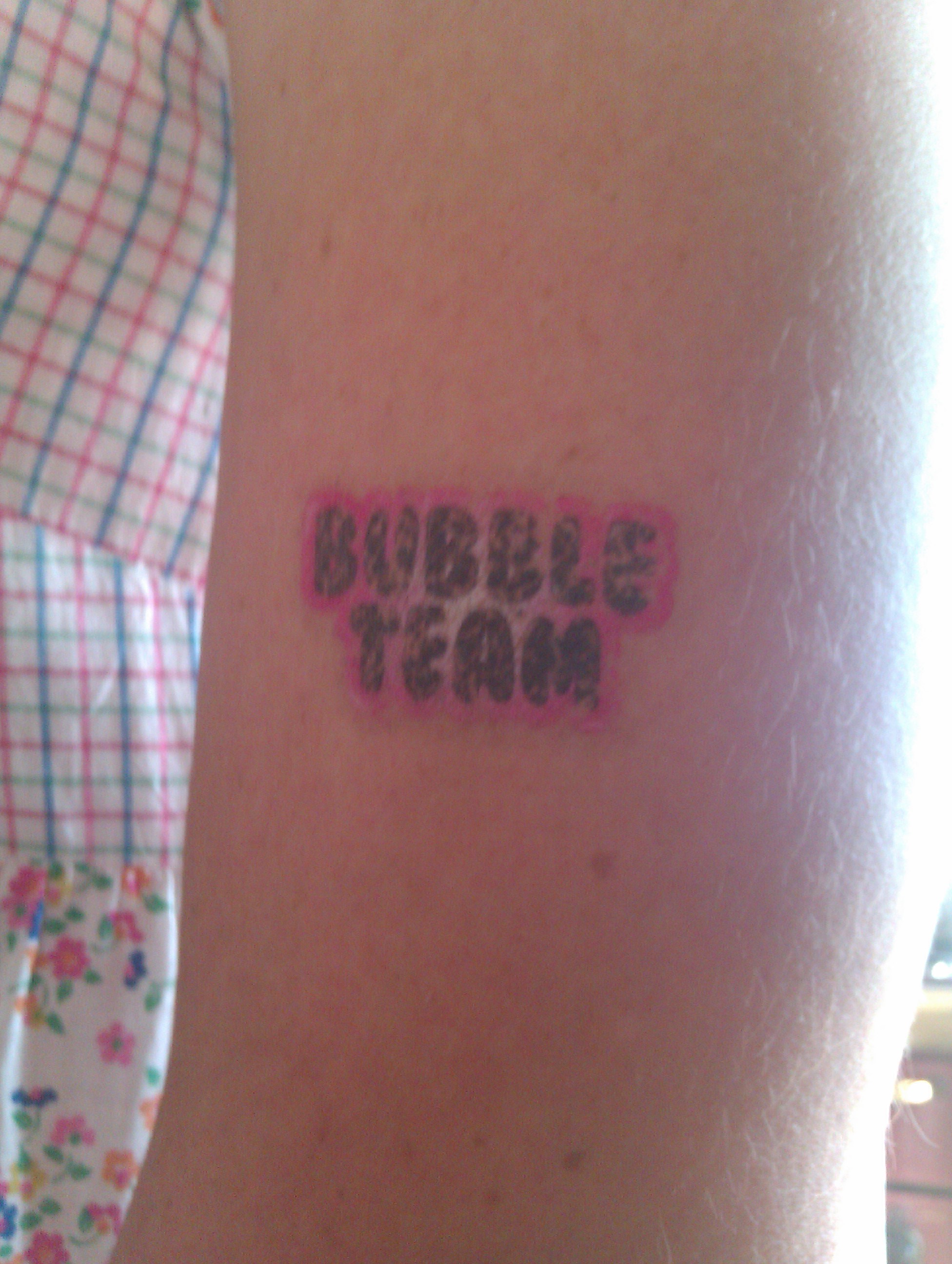
Temporary tattoo free with bubble gumHow to occupy a child on a long journey: teach it to do something a little bit naughty.  It will be completely captivated for however long it takes. Example #1: blowing bubbles with bubble gum.

Laura often surprises me with a new ambition, and the latest is to learn to blow bubbles with bubble gum.  I suspect it is inspired by watching Sky television: in her favourite show, iCarly, resident bad girl Sam is an expert gum blower.

For most of Laura’s friends, bubble gum is a banned sweet and she’s never tried it before. But she has good strong teeth and I decide it won’t harm her to fulfil her goal at least once in her childhood.  I therefore invest two euros in a hypermarket grab bag of bubble gum and cunningly produce it just when we’re getting to the “Are we nearly there yet?” stage of a three hour drive during our French summer holiday. Laura is enchanted.

For the next half hour, I sit alongside her on the sofa of our camper van, training her in this not so gentle art. It must be at least 30 years since I last blew a bubble gum bubble. But sinking my teeth into the solid pink rectangle, I realise that it’s like riding a bike: once learned, it’s a skill you never forget.

I demonstrate how to soften it up, stretch it with your tongue and catch it with your top and bottom teeth before slowly, gently blowing into the middle. The resulting pink globe emerges to a look of disbelieving rapture on my daughter’s face. Can this really be Mummy doing this? It’s a special mother and daughter bonding moment.

I’m about to screw up the wrapper and put it in the bin when I discover a hidden bonus: inside each paper is a temporary stick-on tattoo.  I demonstrate this on my arm (precipitating odd looks in the patisserie later).  Appropriately my tattoo spells out the legend “Bubble Team”.  We investigate other wrappers, branding Laura with French slogans such as “completement mabulle” and “ce dechire“.  With the help of a pocket dictionary, we translate these tattoos loosely as “completely bonkers” and “it’s ripping”.  If this doesn’t gain me Cool Mummy points, I don’t know what will.

Still chewing, I return to my seat at the front of the van, leaving Laura to refine her bubble blowing technique unobserved.  By chance, my husband has put an Eagles album on to play. It’s a Proustian moment: the heady cocktail of gum and Hotel California  transports me back to my teenage years at an international school, where many of my friends were American.

For the next few kilometres, I’m gazing out of the window idly blowing bubbles. It’s not the Loire Valley that I’m seeing, but the smiling faces of those fine gum-blowing gals.  I think about the parties, the dances, the in-jokes we shared; the teachers, the lessons, our pride on graduation day.

And then I remember another small detail about the art of gum-blowing: never blow a bubble into an oncoming wind.  Sticky-faced, I furtively close my window, hoping that Laura wasn’t watching.

Posted in Family, Personal life

Back to School

American soldiers cross the Siegfried Line and...
Allied soldiers marching across the Siegfried Line (Image via Wikipedia)

As you will have noticed if you have been anywhere near a supermarket since June, this month it’s back to school, and for primary school children like my eight year old daughter Laura, another term means another topic.

When I was that age, a topic was a simple, self-driven task: four sheets of paper to fill on a set subject, the next on the list set by the teacher. I can see now that these topics were time-fillers, to occupy the brighter pupils who had completed all the workcards while the others caught up. I remember vividly picking bits of pebbledash off my suburban semi-detached house to sellotape on to my rather literal interpretation of the topic “My Home”.

These days, it’s not so simple. The modern topic is a whole-class, cross-curricular activity in which a single theme unites the many subjects to be taught throughout the term. Picture the topic a the spider at the heart of its web, the focal point of many subject strands woven cleverly together. The whole is definitely much greater than the sum of the parts. The result is a fun learning experience, leading to a broad, balanced outlook on life that I wish I’d had at Laura’s age (or indeed, now).

Last term, for example, Laura’s topic was on World War II. I was astonished at how dextrously this sombre subject was presented to capture her young imagination. And capture her imagination it certainly did. The class didn’t want the term to end.

“I think this is probably the best topic I’ll ever do in my life, Mummy,” she declared at half term.

Digging for victory in the school’s new vegetable garden and comparing the effectiveness of different materials for black-out ticked the science box. Writing speeches for Churchill, composing propaganda slogans and drafting newspaper reports covered literacy. Calculating the best use of their sweet ration was about as compelling a numeracy task as you can get. Swing dance was a popular PE session and learning catchy war-time songs went down well for music. One of Laura’s friends spent most of a playdate at our house singing “We’ll be hanging out the washing on the Siegfried Line” at the top of her voice, with as much enthusiasm as any pop song.

I’m not sure what part of the National Curriculum was served by sitting under their desks for half hour for a mock air raid, but it’s certainly a lesson they will remember for the rest of their lives.

Ever the dutiful parent, I conscripted my parents to visit Laura’s class to talk about their experiences as evacuees from London, my father having been helpfully sent to the Cotswolds. Indeed his wartime love affair with the area (and one Dorothy Duckett) is what led me to live here myself. He brought his own children back for summer holidays and I vividly remember deciding when I was about Laura’s age that this was where I would live when I grew up.

To give some airtime to all sides, I also invited an elderly German friend, contemporary with my parents, to write the class a letter about her own experiences of evaculation to the German countryside. Many of her neighbours were killed in British air raids and she has suffered from claustrophobia ever since her numerous trips to the air raid shelter. An old Dutch school friend of mine recounted his mother’s experience of Nazi occupied Holland. Her greatest trauma was losing her mother and her home to an American (yes, an American) bomb. Friendly fire: it happened then too.

But just when I think the World War II topic has drawn to a close, and I’m packing for our summer holidays, I’m taken aback by Laura’s request to divert the itinerary. She thinks our leisurely tour of France in our camper van should now wander east: she wants us to annex Germany. I’d be less keen to change our plans, had I not overheard a game that she was playing with friends one afternoon towards the end of term. The trampoline had become a Nazi concentration camp, in which Laura and two of her friends were imprisoned. A fourth friend was playing the role of a German soldier. Fetching some glasses of squash from the kitchen, she shouted at them “Here, drink this slime, prisoners!” In the interests of international relations, I think I’d better take her there to make some German friends. But while we’re there, I don’t think I’ll mention the war.

(This post was originally written for the Tetbury Advertiser, September 2011)

Posted in Family, Travel

A Matter of Convenience

la p'tite maîson ès danmes: un êcritchieau en ...
Image via Wikipedia

Inspecting the toilet on the ferry is part of Laura’s summer holiday ritual, so it’s  no surprise when, crossing from Dover to Dunkerque, she asks to visit the Ladies.

I’m not unsympathetic to my daughter’s fascination with public toilets.  I was just the same at her age.  And like her, I was a well-travelled child.  When I was 8, my parents gamely took me, my brother and sister on a trans-American road trip.  We drove from Philadelphia to Los Angeles in a fortnight, on a scenic route that memorably took in the Pennsylvania Dutch country, Mount Rushmore, the Great Lakes, Yellowstone Park, the Black Hills of Dakota and Las Vegas.  Whenever I see the famous giant letters spelling out HOLLYWOOD on those famous Californian hills, I still feel proprietorial.

It was on this trip that our family stayed in hotels for the first time.  To me, the new Holiday Inn chain seemed the height of glamour.  And the many diners and restaurants that we visited on route offered a multitude of lavatorial inspection opportunities.  Best of all was the one that included a perfume machine.  When you put a dime in the slot, 10 cents worth of Chanel Number 5 squirted onto your proffered wrist.  To my eight year old mind, life couldn’t get more sophisticated than that.

Laura’s first ferry trip came when she was just three weeks old, travelling on a passport in which her photo included a giant hand (mine) holding her tiny head erect.  Ever since that initiation eight years ago, she has been passionate about ferry travel, whether crossing the English Channel, island-hopping in Greece, or adding to her collection of Hebrides, Inner and Outer.

So, hand in hand, legs braced against the gentle summer swell of the ferry, we make our way towards the symbol for the ladies’ loo.  The raised ledge of at the entrance to each cubicle is a reminder of rougher crossings in which water may be sweeping across the floor.

As we enter the cubicle, a big red sign catches our eye.  Laura reads the text above a large downward arrow.

“No foreign bodies.”

She frowns.

“What does that mean?”

I hesitate.  It’s a good question.  What indeed does it mean?  Perhaps there should be some translations. We don’t want continental travellers inferring that our chosen (Danish) carrier, DFDS, is xenophobic.  Even armed with an English phrase book, our European neighbours could easily get the wrong end of the stick. In my mind, I anticipate possible mistranslations: “English evacuation only”, “Defense de pooer”etc.

Whatever its intention, the sign does not bother us.  After all, we’re not foreign bodies.  We’re British.  And now, our visit over, there is a corner of the English Channel that will be forever England.

Bemused, we emerge to wash our hands.  Above the sink, we find another sign entreating us to “Beware of sharp objects!”

We are startled  by this: we hadn’t noticed any such dangers on our way in.  I scan the room.  There are categorically no sharp objects to be seen.  The sink, the taps and the hand-drier all have beautifully rounded edges.  So what’s this sign in aid of?  Is it just a general warning for life?  A philosophical point to be borne in mind for future reference? They might as well have posted up a notice beseeching us “Do not run with scissors”, “Never ride a carousel while eating a lollipop”, or, that old favourite,  “Beware Greeks bearing gifts”.

For a moment I feel grateful to DFDS for caring so much about our well-being.

And though I don’t mention it to Laura,  I wonder what notices they’ve put in the Gents.

Posted in Writing

The Importance of Lying Fallow

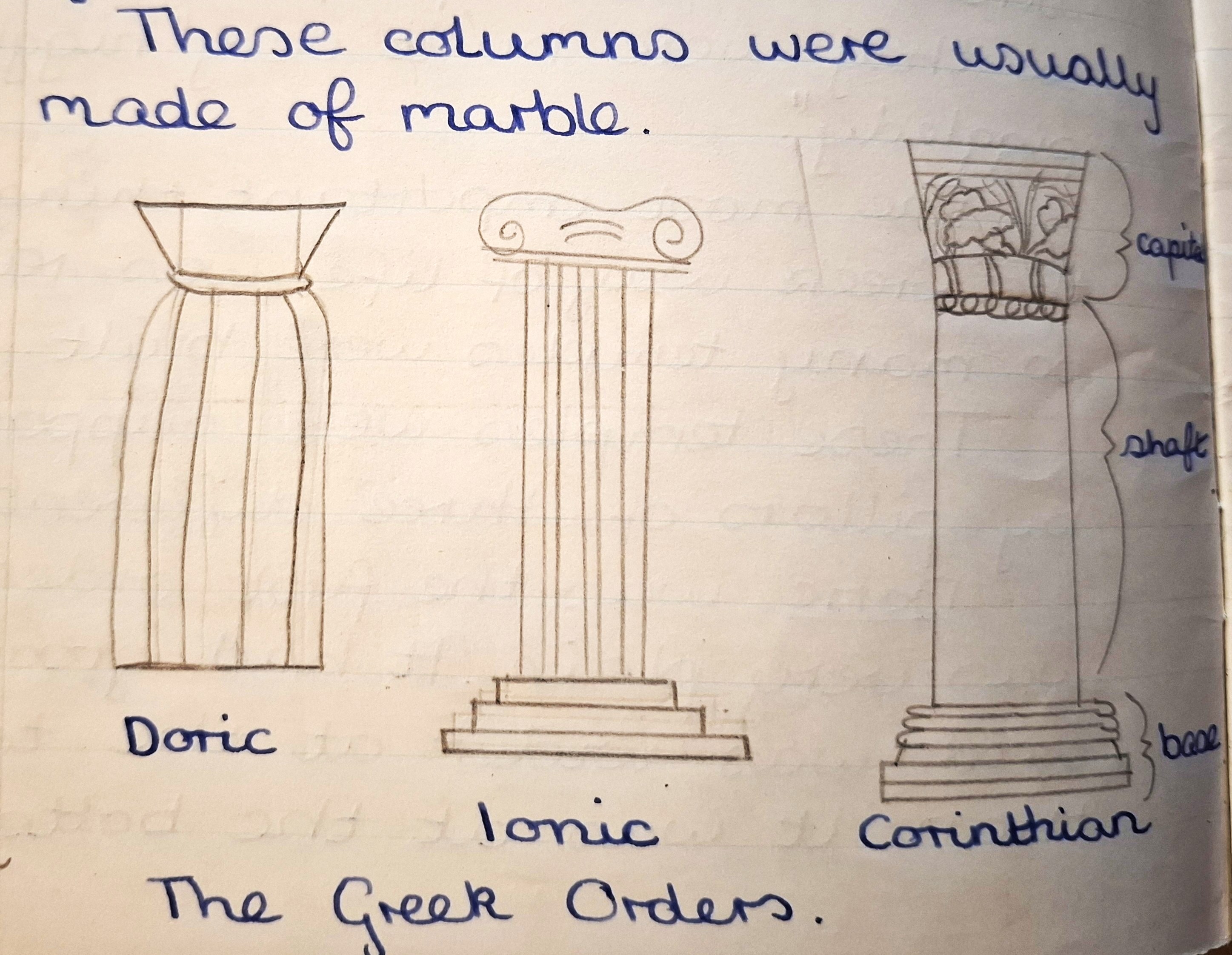
Sometimes there’s an inverse relationship between how well you remember facts from school and how helpful they will be in your adult life. I have yet to find a use for my unerring ability to differentiate between Doric, Ionic and Corinthian columns. My skill in drawing the cross-section of an oil derrick has sadly never helped me earn my keep.

Even in my geography class that particular talent was not appreciated once I’d added boys’ names to each of the structures on the page.  (Well, I didn’t want Derrick to get lonely.)  I can vividly picture those diagrams, and so can Elizabeth, the girl who became my best friend the day we started secondary school, sharing the bond of equally awful short haircuts and new school shoes, disdainfully referred to as our “Noddy boots”.

“Why are you and Eliz. being so slow?” wrote the geography teacher underneath Derrick and his chums, as if she didn’t know.

Another diagram lodged in my mind with photographic clarity is that of a mediaeval farmer’s field.  We had to illustrate the principle of crop rotation.  The concept of lying fallow made a big impression on my early teenage brain: at that age I’d have embraced anything that transformed sloth into a virtue.

As I’ve got older, I’ve often thought back to this picture, not because I’ve taken up farming – though my back garden is unusually lying fallow this year.  (I cheered when I heard a radio report that “the natural look” was in fashion for gardens this year: gardens don’t get much more natural than mine.) I’m comforting myself that I should get a much better harvest next year as a result.

When I most appreciate the concept of lying fallow is when I’m recovering from an illness.

It’s extraordinary how a few days of sloth recharges the brain. It’s a given in any period of convalesence.

  • The first stage of my recovery is always when, in a lightbulb moment, I realise that the daytime television I’ve been watching is utter trash.
  • Then something deep within my subconscious starts to stir – and I  leap out of bed, grab a notebook and pen, and start to scribble.
  • Before I know it, there’s a surge of creativity and insight, and my brain feels positively reborn.

It’s not just illness that yields this regeneration: equally powerful is a trip away from home.  I’m rather hoping that the summer holidays, due to start any day now, will have a similar effect.

Watch this space to find out….