With the opening ceremony of London 2012 nearly upon us, I have to say that I’m entirely happy with my experience of the Games to date: watching the Olympic Torch pass by.
I didn’t want to miss the opportunity for my daughter Laura to see a piece of history in the making. About to turn nine the next day, she would remember the event for the rest of her life. It would also be the perfect overture to her birthday party, the theme of which was to be the Olympic Games (albeit our games largely featuring the garden hosepipe, making the most of the fleeting heatwave).The timing couldn’t have been better.
And so after school on the Tuesday afternoon, we shot off down the A46 to park near my brother and sister’s houses, a stone’s throw from the Bath to Bristol road. I’d have preferred to see the Torch crossing the Clifton Suspension Bridge, enabling us to segue neatly from Laura’s current school topic (Brunel) to the next one (The Olympic Games) but it would have meant missing a morning of school.
We strolled down to the Torch route at 5 o’clock and the sun was scorching. We quickly claimed a piece of (hot) pavement from which we could enjoy an unimpeded view and sat down to see what would happen next.
We weren’t really sure what to expect, but somehow I thought there’d be something to imbue us with the Olympic spirit, inspiring us to strive “faster, higher, stronger”. I thought there would be an international vibe to the proceedings, in preparation for so many nations coming together.
“I think I can see him!”
I thought to myself, if this was America, there’d be marching bands with drum majorettes and baton twirlers, military precision and grandeur and pomp and show. If it was China, there’d be military might and vast crowds of synchronised dancers in colourful costumes.
But this was Britain, and what unfolded was an endearingly British spectacle. Here was the general public at its whimsical British best, turning pink in the hot sun without sunhats or sunblock, tucking into Mr Whippy’s 99s and making their own entertainment.
Several small children had brought along their own Olympic Torches, home-made in the best Blue Peter tradition, all sticky backed plastic and kitchen tinfoil. Many waved Union flags, dusted off from last year’s Royal Wedding and being given a preliminary airing in preparation for the Royal Jubilee. With a wry flourish, my brother produced a free promotional flag that he’d been given by a building company at the height of last year’s Will-and-Kate mania. The building company had since gone bust.
Amiable security guards, armed only with dayglo yellow waistcoats and walkie talkies, ambled about the crowds, trying to look busy to justify their temp agency fee. They were clearly at a bit of a loose end. One of them, with spectacular dreadlocks, suddenly seized a home-made Olympic torch from a child and started to run along the route, waving at the spectators as if he were the official torch bearer. A Mexican wave of cheers followed him. Then a couple of cyclists, having jumped the road blocks, pedalled cheerfully along the centre of the cleared street to further applause.
AT LAST!
Finally it was time for the real thing, heralded by pairs of police cars driving slowly and officiously along. But their windows were wound right down and the policemen inside were relaxed and smiling, proffering royal waves. Then came the sponsors’ open-topped buses, understaffed, a few souls in garish uniforms looking slightly embarrassed as they waved to the crowds. But the crowds didn’t care: they just let out a rousing cheer.
At last along came the Olympic bus (but it didn’t appear to be faster, stronger or higher). Jogging behind, holding the Torch aloft, was an elderly white-bearded sage. He looked as if he’d just come down from Mount Olympus. He waved and saluted as he trotted along, clearly savouring every moment of his three hundred metres of fame. The crowd went wild.
Famous for 300 metres
And then he’d passed by and it was over. We all dispersed quickly and quietly, ripples of innocent pleasure radiating out through suburban streets. There wasn’t a hint of trouble. We’d all got more than we bargained for: a bit of a laugh, some unscheduled sunshine, a Mr Whippy and some community bonding.
I came home very glad to be British.
This post originally appeared in the Tetbury Advertiser, July 2012 edition.
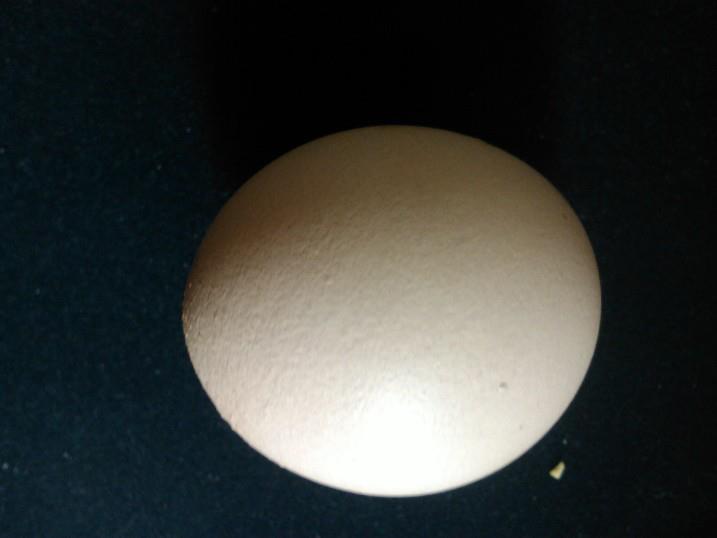
Recently I posted on Facebook a photo of an almost spherical egg, found in a box of half a dozen that I’d purchased from a local farm gate. As so many people “liked” the photo, I thought it might be of interest to reproduce here an article I wrote many years ago for the magazine “Country Gardens” (now “Country Smallholdings” ) about the time we kept chickens. Too many visits from local foxes put an end to that venture after a while, but it was fun while it lasted – and I’ve never bought supermarket eggs since.
It was the taste of a fried egg one lunchtime that made me acquiesce at last to my husband’s long-held ambition to keep a few chickens in our large country garden. Or rather, the realisation, as I chewed it, that the supermarket-bought egg tasted of absolutely nothing.
My husband favoured free range methods, but having just spent three years transforming a wilderness into a kitchen garden, I was reluctant.
“They prefer slugs to plants,” he was still saying some months later, rather unconvincingly as our new feathered residents were making a bee-line for my tender broccoli seedlings.
However, before we could even consider inviting hens into our lives, we had to prepare safe and comfortable housing for them.
SAFE AS HENHOUSES
We could, of course, have bought a ready-made wooden ark, for a hundred pounds or so, but we preferred to put to constructive use one of the small stone outhouses that was otherwise serving only as a dumping ground for flowerpots. We chose the one that seemed to have started life as a pigsty and my husband and father set to work to convert it into a henhouse.
A simple roof repair and chicken wire job turned into a major renovation. A completely new roof and mains electricity were installed, (so that artificial light would fool them into laying eggs throughout the winter), and the bottom of the run was sunk deep into concrete, to be fox-proof. The inside walls were rough plastered, to make them less receptive to parasites, but it took the join efforts of my father and I to restrain my husband from emulsioning it just to make it more homely for the hens.
“This isn’t a henhouse, it’s a luxury hotel!” remarked a neighbour wryly.
With the work finally completed, we thought it would be simple to acquire a few hens. After all, we lived in the country, didn’t we?
FIRST CATCH YOUR CHICKEN
We visited the Domestic Fowl Trust at Evesham – a wonderful place, with hundreds of breeds and hens in all shapes and colours. Having taken several hours there to choose our favourites, we discovered that they would have to be hatched to order, and so we’d have a long wait for egg-laying hens. We’d also have to pay a great deal more than we could now afford, having rashly spent so much on the new henhouse.
Returning home in despair, we began to wonder whether pigs were not such a bad idea after all. Then I picked up the local paper and saw a small ad that seemed too good to be true: “Hens laying large brown eggs. £1.50.”
“There’s a catch! They must be battery hens,” I cautioned my husband. He was not convinced.
“But this is the country,” he protested. “They’re probably just nice people who keep chickens for love, not profit.”
I reserved my judgement and reflected that at £1.50 apiece, a mistake would not be expensive.
We drove the next day to the farmhouse, which had outside a large sign detailing “farm-fresh eggs” for sale. My heart sank – this was code for battery eggs, I remembered.
We parked in a yard edged by the farmhouse and a long dark shed. As soon as we stopped, we were aware of a constant clucking and cackling, emanating from the shed. A small door was the only entrance or source of light, and we stepped inside.
How not to keep chickens (Photo credit: Wikipedia)
Four rows of small wire cages, stacked four high and back-to-back, crammed as many hens as possible into the space available. Rolls of polythene sheeting beneath each “floor” of cages allowed the droppings to be rolled out without too much bother, while drainpipes along the front held water, a sparse ration of pelleted food, and eggs that had rolled out of the trap doors at the bottom of each cage. We seemed to have happened upon the hens in the midst of a riot, their featherless necks rubbing against the wire as they looked about them, clucking indignantly.
“I’m getting back in the car,” I said. I’d suddenly gone right off eggs. At that point, the lady of the house entered the yard, followed by a small cheerful spaniel.
“We’ll take six of them,” my husband told her firmly, whispering to me, “I’d like to take them all.”
She put them in cardboard boxes tied with a single string. Knowing how mad our cats go in transit, I had visions of driving home in clouds of feathers as they made circuits of the car. To my surprise, we just heard the odd confused cluck. When we got them home, we began to realise why.
OH, BRAVE NEW POULTRY WORLD
We took the chickens out of the boxes and stood them in the henhouse. We stood back, expecting them to start exploring their new home. The chickens stood still. We picked one up and moved it to a different place. It stood still. It dawned on us slowly that they didn’t know that there was any other option. They’d not been able to move about before, and so it did not occur to them as an option now. We were therefore amazed to discover that within five minutes one of them worked out that it was no longer bounded by a cage. Gingerly, it took a step forwards and, plucking up all its courage, pecked at the ground. Within a few minutes, the others began to follow suit. To see them become aware of their freedom was a great delight. For the first day and night we kept them in the henhouse. We thought this might seem stifling to them, but there was so much novelty. Sawdust to scratch in, a big plastic seed tray full of food, a washing up bowl full of drinking water, a tray of grit, all freely available – plus of course nestboxes and a perch, which they had never before seen.
My husband decided to teach them to perch. He put them all in turn on the wooden perch he’d carefully fashioned. We waited. Then – thump, thump, thump, thump, thump, thump. In turn, they all fell off! However, the act of falling alerted their instincts to flap their wings – something else they hadn’t been able to do before. Watching an ex-battery chicken stretch its wings for the first time is a sight full of vicarious bliss.
He also introduced them to the nestboxes, and our delight was unbounded at finding three large eggs there next day. We soon realised that the chickens preferred to sleep in the nestboxes rather than on the perch. They liked to huddle together in them, perhaps preferring the security of the nextbox walls to the exposure of the perch.
The next day we left them out into the fixed run. They were shy of the sunlight at first but didn’t take much persuasion to emerge from the pophole. We fed them lots of weeds, especially dandelion leaves which they adored, but discovered that nettles, recommended by the books, were left untouched.
My husband has also made a movable run to allow them to range on grass or soil. (His excuse for getting chickens in the first place was to enable us to control our slug problem organically.) We were pleased to see how thoroughly they dug over a plot of ground, but we have yet to teach them to differentiate between our ‘friends’, such as worms, and our ‘enemies’, the slugs. We have even found a chicken with a frog in it sbeak, whereupon we gave the hen a lecture about frogs being their colleagues on slug patrol, not their dinner!
PUTTING A CAT AMONG THE CHICKENS
We were anxious as to how the chickens would react to our cats. We were very conscious that our seasoned birdstalking cats, who have been known to steal drumsticks from neighbours’ barbecues, might mistake the henhouse for their very own larder. We need not have feared for the hens – the cats were the ones that needed rescuing! When the hens first took up residence, our two littlest cats, Mabel and Dolly, spent hours with their noses pressed up against the wire of the run. There were fascinated by the jerky movements of the hens, who would occasionally acknowledge the cats’ presence by pecking their noses through the wire.
When we allow the hens to free-range as a treat (under our strict supervision), the cats follow them, but after the odd initial skirmish the chickens have established their superior status and they will chase the cats away if they get too close. It makes a refreshing change to see a big bird flapping down the garden in pursuit of a cat!
EARNING THEIR KEEP
The hens are now producing an average of three eggs per day, and sometimes as many as five, which we are told is very good for yearlings. The eggs are large and a dark flesh colour, and some are so huge they will not fit into a standard size egg box. We were very proud recently when a carefully selected half-dozen took third prize in our annual village show.
We also benefit from their manure, which long with the sawdust from the henhouse has topped up the compost heaps to capacity – the only problem being that we feed virtually all the weeds to them, so the green element of the compost heap has been reduced, other than nettles of which there are still plenty. Perhaps next year we will also be able to produce champion beans – a crop which apparently dotes on chicken manure.
In return for this bounty, we provide a handful of layers’ pellets to each chicken per day, with a little oystershell to avoid soft-shelled eggs. We throw down a few handfuls of grain for them to scratch for and a lot of kitchen scraps. In colder weather we give them a dish of layers’ mash, mixed with warm water to form a porridge. They also help us to take care of gluts of garden produce that we cannot preserve. We were delighted to find they even like the cucumbers that we had accidentally allowed to turn bitter on the plant.
Raiding the larder for special treats (not that they need them), my husband will give them tinned corn, baked beans, tinned tomatoes and sultanas. Consequently if they seem him with a plate in his hand, they will follow him anywhere (even into the kitchen!) – very handy for persuading them to return to their house after a free-range session.
The books are right when they say ten minutes care a day, plus half an hour to clean them out once a week, is sufficient. But we spend a lot more time with them because we find them soothing, entertaining and undemanding companions who soon take away the stresses of the day. They are also very popular with our friends. When we go away, we have no shortage of volunteers to look after them, especially when we say they can keep any eggs they find.
And what of the eggs’ taste? Well, of course, it’s absolutely delicious!
I really didn’t need six new washing up bowls. I didn’t even need just one. But there was something so appealing about this neat nest of bowls, quite apart from their low price, that made them irresistible.
Of the two of us, I’m usually the stronger one going round Lidl. Whereas my husband cannot exit the shop without another household tool or gadget, I’m happy to leave with just their fruit, vegetables and chocolate.
“It’s only a bargain if you actually need it,” still echoes in my head: sage counselling from my best friend’s mother, probably the most sensible person in the world.
But I pick up these bowls and turn them round in my hands, pondering why I’m so drawn to them. It’s always a mistake to handle something you’re trying to resist buying. It’s known in the trade as “puppy dog selling”: the tactile experience makes you keener to buy than if you’d just looked. (Ironically, my husband once used this technique to convince me to adopt a kitten.)
And then the penny drops. It is a Proustian madeleine moment. For these simple plastic bowls whisk me back to my grandma’s kitchen. Or rather, her scullery, as she always called it. Born in 1900, she had grown up with a smattering of Victorian vocabulary that never left her.
To Grandma, her small terraced house would have seemed modern, being built around 1930, when Sidcup was starting to segue from a Kentish village into a London suburb. For decades, Grandpa walked to the railway station for a civilised 30 minute commute into the City.
The house may have been modern, but it was also compact. The scullery was no more than a narrow galley, with cupboards and appliances down one side and a slim glass-fronted cupboard mounted on the wall opposite. The appliances were few: a rounded, low, old-fashioned fridge; a small gas stove and a wall-mounted gas geyser to heat the water, its pilot light permanently glowing blue until you turned the tap, when with a whoosh! a little row of blue flames came to life to heat the water as we needed it. A slightly intoxicating smell wafted out as the hot water ran, though not as pungent as the paraffin heater in the bathroom.
Beneath the geyser was a big old white sink, and in the sink lived a plastic washing up bowl. Grandma’s preferred colours for the plastic washing up bowl were a deep rose pink and a peach, which, if melded together, would have combined to make her favourite colour: flame. The washing up bowl of the moment provided a welcome splash of colour in an otherwise grey and shady space, matched only by three bright Melamine cups and saucers in the wall cupboard, where they lay in wait for when my brother and sister and me came to tea once a week. My sister’s cup and saucer were rose pink, my brother’s mocha and mine was tangerine.
In this narrow space, Grandma would potter up and down, busy but contented, reminding me of Mrs Tiggywinkle in her pinny and hairnet. Every day while I was at primary school, I came home to Grandma’s for lunch, looking forward to what she’d produce from her scullery. Her considerable culinary skills had enabled her to feed her young family through the rationing of the Second World War and it was simple, healthy, delicious food. Everything in the scullery seemed old and well worn, from the wavy-edged pyrex pudding bowls to the tin pie-dishes that gave her delicious gooseberry tart a tingling metallic after-taste. I loved them all. Years of having to make do and mend meant nothing was wasted; things were only replaced when really necessary.
Like the washing up bowl. Grandma showed me how after so many uses the smooth bowl would start to roughen. Eventually little whitened tags of plastic would stick up as the plastic wore thin. At a certain point – probably every three or four years – she would decide enough was enough, and splash out, so to speak, on another. The purchase of a new one was a significant occasion that made a big impression upon me. I’ve never liked waste ever since – one of the many valuable qualities that I picked up from my dear Grandma.
But now, thanks to the temptations of Lidl, I am the proud possessor of not one but six new plastic washing up bowls. In Grandma’s book, that would count as a wild extravagance. But I think if she knew the reason I succumbed, it’s an extravagance she’d find very easy to forgive.
Just before her ninth birthday, my daughter asked me how I’d chosen her name. Given that it’s one piece of parenting that I’ve never regretted, I’m happy to share that information with you now.
Two weeks on from the Royal Jubilee celebrations, and I can’t quite bring myself to turn off the red, white and blue fairy lights outside my house, nor to take down the bunting. I don’t want to lose that carefree sense of fun that took over the nation’s lives, for all but the most hardened Republicans.
Cards on the table: I’m not especially a Royalist, but I do have a profound admiration for those Royals who work hard and tirelessly to do their duty for the country. I certainly wouldn’t want to swap places with the Queen. During the Jubilee period, it’s been a treat to see our national flag restored to its proper use of celebrating our national unity, rather than indicating right-wing tendencies or National Front affiliations. I hung the biggest flag I could find from my bedroom window. (“Are you doing that just to irritate Daddy?” asked my nine-year-old daughter, too perceptive for her own good of my husband’s revolutionary tendencies.)
Admittedly, the weekend of celebrations was not quite what I expected it to be. First of all, the very British but very uncooperative weather meant I didn’t get the chance to wear the long, light cotton sundress that I’d bought for the occasion in the colours of the flag. Secondly, our village decided to have a party in the recreation ground, rather than the street. To my mind, you can’t beat a street party. But we did have a jolly good time.
Laura and friend, snapped on the rec by my friend. They look like they’ve just travelled back in time
My best memories will be:
– laughing at the egg-catching competition on the rec (we were having so much fun that we didn’t realise the showers had turned into torrents until it was finished)
– snuggling under a blanket in front of a log fire with my daughter Laura, slightly steaming as we dried off after said village party, as we watched the Royal Flotilla (also in pouring rain)
– a frisson of pleasure watching the Queen and her inner circle start jigging up and down to the sounds of the Sailors’ Hornpipe played by the floating Royal Philharmonic Orchestra
Ablaze with patriotism, Laura at the Beacon bonfire, adorned by IKEA battery-powered fairy lights
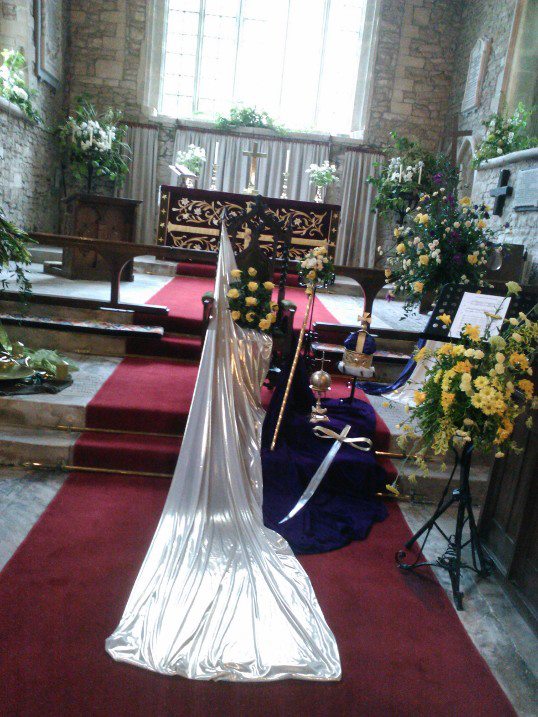
– being astonished by the colour and imagination of the Jubilee-themed Flower Festival at the local church
– trekking up to our village’s Beacon Bonfire and spotting the next one at Uley, 10 miles or so away
After all, the whole point of a Beacon Bonfire is to be seen from afar, and send a kind of Mexican wave of bonfires across the length and breadth of the nation. And for a moment there, the nation felt just like a close-knit village. It was a fabulous feeling, and I really hope we don’t have to wait another 60 years to feel that way again. God Save The Queen!
If you like the British Royal Family, you might like these posts:
A taste of the Jubilee Flower Festival at St Mary’s Church, Hawkesbury Upton
Looking up to the altar
Annointing the new QueenThe Lords declare their loyalty to the Queen
Prince Philip – in flowers
The Queen’s coronation carriageMy favourite: the Yeomen of the Guard (Beefeaters)
Footnote: I’ve just heard that my friend Mary Beresford, who masterminded this Flower Festival, has been awarded the British Empire Medal in the Queen’s Birthday Honours, for service to her community. I’m so pleased for her!