
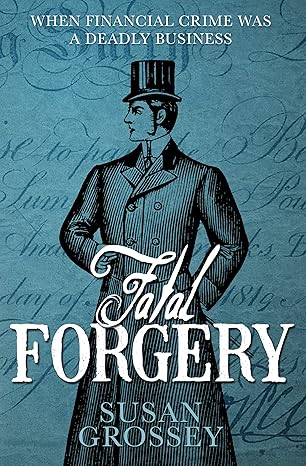

At the end of every month, I like to invite an author friend onto my blog for a fun conversation about their writing life. This month, I’m pleased to welcome Susan Grossey, author of historical crime fiction, whose career I’ve followed since her debut novel, Fatal Forgery, back in 2013.
Susan specialises in historical cases of financial crime, inspired by her own career. No, she’s not a forger herself! Over to Susan to explain…
Susan Grossey: I am proud to boast that I have made my living from crime! After running an anti-money laundering consultancy for twenty-five years, I became a full-time author of historical crime fiction novels – the common theme is money, and just how far people will go to acquire and keep it…
Debbie Young: So you side-stepped into writing historical fiction from a very different but related kind of writing in your previous career – please explain!
Susan Grossey: In my previous career I ran an anti-money laundering consultancy – advising banks, accountancy firms, casinos and the like on how to spot and report criminal proceeds moving through their organisations.
I will confess that this ignited in me a rather unhealthy obsession with dodgy money – and with exploring quite how naughty people are prepared to be in order to get hold of it.
During my consultancy years I wrote dozens of non-fiction books on money laundering, which served only to convince me that dirty money is perhaps the most fascinating subject in the world.
Debbie Young: When you first thought of writing historical fiction about financial crime, to what extent did it feel like following the old adage of “write what you know” and how much research did you have to do? How different were the historical crimes from those you were writing about in your previous day job?
Susan Grossey: My first foray into historical financial crime fiction came about when a client asked me, as a favour, to do some research into a colourful character in their bank’s history.
In 1824 a man called Henry Fauntleroy stole a huge amount of money from the bank after inheriting it from his father, and the mystery was why he would do such a thing – particularly in an era that still imposed the death penalty for such crimes. I wrote a small piece for the bank’s annual report and that was that.
But a few years later I was thinking about trying my hand at fiction, and Henry popped back into my mind. My first attempt was a lightly fictionalised biography of him, but I realised that I didn’t like him enough to make him my central character. And so I rewrote the whole book from the point of view of the man who had arrested him – a magistrates’ constable whom I called Sam Plank.
Sam Plank was a much more rounded and sympathetic individual, and so Fatal Forgery was born. What I hadn’t foreseen was that I would fall so deeply in love with Sam that I couldn’t bear to say goodbye – and I ended up writing seven books about him!

And as for the difference between financial crimes in the 1820s and today – well, there is very little difference! And that’s what I find fascinating. The techniques may change, but really it’s all a cycle.
In the 1820s, people were very suspicious of the new-fangled paper money replacing their beloved coins – and now we are equally suspicious of the cybercurrencies replacing our beloved paper money!
The other salutary revelation is that, when it comes to money, human nature does not change one bit. There are still the greedy ones, the adventurous ones, the cautious ones, the contented ones – if we were to travel back two centuries to London in the 1820s, we would recognise our own friends and neighbours in everyone we met.
Debbie Young: You have two series about two very different kinds of what might be described as early policing. Can you please explain the kinds of ‘police’ that Sam Plank and Gregory Hardiman are.
Susan Grossey: Oh, I am so pleased you asked – I just love talking about early policing!
In London, everyone has heard of the Bow Street Runners and of the Metropolitan Police – but between them, when London’s population was growing at a furious rate, the capital experimented with various methods of policing. And the most successful of these was the system of magistrates’ constables, which operated from about 1810 to 1829. In short, magistrates worked out of seven court offices in London, and attached to each court office was a group of four to ten constables. If a crime was committed, the victim would report it to his local magistrate, and if the magistrate agreed that someone needed to be brought in for questioning, he would send out a magistrate with a warrant to arrest him.
Sam Plank is one of these magistrates, working out of the Great Marlborough Street office (near the Liberty department store now).
Life was very different in the backwater of Cambridge. It was a small town of mainly religious scholars, and although there were a few town constables, they had no jurisdiction over the university undergraduates. In 1825 a piece of legislation called the Universities Act was passed, giving the two universities – Cambridge and Oxford – the right to appoint their own constables. And my narrator, Gregory Hardiman, is a university constable. But it was only a part-time job (patrolling the town from 6pm to 10pm, to get the undergraduates back into college before curfew) and so he also works as an ostler (looking after the horses in a coaching inn) in order to make a living wage.
Neither the magistrates’ constables in London nor the university constables in Cambridge had any responsibility to detect or investigate (detectives weren’t invented until 1832 in London), but Sam and Gregory are both curious men and tend to go beyond their job descriptions!

Debbie Young: How different does it feel to be writing about your home city of Cambridge rather than London? Obviously you’re writing about the university community, but how else does Cambridge of that era differ from London, and how is it similar?
Susan Grossey: I was encouraged to consider setting a series in Cambridge by a local bookseller, Richard Reynolds. He was always extremely supportive of my books when he worked at the university bookshop Heffers, and continues to be so now that he has his own crime fiction bookshop called Bodies in the Bookshop (where I volunteer about once a fortnight, ostensibly to help customers but really so that I can spend ALL DAY surrounded by books).
I thought a Cambridge setting would be a doddle: I studied at the university and have lived here for nearly forty years. How wrong I was!
The issue is that there are two histories of the place – town and gown – and both are much more complicated and involved than I had realised.
On the other hand, I can walk to every location and look at it for myself, and the local librarians – town and gown – are outstandingly helpful.
And Cambridge in the 1820s was extremely different to London. The capital was the centre of the world, at the vanguard of every invention (particularly to do with trade and finance), cosmopolitan, fast-moving… Cambridge was a swampy backwater full of religious scholars. The university was entirely male, and banned concerts and gambling in case the young men were led astray.
It was not a fun place – so travelling from London to Cambridge in the 1820s would have been akin to going back fifty years in time.
Debbie Young: I love the characters in your books – both the protagonists and the supporting roles. To what extent are your books driven by character?
Susan Grossey: Actually, I think my books are driven more by character than by plot! I enjoy finding suitable plots, by plundering newspapers and court records of the time, but as soon as I start writing, my attention is drawn to character development.
In fact, I am such a character fiend that the narrator of my Cambridge audiobooks recently complained that I had put nearly eighty people into the first Gregory book – that’s probably a few too many!
Debbie Young: That’s hilarious! I hadn’t noticed how many there were when I read it, so don’t let that put you off, folks!
Susan Grossey: Because my Cambridge series was planned from the outset as a set of five books, I created my characters before I wrote a single word of the first book. I devised characters arcs for the main individuals – so I already know where they will be at the end of book five. And in each book I can drip-feed a little more information about them.
The London series was what I call an accidental series – I thought I was writing one book, then one more, and so on, and didn’t admit that it was a proper series until book four! By then, it was too late to think of cleverly holding back information.
Debbie Young: I’m so pleased to see the development of your own brand as a kind of “Ms Cambridge”, what with your sidelines of working in the Bodies in the Bookshop and writing a monthly column about the history of places in Cambridge for your local magazine. Those must be great ways for reaching new readers for your books. How do these two sidelines help or hinder your writing?

Susan Grossey: You already know why I work in Bodies in the Bookshop – pure bookish indulgence! And I agreed to write the monthly column in Velvet magazine (it’s called “Stories of a City” – see two sample articles below) because the editor agreed that one of the columns could feature the bookshop, which I thought would help them. But the common theme is my love of Cambridge. It has its faults – the number of tourists in high summer is astonishing, and we have yet to crack the traffic problem – but it is one of the most beautiful cities in the world, and the sense of history is matchless. All of this draws readers to Cambridge-set books – I have many readers in the US, for example, who love the ultra-Englishness of the setting.


And in a new venture I have devised a walking tour of Gregory Hardiman’s Cambridge, visiting the locations in the books – I’m running it for the first time in early December, to mark the launch of the third Gregory book, Whipster.
Debbie Young: As I’ve told you from when I saw your very first published novel, I think your covers are gorgegous! Although I read a lot of ebooks, I’ve collected the sets in print over the years, because they look so beautiful on my bookshelves! How did you go about developing such distinctive covers and brands for your two series?
Susan Grossey: Thank you – I also think my covers are gorgeous, and I can say this because I had very little to do with them! For my very first book (a non-fiction title about money laundering), I was lucky enough to find a cover designer called Andrew Brown at Design for Writers. When I turned to fiction, I asked if he was interested – and thank goodness he was! He has devised a clever and searching questionnaire for authors in order to truffle out their ideas for their cover, and then he patiently and tactfully turns those ramshackle thoughts into a marketable cover.
I knew instantly that his cover for my first London book was a winner, and so for the rest in the series we kept to the same formula: colour from the period, a bespoke font, a blurry background document, and a line drawing of a figure. It held the series together and – most importantly – told people immediately what genre of book it was, even in a tiny thumbnail cover image.
With the Cambridge series, I didn’t even think about it for a nanosecond: I just told Andrew what I was planning and let him run free – and back came another masterful cover. So I deserve no credit at all, except for my great cleverness in finding Andrew.
Debbie Young: You recently retired from your day job, and planned to have more time to write. How is that working out?
Susan Grossey: Debbie, I am loving it! I worked in my own consultancy for twenty-five years, and decided that I had given long enough to it. Money laundering techniques have gone very cyber, which interests me less – another reason why I am drawn to the past!
But I do not write full-time – far from it. I do various volunteering roles: I am a magistrate, I write letters to prisoners, I teach adults to read, and there’s the bookshop as well. I still do a very small amount of consultancy for local clients, just to keep my hand in. And I like cycling (on a tandem – I’m the one at the back) and walking.
But the true joy of being retired is being able to organise my time as I wish: if I have planned a writing day but the sun is shining, I can go cycling instead and write the next day.
After all those years of being ruled by the Filofax, the flexibility is wonderful.
Debbie Young: Do you plan to focus on Cambridge in all future fiction, or are there other geographical areas that you’d like to write about?
Susan Grossey: Hmmm, I have been thinking about this myself.
My problem is that I am deeply in love with the 1820s, which is a decade neglected in most fiction – everyone loves the Jane Austen era and then the Victorian decades, but the bit in the middle is ignored.
And so I need to find locations where the 1820s were significant. I’m quite drawn to King’s Lynn in Norfolk – they certainly have an interesting history, but sadly their heyday was in the late mediaeval period. I could widen out into Suffolk and Norfolk generally – two very different counties, so that would be interesting. And my husband asked whether there was any way I could engineer a meeting between Sam Plank and Gregory Hardiman – and I think there might be… Another option is to do a Colin Dexter and write prequels for both men.
Debbie Young: Ooh, yes please to prequels and a meeting between Sam and Gregory! There’s also a commercial reason for doing that: if people have only experienced one or other of your series, this book would be their gateway into the other series. Also, avid readers of both would get such a kick out of it. In my second and third series (St Bride’s and Cotswold Curiosity Shop), I’ve had fun making them visit people and places mentioned in my first series (Sophie Sayers), and readers seem to love that.
Next question: fun with wordplay! Gregory Hardiman is fascinated by words and language, noting down new words he learns in a little notebook he carries always with him. You’re having fun with words too, choosing possibly slightly obscure one-word titles for his books, starting with Ostler, then Sizar. You also make a point of having single-word chapter headings, eg Ostler begins with “Tempest”, “Horsemen”, “Inquest”. I love having fun chapter titles too – I think writers who just use numbers are missing out! Where do these words appear in your writing process – are they a starting point, or something you add in afterwards at editing stage?
Susan Grossey: Gregory’s love of words comes from my own fascination with them. I’m not quite in the Susie Dent league, but I am forever checking etymologies and looking for unusual words.
In the second London book I included a small glossary, and readers liked it so much that I have expanded it and included one from the beginning in the Cambridge series (as Gregory’s vocabulary would have included terms from his Norfolk childhood and his time in the army, as well as general Regency slang).
I knew I wanted Gregory to be an early pioneer of self-improvement, and the vocabulary book seemed like a good way to signal his intellectual curiosity and ambition.
As for the chapter titles, they are my reward: once I have spent those long, long, loooooong hours formatting my book, I allow myself to go back and turn all the chapter numbers into one-word titles. It’s a good exercise as it makes me condense each chapter into one idea in my head. The first book title in the Cambridge series – Ostler – was not hard to find, as it’s Gregory’s day job, but readers said they liked the obscurity of it, and so I decided to continue with Sizar, and now with Whipster. I hope the unusual word catches people’s eyes and makes them pick up the book to find out just what a whipster might be! (It’s a young man of considerable energy and some mischief.)
Debbie Young: Susan, thank you so much for joining me on my blog today. I hope our conversation inspires more readers to try your books. I can guarantee them they’ll be hooked if they do! And best of luck with the launch of Whipsteron 1st November – I can’t wait to get stuck into it!
More About Susan Grossey
To find out more about Susan Grossey and her books, visit her website: www.susangrossey.com.
A Free Ebook for You by Susan Grossey
 If you sign up for her free mailing list at www.susangrossey.com, Susan will very kindly send you a free ebook of Fatal Forgery to get you started. Now there’s an offer you can’t refuse!
In Other News
I’ve been unusually inactive over the last ten days due to being unwell (on the mend now, thankfully), but my spirits have been buoyed up by two pieces of news about my books:
 my lovely agent Ethan Ellenberg has just secured a Russian translation deal for Death at the Old Curiosity Shop, in addition to my Italian and German deals
- my wonderful publisher, Boldwood Books, has organised a BookBub Featured Deal (if you know, you know) for this coming Sunday, 2nd November, which means nearly two million readers in the US, UK, Australia and Canada who love cosy mystery will be alerted to a 99p/99c special offer on the ebook of Death at the Village Christmas Fair. You don’t need to be a subscriber to BookBub to take advantage of this offer – if you live in those countries, the ebook should already be on offer at that price, so snap it up now, as it’ll go back to its usual RRP soon.
I’ve also just taken my first event booking for 2026 – I’ve been invited to take part in the inaugural Bath and North East Somerset Festival of Libraries.
In the meantime, I have a busy schedule of events in the run-up to Christmas – check out the right-hand sidebar on my website for more information and to book tickets.

One thought on “In Conversation with Susan Grossey, Author of Historical Crime Fiction”