Posted in Family, Personal life

Back to School

American soldiers cross the Siegfried Line and...
Allied soldiers marching across the Siegfried Line (Image via Wikipedia)

As you will have noticed if you have been anywhere near a supermarket since June, this month it’s back to school, and for primary school children like my eight year old daughter Laura, another term means another topic.

When I was that age, a topic was a simple, self-driven task: four sheets of paper to fill on a set subject, the next on the list set by the teacher. I can see now that these topics were time-fillers, to occupy the brighter pupils who had completed all the workcards while the others caught up. I remember vividly picking bits of pebbledash off my suburban semi-detached house to sellotape on to my rather literal interpretation of the topic “My Home”.

These days, it’s not so simple. The modern topic is a whole-class, cross-curricular activity in which a single theme unites the many subjects to be taught throughout the term. Picture the topic a the spider at the heart of its web, the focal point of many subject strands woven cleverly together. The whole is definitely much greater than the sum of the parts. The result is a fun learning experience, leading to a broad, balanced outlook on life that I wish I’d had at Laura’s age (or indeed, now).

Last term, for example, Laura’s topic was on World War II. I was astonished at how dextrously this sombre subject was presented to capture her young imagination. And capture her imagination it certainly did. The class didn’t want the term to end.

“I think this is probably the best topic I’ll ever do in my life, Mummy,” she declared at half term.

Digging for victory in the school’s new vegetable garden and comparing the effectiveness of different materials for black-out ticked the science box. Writing speeches for Churchill, composing propaganda slogans and drafting newspaper reports covered literacy. Calculating the best use of their sweet ration was about as compelling a numeracy task as you can get. Swing dance was a popular PE session and learning catchy war-time songs went down well for music. One of Laura’s friends spent most of a playdate at our house singing “We’ll be hanging out the washing on the Siegfried Line” at the top of her voice, with as much enthusiasm as any pop song.

I’m not sure what part of the National Curriculum was served by sitting under their desks for half hour for a mock air raid, but it’s certainly a lesson they will remember for the rest of their lives.

Ever the dutiful parent, I conscripted my parents to visit Laura’s class to talk about their experiences as evacuees from London, my father having been helpfully sent to the Cotswolds. Indeed his wartime love affair with the area (and one Dorothy Duckett) is what led me to live here myself. He brought his own children back for summer holidays and I vividly remember deciding when I was about Laura’s age that this was where I would live when I grew up.

To give some airtime to all sides, I also invited an elderly German friend, contemporary with my parents, to write the class a letter about her own experiences of evaculation to the German countryside. Many of her neighbours were killed in British air raids and she has suffered from claustrophobia ever since her numerous trips to the air raid shelter. An old Dutch school friend of mine recounted his mother’s experience of Nazi occupied Holland. Her greatest trauma was losing her mother and her home to an American (yes, an American) bomb. Friendly fire: it happened then too.

But just when I think the World War II topic has drawn to a close, and I’m packing for our summer holidays, I’m taken aback by Laura’s request to divert the itinerary. She thinks our leisurely tour of France in our camper van should now wander east: she wants us to annex Germany. I’d be less keen to change our plans, had I not overheard a game that she was playing with friends one afternoon towards the end of term. The trampoline had become a Nazi concentration camp, in which Laura and two of her friends were imprisoned. A fourth friend was playing the role of a German soldier. Fetching some glasses of squash from the kitchen, she shouted at them “Here, drink this slime, prisoners!” In the interests of international relations, I think I’d better take her there to make some German friends. But while we’re there, I don’t think I’ll mention the war.

(This post was originally written for the Tetbury Advertiser, September 2011)

Posted in Travel

Reliving History in Northern France

La Coupole
La Coupole, the war museum near St Omer, France (Image by Charles D P Miller via Flickr)

Pottering southwards from Dunkerque on our French odyssey this summer, we take the opportunity to revisit a memorable tourist attraction near St Omer.

La Couple is a remarkable structure: a domed, semi-underground cavern that would serve well as a film set for the lair for a James Bond villain.  But it was the real life setting of a far greater horror.  It’s a Nazi military bunker, built to house and launch the revolutionary V2 bombs on London.

The museum has a particular significance for me.  The London suburb in which I spent my childhood was a target for V2 bombs. I remember my grandma telling me that the most frightening thing about them was when they went silent: that meant they were about to hit the ground.

My eight year old daughter Laura has just finished a school topic about World War II.  She and her classmates enjoyed it so much that they did not want the term to end.  We’re hoping the museum will complement her topic nicely, but I quickly realise that  its displays are more horrific than I had remembered.

Fortunately some of the significance goes over Laura’s head.  She laughs at the spectacle of a slide show projected on a pocked and pitted rough brick wall, thinking it makes a funny cinema screen.  It’s actually a reconstruction of a squad’s wall against which many French citizens met their death.  She looks askance at a coarse stripey suit in a glass case: it offends her developing sense of fashion.  I don’t want to explain that someone may have died in this suit: it’s the uniform of a concentration camp prisoner.

Watching films of French refugees heading south on foot, pushing sparse possessions in handcarts and wheelbarrows, I wonder what  it would have been like if we’d been part of that procession.  What would Laura have wanted to take with her? She’s not good at travelling light. Seven cuddly toys have somehow stowed away in the camper van this holiday, although I’d told her to bring only two.

Then I remember an assignment she did at school.  Her class had to plan what they’d have taken in their suitcases,had they been evacuees.  No doubt many of them will have included modern luxuries such as ipods and XBoxes.  Not so Laura.  She thoughtfully showed her favourite cuddly toy (so she’d have something to comfort her at night), a notebook and pen (in case she got bored), and her diabetes test kit.  She drew a neat and accurate illustration of the lancets, test strips and a blood glucose monitor that we use many times a day to manage her Type 1 diabetes.

I realise with a start that to be among those French refugees would almost certainly have sentenced Laura to death, not from Nazi atrocities, but from her diabetes. Her complex medical needs, such as refrigeration for her insulin, and supplies for her high-tech insulin pump, could never have been met on such a journey.

Suddenly Gordon and I find ourselves making excuses to leave the museum before  she is ready to go.  As we march across the car park back to the safety of our camper van, I hug my daughter a little tighter, patting the test kit in my handbag for reassurance.  La Coupole is indeed an extraordinary monument, but as it recedes into the shadows behind us, I do not for a moment glance back.

Posted in Writing

The Importance of Lying Fallow

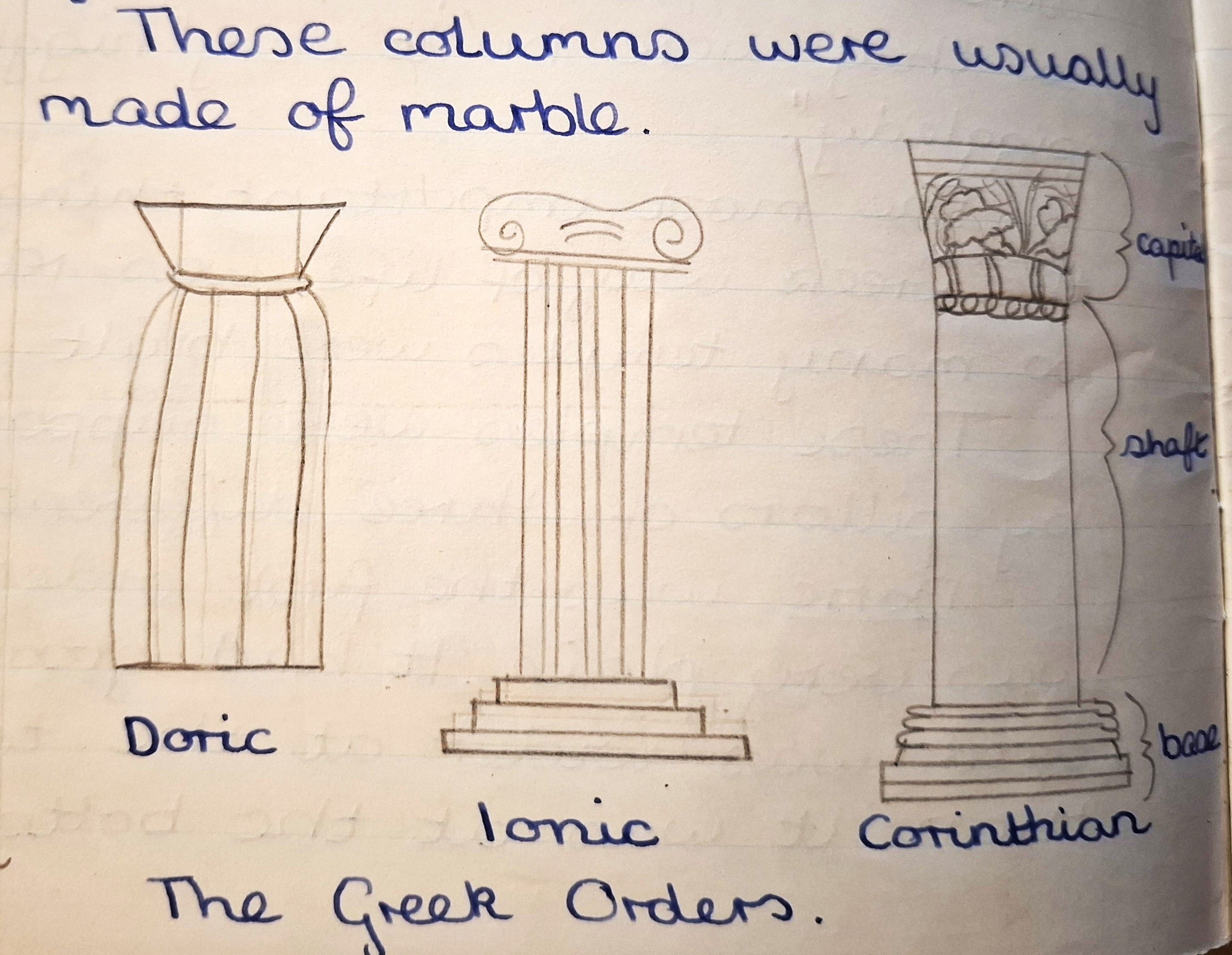
Sometimes there’s an inverse relationship between how well you remember facts from school and how helpful they will be in your adult life. I have yet to find a use for my unerring ability to differentiate between Doric, Ionic and Corinthian columns. My skill in drawing the cross-section of an oil derrick has sadly never helped me earn my keep.

Even in my geography class that particular talent was not appreciated once I’d added boys’ names to each of the structures on the page.  (Well, I didn’t want Derrick to get lonely.)  I can vividly picture those diagrams, and so can Elizabeth, the girl who became my best friend the day we started secondary school, sharing the bond of equally awful short haircuts and new school shoes, disdainfully referred to as our “Noddy boots”.

“Why are you and Eliz. being so slow?” wrote the geography teacher underneath Derrick and his chums, as if she didn’t know.

Another diagram lodged in my mind with photographic clarity is that of a mediaeval farmer’s field.  We had to illustrate the principle of crop rotation.  The concept of lying fallow made a big impression on my early teenage brain: at that age I’d have embraced anything that transformed sloth into a virtue.

As I’ve got older, I’ve often thought back to this picture, not because I’ve taken up farming – though my back garden is unusually lying fallow this year.  (I cheered when I heard a radio report that “the natural look” was in fashion for gardens this year: gardens don’t get much more natural than mine.) I’m comforting myself that I should get a much better harvest next year as a result.

When I most appreciate the concept of lying fallow is when I’m recovering from an illness.

It’s extraordinary how a few days of sloth recharges the brain. It’s a given in any period of convalesence.

  • The first stage of my recovery is always when, in a lightbulb moment, I realise that the daytime television I’ve been watching is utter trash.
  • Then something deep within my subconscious starts to stir – and I  leap out of bed, grab a notebook and pen, and start to scribble.
  • Before I know it, there’s a surge of creativity and insight, and my brain feels positively reborn.

It’s not just illness that yields this regeneration: equally powerful is a trip away from home.  I’m rather hoping that the summer holidays, due to start any day now, will have a similar effect.

Watch this space to find out….

Posted in Family, Personal life, Writing

Not Written Off Yet

Rock-paper-scissors chart
Image via Wikipedia

Although it’s taken me a long time to label myself as a writer, writing has been at the core of all the jobs I have ever done – reporter, PR, marketeer.  But what I most enjoy writing – and reading – are letters.  Among my most precious possessions are airletters penned by my grandmother when, aged 8, I lived in America for a year.  (Her not-so-subtle parting gift to me was a writing case, so that I might write to her too.)  I cherish boxes of letters from old schoolfriends, received when I moved to Germany at the age of 14.

So I was terribly disappointed to discover last year that I’d missed by a few days the deadline to apply for a job writing letters for Steve Webb, our local MP, responding to his constituents’ enquiries and requests.  For a long-term supporter of the Lib Dems, what a dream job that would have been: getting paid for writing about issues that really mattered to society and playing a small but significant part in changing our nation for the better.

My disappointment was short-lived.  In the wake of the General Election, as the new coalition emerged, I decided I’d had a lucky escape.  I would not have relished responding to the wrath of the disillusioned masses.  I began to feel sorry for Steve Webb, even though he’d been elevated to Cabinet Minister. But I still couldn’t stop myself firing off a few letters to him expressing my dissatisfaction with some of the new government’s policies.

Then last week I had the chance to meet him.  He visited the village school to plant a tree donated by Morrisons and I was invited to take photos for the school.  My disenchantment quickly melted away.  He came across as a sympathetic, dedicated representative of our community with a genuine interest in our children.  Some of them will not be eligible to vote for another 14 years, so no cynical fishing for votes there. He may be a Cabinet Minister, but he gave himself no airs and graces.  No formal silver spade for him – he got stuck in and muddy.  And no cynical kissing of babies, either – instead he played “Rock, Paper, Scissors” with the Year 6 boys.

A little later, we spoke briefly and he asked me my name.

“Ah, yes, Debbie Young,” he smiled.  “France Lane.”

My goodness!  I thought.  A Cabinet minister knows where I live!  What stroppy message had I put in my letters to make my address stick in his mind? But really, that doesn’t matter now.  Next time there’s an election, I know who’ll be getting my vote.

(This post was originally published in Hawkesbury Upton Parish Magazine, April 2011)

Posted in Family, Personal life

And So This is Christmas…

Hourglass
Image via Wikipedia

It’s as if the whole world is on fast forward.  Sitting down to write this month’s column, I can’t help feeling it’s only a week since I sent in the last one.  Getting my daughter ready for her weekly tapdancing class on Tuesday, I had the impression that I’d done the same the day before.   I still have to concentrate when writing a cheque to ensure I don’t date it 2009.

When I was 14 my history teacher, Ms Trebst, explained to the class that one’s concept of time changes with age.  A five year old has to wait 20% of her life from one Christmas to the next, she told us, while for a 50 year old, the interval is just 2%.

We were sceptical.  Ms Trebst had a reputation for getting things wrong.  For a whole lesson, she’d talked to us about “Visgoths” before we pointed out that as it was spelt Visigoths it must be pronounced Vizzy Goths.  “What, like Fuzzy Bear?” she gasped in disbelief, as if this tribe of barbarians couldn’t possibly be called something that sounded a bit cuddly.

Ms Trebst was also renowned for debauched habits. To mark multiple-choice tests , she’d use her cigarette to burn holes in a sheet of A4, making a template for where the right answers should appear on the test paper.  She offered extra marks if we stapled chocolate to our homework.  But at least she marked it properly.  Another teacher failed to spot a cake recipe that my friend had embedded in her essay to test her theory that he graded your homework according to how much he liked you.  She got an A.

But time was on Ms Trebst’s side.  I’ve been around long enough now to know from first-hand experience that  she was right.  I perceive everything to be happening 7 times faster than my daughter does, because the ratio of our ages is currently 1:7.  It must be tough being a new-born baby.  That first day in the big wide world, it must seem literally like a life time between the first feed and the next.  No wonder babies cry so much.

Oh well, better sign off and email this column off before the deadline – then sit down tomorrow to write the next one.

Merry Christmas, everyone.  Of course, it will be over all too quickly, but don’t worry, there’ll be another one along before you know it.

(This post was originally published in the December 2010 edition of the Hawkesbury Parish News.)