Posted in Personal life, Writing

In the Eye of the Beholder

Who lives for 30 years within walking distance of Badminton Horse Trials without ever going to see them? Me, actually. Until now, neither the horses nor the shopping have tempted me, because horses and crowds, and indeed crowds of horses, leave me cold.

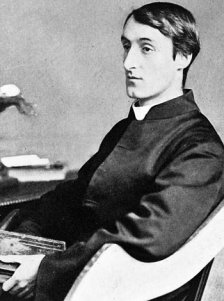
Then this year, singing in the choir at Great Badminton Church on the Sunday of my 31st Horse Trials weekend, I begin to see horses in a new light when the visiting preacher channels his inner Gerard Manley Hopkins and St Francis.

Now there’s great starting point for a fantasy dinner party guest list.

St Francis of Assissi (public domain image)

Gerard Manley Hopkins (public domain image)


He talks about seeing God in nature and, in particular, in the energy and vitality of the horse. When he puts it like that, whether or not the horse’s maker is God, I can’t help but appreciate the end product. Strolling back to my car, I’m admiring not the power of the stable hands’ electric bikes which had earlier caught my eye, but the perfect engineering of the horses in nearby fields.

Horse by Leonardo da Vinci via Wikimedia Commons - Public Domain
Leonardo da Vinci was also fascinated by horses and sketched them repeatedly (image here from Wikimedia Commons – Public Domain)

This sense of wonder soon spreads to other things, notably a carrier bag of organic vegetables given to me by my niece after inadvertently duplicating her family’s veg box order. Emptying the bag onto the kitchen table, I discover a high-fibre art gallery: a knobbly hand of ginger in a neat cotton string vest; the perfectly furled leaves of a white cabbage; the proud, straight seams on stalks of celery; and much more.

My father first drew my attention to the extraordinary patterns known as Fibonacci numbers that occur naturally in certain flowers, fruit and vegetables. Googling Fibonacci – or as close as I can get to the right spelling – I’m reminded that this mathematical term describes a sequence in which each number is the sum of the two previous numbers.

0, 1, 1, 2, 3, 5, 8, 13, 21, 34, …

When petals or seedheads develop in this pattern, they look stunning. Perhaps the most familiar example is the array of seeds at the centre of a sunflower, but the most exquisite is the Romanesco broccoli, its florets tiny miracles.

Photo by Ivar Leidus via Wikimedia Commons https://commons.wikimedia.org/wiki/User:Iifar

Although there’s no Romanesco broccoli in my gift bag, the contents are all beautiful in their own way. I consider signing up with the veg box supplier to relive this wonder every week. Then I reflect that in supermarkets I favour misshapen veg branded “wonky”, as if it were a virtue rather than failure to comply with their buyers’ stringent quality criteria. It’s like comparing a pedigree cat with a moggy. Which to choose?

As if on cue, Bertie, one of my three rescue cats, strolls by, chirruping a friendly greeting. With random black patches scattered over his long white fur, he’s more Jackson Pollock than Fibonacci, but I pick him up for a cuddle, telling him he’s beautiful too. I like to think Gerard Manley Hopkins and St Francis would have done the same. Besides, Bertie’s a lot easier to lift than a horse.

photo of kitten asleep on weighted blanket

This post was originally written for the June edition of the Tetbury Advertiser.

Posted in Events, Family, Personal life, Travel

On Track for the Holidays

A few years ago, my husband suggested we download an app* that keeps track of family and friends via their mobile phone signals.

He tends not to listen when I tell him where I’m going, and the most frequent message left on my mobile is from him, saying, “Debbie, where are you?”

He once called me on a Friday afternoon, concerned that our daughter was late home from school. My reply: “That’s because she’s here with me in the car, and we’re on our way to Cornwall for the weekend.” We had of course told him of our plans many times before we left.

While my husband was all in favour of the app, my daughter and I were not keen. It felt intrusive, like being microchipped or electronically tagged.

When the pandemic put paid to travel, we let the matter drop, but when we started to travel again this spring, and with my daughter planning some gap year adventures, we agreed to install the app for reassurance.

Our first chance to test it came in April, when my husband and daughter headed to the south of France for a week. As I’d made all the bookings, I felt personally responsible that everything should go smoothly, so I was glad to use the app to track their progress . With planes, trains and automobiles involved in their journey, there was ample opportunity for trouble – flight delays, cancellations and missed connections – even before we factored in my husband’s propensity to misplace his possessions.

Initially, following their progress on the app made me feel like a spy, but it soon became enjoyable and absorbing, although the intermittent phone signal made it slightly unreliable.

Often they appeared to be in two different places, even when I knew from speaking to them on the phone that they were in the same vehicle or hotel. Part way through their trip, I discovered that if I hit the right button, I could follow their progress at micro level.

When they were in Avignon, for example, I could trace their progress along the ancient bridge, although it didn’t tell me whether they did the famous dance immortalised in the song, “Sur le Pont d’Avignon”, as we did when we visited ten years ago. Fortunately, I remembered the ancient bridge no longer reaches the other side of the river, but stops mid-stream. Otherwise I might have been concerned that they’d dropped off the end and been swept away by the Rhône.

So thanks to the app, I was able to relax while they were away, and on their return, I knew exactly when to put the kettle on to make them a welcome-home cup of tea.

Admittedly, my husband returned minus his glasses (mislaid before they’d boarded the first plane), his jacket (lost, then found, then lost again), and his wallet.

All we need now is an app to keep track of his possessions.

This post first appeared in the Tetbury Advertiser‘s May 2022 edition. 

*The tracking app we used is called Life360.

Speaking of Holidays…

I’ve chosen as the topic of the next HULF Talk – a Hawkesbury Upton Literature Festival event – “Holiday Reads“. On Saturday 25th June, I’ll be chatting with three guest authors to help you find your next books to take on holiday – or to read at home this summer to travel by book. Between them, Carol Cooper, Kate Frost and Helena Halme have written engaging, easy-to-read novels set in holiday destinations all over the world,  from Scandinavia to Zanzibar, from Cornwall to the Mediterranean. For more information and to book your tickets, visit the HULF website at www.hulitfest.com.

graphic advertising HULF Talk

Posted in Personal life, Reading, Writing

The Meaning of Kindness

In the run-up to World Kindness Day (13th November), I fell to wondering exactly what the word “kindness” means – not in behavioural terms, but regarding its etymology.

The dictionary reveals that the noun “kindness” is related to kin, as in family (kith and kin) or race (mankind). As an adjective, it originally meant “with the feeling of relatives for each other” – all very well provided your family members had a high regard for each other. Not until the fourteenth century did “kindness” begin to be used more in the modern sense: “courtesy or noble deeds”, with “noble” indicating selflessness rather than a posh pedigree.

Fast forward to the twenty-first century, and scientists can prove that when we are kind to others, our brains release feel-good hormones such as dopamine, oxytocin and serotonin, bringing us physical and mental health benefits.

My grandma used to tell me “Virtue is its own reward”, but so, it seems, is kindness. Thus being kind to others is also an act of self-care – and a great way to make yourself feel better that is entirely free of calories and alcohol units.

The Random Acts of Kindness Foundation, created in 1995, promotes the idea of spontaneous generous gestures to strangers, such as leaving money behind the till of a coffee shop for the next homeless customer or letting someone go in front of you in a supermarket queue. Many such acts are done anonymously.

The phrase “anonymous benefactor” always makes me think of Magwitch in Charles Dickens’ Great Expectations, although most nameless donors will have only anonymity in common with Pip’s ex-convict associate.

Plot spoiler alert: Magwitch is Pip’s anonymous benefactor in Charles Dickens’ Great Expectations. Illustration by J Clayton Clarke (Kyd), public domain.


When making online donations I always hesitate before clicking the “show my name on the website” box in case it looks like virtue-signalling. I also wonder whether offering this option is just smart psychology on the part of fundraising sites. Do donors who make their name visible feel obliged to give more money than those who hide their identity? I’d love to know.

Now here’s an easy way to commit an act of kindness that will not only lift your spirits but include a reward in, er, kind: order a copy of Everyday Kindness, a new anthology of 55 short stories on the theme of kindness, each by a different author, one of whom is me. The anthology, launched on World Kindness Day, is the brainchild of its editor, bestselling novelist and philanthropist L J Ross. All the authors have donated their stories for free, and all profits will go to Shelter, the charity for the homeless and those in poor housing. The hardback and ebook may be ordered online via this link: linktr.ee/EverydayKindness, or you can order your copy from your favourite bookshop.

There, I feel better for that!

Click the image to order your copy now

This post was originally published in the November issue of the Tetbury Advertiser

Posted in Personal life, Travel

How Blue Was My Hilltop

In my Young By Name column for this month’s Tetbury Advertiser, I wrote about a sight I’d like to spot more often in the Cotswolds – although they are beautiful enough as they are!

Driving along a lane in the high fields near Newark Park, I spot a mirage-like splash of blue big enough to fill a field. Or is it mauve? Rippling in the late afternoon breeze, the flowering crop is changing colour as readily as the two-tone tonic suits favoured by Mods in the 1960s. Oil poured on water morphs from black to rainbow hues because the floating film is just a molecule thick, but when I park alongside the field, these plants are chest high.

close-up view of flax

I’m used to seeing cars stopping on the roadside in early summer to photograph swathes of pillar-box red poppies among the crops. A few years ago, a field just off the A46 was as densely carpeted with poppies as the famous scene in The Wizard of Oz. An instant tourist attraction, it triggered a proliferation of social media selfies.

poppy field viewed from a distance, a brilliant red stripe in a green landscape
The arresting view of Hawkesbury’s poppy field caused may motorists to divert from the A46 for a closer look

The mauve flowers – or are they blue? – in this field by Newark Park have a far subtler beauty. It is of course a field of flax, the first I’ve seen for a long time, and an increasingly rare sight in the Cotswolds. How I wish I could substitute flax for the ubiquitous rapeseed, whose vivid flowers look all wrong in our gentle landscape. They also make me sneeze like one possessed, a yellow morning mist floating above their fields like mustard gas. While I don’t expect farmers to choose crops for their good looks, I do wish flax could be more profitable.

view of field from by drystone wall

Flax, aka linseed, is certainly a useful and versatile crop.  Chez Young, we add linseeds to our breakfast cereal and salads for their health benefits. Linseeds are rich in fibre, protein, Vitamin B, minerals and Omega 3 fatty acids.

I wish the latter didn’t sound so unappetising: “Mmm, fatty acids,” said Homer Simpson, never.

Research indicates that linseeds improve digestive health and lower blood pressure, bad cholesterol and cancer risk. If that’s not enough to win your heart, linseed oil goes into paints, varnishes, animal feeds and cricket bats.

The stalk, with fibres three times stronger than cotton, is the source of linen. The Ancient Egyptians considered linen a symbol of purity and allowed only priests and mummies to wear it. Much as I love linen clothes, that’s not a sacrifice I’d be prepared to make. Flax fibres are also used in the manufacture of cigarette papers (boo!) and teabags (hurrah!)

So why don’t we grow more flax on the rolling hills of the Cotswolds? When I google its preferred growing conditions, I discover it’s not just a matter of money. Flax thrives on alluvial soil, ie rich in sediment deposited by running water on a floodplain. With an average elevation of over 100m in the Cotswolds, I’m guessing alluvial soil is not our long suit.

As the sky begins to darken ahead of a thunderstorm, I realise I must make the most of this rare scene, so I capture it on my smartphone before returning to my car – and, like a tourist on my home turf, to social media.

poppies in a Hawkesbury field
More poppies, spotted on my way home from Newark Park

array of seven books in series
Follow the changing seasons of the Cotswolds year from one summer to the next in this seven-book series

SERIES OF GENTLE MYSTERY NOVELS INSPIRED BY THE SEASONS IN THE COTSWOLDS

Watching the changing seasons in the Cotswolds is one of the inspirations for my Sophie Sayers Village Mysteries series, which follows the course of village life from one summer to the next through the eyes of newcomer Sophie Sayers.

Click here to find out more about this seven-book series.  

Order the first ebook in the series here. 

Order the paperbacks online here.

Or ask your favourite local bookshop to order from their usual stockist, quoting ISBN 978-1911223139.

All the books in the series are available in both paperback and ebook, and Best Murder in Show is also available as an audiobook (order direct from me via this link for a very special price), and production is about to start on the audiobook of Trick or Murder? 

Posted in Family, Personal life, Writing

Running to Stand Still

In my Young By Name column for the Tetbury Advertiser‘s June issue, I’m anticipating a return to almost-normal life – and being careful what I wish for. 

Inheriting my parents’ strong work ethic and optimism, I have developed a lifelong tendency to try to do more than is physically possible in the available time. Even so, people often remark that I’m prolific, usually in the same breath as asking me to do something for them on the old “ask a busy person” principle. (I really need to learn to say no.)

The upshot is that most of the time, like the Red Queen in Lewis Carroll’s Alice Through the Looking Glass, I feel as if I’m running to stand still. “It takes all the running you can do to keep in the same place,” the Red Queen tells Alice. “If you want to get somewhere else, you must run at least twice as fast as that.”

I occasionally write a ‘done’ list to prove to myself that I have been more productive than I think, but who has time to do that every day?

drawing of Alice and the Red Queen running by John Tenniel
(Image by John Tenniel for Lewis Carroll’s “Alice Through the Looking Glass” in public domain)

Jumping Off the Treadmill

Cover image of Secrets at St Bride's
I loved the pattern of the year working in a boarding school, alternating between busy term-time and long holidays – the inspiration for my series of school stories!

When in 9-5 jobs I stepped off the treadmill for holidays, I was conscious that my work would come to a standstill while others beavered away in my absence. My favourite time to take a break was therefore during the Christmas/New Year break, when almost everyone else went on leave too.

When I worked on a year-round contract in a school office, I rejoiced every time term ended, because in the absence of teachers and pupils, much as I loved them, I felt I had time to catch up with myself.

Stopping the World

To help me stay on top of all my tasks, I used to wish I could put the rest of the world on hold, in the manner of Sleeping Beauty’s fairy godmother making the kingdom sleep for 100 years. My only proviso was that I wouldn’t age a century by the time I woke everyone up again. What a shock that would be for my poor husband!

Covid-19 has put paid to that fantasy for good.

photo of the authors parents
My parents on their 65th wedding anniversary, when we took them to Bourton-on-the-Water

As we emerge, blinking, from the quasi-hibernation of lockdown, I’m hoping this past year is the closest I will ever get to casting that magic spell. As I predicted in the April 2020 issue of the Tetbury Advertiser, for me lockdown resulted in tidier bookshelves, larder, wardrobe, etc, and I’m pleased about that. But going forward, my priorities have changed.

Top of my to-do list post-lockdown will be hugging my parents.

That’s one action I’m happy to keep adding every day.