Posted in Family, Travel

When in Belgium, Drink as the Belgians Do (In Praise of Oxo)

(The next installment of our Easter trip to Luxembourg, via France and Belgium, with a quick dip into Germany too)

Laura on the Dinant Citadel steps
The funicular railway was due to open the following week. Of course.

Recovering from climbing up (and down) the 408 steps from the Belgian town of Dinant to the citadel that looms over this small riverside town, we head to a cafe to rehydrate.

Perusing the menu, my daughter plumps for Coca-Cola Light (that’s Belgian for Diet Coke).  I favour the fizzy mineral water Apollinaris, to echo the Roman theme of the engaging thriller I’m reading – Inceptio by Alison Morton.  My husband, not being female and therefore not just glowing from our recent ascent, homes in on a drink to replenish lost salts: an Oxo.

The Oxo Tower, Lonodn
The beautiful Oxo Tower (photo: Wikipedia)

Although this menu does have an international aura, I’m surprised to see Oxo listed. Rightly or wrongly, I associate it inextricably with my home country, having grown up just a few miles from the famous Oxo Tower in London.

OXO & ME

The Oxo Tower, now a fancy restaurant with panoramic views across London,  was a familiar landmark on the commuter railway from our suburban home in Sidcup to Charing Cross. At secondary school, tasked with painting a city skyline, I incorporated a meticulous rendition of the Oxo Tower. I was incredulous when my elderly art teacher, Miss Barbara Snook, objected. What was not to love about the Oxo Tower? Not only was the architecture Art Deco, but the lettering was pleasingly palindromic.

Miss Snook admitted that she loved the Oxo Tower; I suspected they’d shared their heyday. But then she memorably explained her reasoning:

“In any painting, try not to include words, because the eye is automatically drawn to the text to read it and is diverted from the rest of your picture.”

She was right. I’ve often recalled her advice in art galleries, distracted by labels, and wished I’d shown more respect for her wise words at the time. It was only after leaving school that I discovered that she was also a world authority on embroidery. Years later, as a belated tribute to her wisdom, I bought from a secondhand shop a book that she’d written about needlework; I treasure it still.

And again, decades later in a cafe in Belgium, I sit recalling her sagacity as we wait for the waiter to bring our unlikely assortment of drinks.

Old Oxo ad from the Oxo website
Originally endorsed for its health-giving properties by Florence Nightingale, apparently. Coincidentally, my Auntie Nellie’s full name was also Florence. (Image: http://www.oxo.co.uk)

I realise that the only other setting in which I’ve come across people drinking  Oxo as a beverage rather than adding it to a casserole or gravy is my grandmother’s house (in Sidcup again), where she and my Great Auntie Nellie favoured it as a fortifying mid-morning pick-me-up. This was the same Auntie Nellie who enjoyed salt-and-pepper sandwiches, so I’d assumed her Oxo habit to be a measure of frugality, acquired during war-time rationing, rather than a treat meriting this menu’s price of 2 Euros 30 cents.

AN OXO EXTRAVAGANZA

When our drinks finally arrive, my Apollinaris is pleasingly labelled “The Queen of Table Waters” . Despite its Romanesque name,  it is served in true Belgian style with a tiny dish of bar snacks. But if my drink is the Queen, my husband’s is surely King. Presented in a glass on its own silver platter, it is accompanied by a plastic-wrapped melba toast, a grinder of mixed spices and a bottle of Lea and Perrin’s Worcester Sauce. Getting as close as he ever does to cooking, my husband assembles all the components (they really should serve this drink in Ikea cafes). After the first  sip, he breathes out a big steamy sigh of contentment.

“Aah, this is nice!” he declares emphatically. “I ought to drink this more often.”

I’m about as likely to drink a mug of Oxo as a cup of Bisto, but being the dutiful wife that I am, I buy a box of it at the supermarket on the way back to our camper van. The irony is not lost on me that our next destination will be the picturesque riverside town of Bouillon. Better not mention the Oxo.

Posted in Travel

A Holiday From Books

Laura in her sleeping bag
Laura defies France’s arctic temperature in her new winter-weight sleeping bag

(Overture to a travelogue about our camper van tour of  Luxembourg)

Much as I love my book-centric life, there comes a time when you have to slip in a bookmark and walk away.

The night before I am due to go to Luxembourg for a fortnight, I’m up till 1 a.m. putting the finishing touches to an article about self-publishing. I’ve promised to email it to someone before I leave, and only when I’ve hit the send button do I allow myself to start packing for our trip.

Fortunately, there’s not much to pack, because we holiday in our camper van. This allows little space for luggage and imposes constraints stricter than a budget airline’s. Each of us – that is, my husband, my daughter and me – may bring just one “wanted on voyage” bag, containing whatever we need to amuse ourselves while we’re away. My husband’s contains his newspaper and his Open University books. My daughter’s is stuffed to bursting point with cuddly toys, her Nintendo DS, MP3 player, and story books. Mine is all notebooks, paperbacks, Kindle, ipod and a tangle of recharging cables to fit the van’s cigarette lighter.

After crossing the English Channel from Dover to Calais, we spend the first night in snowy St Omer in northern France, snuggled deep into our winter-weight sleeping bags. After my previous late night vigil, I should be sleeping like a kitten. Instead, I fall straight into the clutches of a nightmare.

My Bookish Nightmare

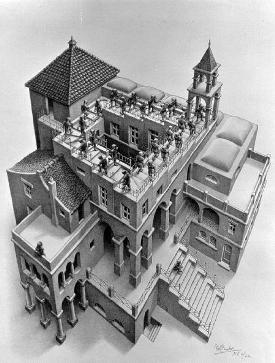
Escher's drawing of a never-ending staircase
Escher’s never-ending staircase (courtesy of Wikipedia)

In this nightmare, I’m rushing through endless rooms full of bookshelves. I’m searching for something, but I’m not sure what. Then I reach some stairs and start climbing, climbing, to ever-higher shelves. Finally a rickety metal ladder leads to a high platform protected only by a low, flimsy railing. (I should add here that I’m terrified of heights.) Only when I reach the top of the ladder does the danger of the situation strike me, and I start to retreat, unable to bring myself to set foot on such an insubstantial landing. As I step back, the whole of the bookcase on the platform topples towards me, threatening to rain down its contents onto my head.

Fortunately, all of this is happening in slow motion, giving me time to grab the sides of the ladder, but I’ve already lost my footing and my legs are dangling in mid-air. Realising I have, unexpectedly, the upper-body strength of Wonderwoman, I try to push the ladder away to  restore the bookshelf to its rightful place. Meanwhile I’m shouting to my husband for help, and suddenly he’s at my side asking me why I’m crying.

I wake up.

“Whatever’s the matter, darling?” he’s saying.

With an effort, I catch my breath.

“I – I – I – I think I need a holiday!” I sob.

Now there’s good timing!

Coming soon – some entertaining observations about our travels through France, Belgium and Luxembourg!

Posted in Travel

Dorothy Was Right: There’s No Place Like Home

Living as I do in an area that’s a tourist destination, I’m always curious when I go away on holiday to see whether I can find any other tourist spots that are equally homely. It’s rare to find another place that’s a match for our little corner of the Cotswolds.

Cropped screenshot of Judy Garland from the tr...
"But, Toto, how will I ever get home to the Cotswolds?" (Photo: Wikipedia)

I’m therefore taken aback to come across a small Scottish town that seems on first glance to meet my demanding criteria.

Late one afternoon, en route in our camper van from Perth to the coast of Fife, we encounter a small market town with a familiar air. Spotting brown tourist information signs to a nearby castle, we decide to stay the night and visit it in the morning. We find a place to park near the centre of town, and while my husband reads the paper and my daughter plays with her toys, I combine a recce with a run (I’m in training for the Bristol 10K).

I gently jog down the narrow high street, making a mental note of the facilities. There’s a craft bakers, an award-winning butchers, two charity shops with a high class of junk, and a useful old-fashioned hardware shop.There are signs to a library and a leisure centre and an edge-of-town supermarket. (Sound familiar, anyone?)

The calorific perils of a chippy, a Chinese and an Indian take-away are offset by a slimming club in the old market hall,which also hosts a cafe offering hearty soups, sandwiches and cakes. (Well, this is Scotland). I jog on to the end of town and I’m immediately amidst farmland, where fingerposts beckon me on to pleasant footpaths through sheep-strewn green fields.

Hmmm, this is home from home, I begin to think. I could get to like this place.

Mary, Queen of Scots
Mary, Queen of Scots, wishing she had Dorothy's ruby slippers (Photo: Wikipedia)

There’s even a local royal connection, albeit not one to ever make the pages of Hello magazine: Mary, Queen of Scots, was once a guest at the local castle and later a prisoner.

Turning left onto a footpath, I jog happily round the perimeter of the town and am rewarded with a glimpse of the castle, in the middle of a small loch. I pause to catch my breath by the ticket office and mentally book a family boat trip to it for tomorrow. Culture, a boat and a spooky-looking setting that would do Scooby-Doo proud – there’s something here to keep all the family happy.

When I head back into town, the charity shops are opposite me, and I notice for the first time that they are in aid of a Scottish children’s hospice. A little further down the road, in the direction of the other end of town, is a sign to that very hospice. A few yards further I pass the high school. It is closed down and boarded up, peppered with danger signs. I’m sure there’s no connection between the closure of the (dangerous) school and the presence of a children’s hospice, but it still makes me shudder with horror. I’m so sad for the children affected by either building.

I run on, hoping to find something cheery to negate the effect of these discoveries. A little ahead of me is a large building, by far the most grand and imposing on the high street. I run a little faster, spirits rising. Level with the gated entrance, I read the sign. It is a funeral directors.  Now feeling thoroughly chilled, I turn on the heel of my trainers and plod back to the van, to find my family waiting. I couldn’t live here, not amidst all this sadness. After all, there is no place like home.

(This post was originally written for the Tetbury Advertiser, May 2012 issue.)

If you enjoyed this post, you might also like this one about the lure of home: East, West, Our Village Show’s Best or this one about another country dear to Mary, Queen of Scots’ heart:   Lost In France.

Posted in Family

Another term, another topic, another school trip…

Sidcup station platform signage, in Southeaste...
The starting point for all my childhool journeys (Photo: Wikipedia)

These days, it seems a term does not go by without the children being taken on a school trip. This policy is especially valuable in these rural parts, where our children do not have as much opportunity to travel as their city-dwelling peers.  I’m quietly envious every time Laura comes home clutching a permission slip for the current term’s trip. I was raised in suburbia and by the age of 12 I was regularly taking the 30 minute train ride into London to visit museums and parks at weekends. Not only did I travel without an adult, I also used to take my much younger cousins – unthinkable these days for reasons you don’t need me to go into here. But we had very few school trips, and none at all in primary school.

Laura’s school outings are always carefully planned to enhance the term’s topic, and the destination is not always obvious. I wondered where on earth would they go to study the Second World War. It emerged that for visiting schools, the Steam Museum at Swindon will recreate an “evacuee experience”. I had a lump in my throat as I packed her off to school that day. She had to wear a 1930s frock and take a teddy, wear a gas mask box over her shoulder and have a luggage label bearing her name pinned to her cardigan. However did my grandparents cope with those farewells? (I’m thankful that they did: it was my father’s evacuation to the Cotswolds and his consequent love affair with the area that made me realise at a very young age that I wanted to live here too.)

Demonstration of Roman army shield formations
Taking health and safety precautions a little too far on the Roman topic school trip

I thought I’d guessed the destination for Laura’s “Ruthless Romans” topic trip. Surely it had to be either Cirencester, Chedworth Roman Villa or the Roman Baths at Bath? But no, they headed off to foreign parts – across the border into Wales for a fabulous day at Caerleon Roman Remains. The photos of the children dressed as legionnaires made it look as though they’d travelled back in time. It was a trip they will remember for the rest of their lives.

Where, then, would they go for this term’s topic? It’s “The Awesome Outdoors”, and not, as one child first reported, “Automatic Doors”. (Her mother thought this unusual theme would lead to some interesting science and technology lessons. It was several days before she realised her daughter’s mistake.)

I love the alliterative titles teachers give to their topics. It’s great psychology for generating excitement. I wondered where would their “awesome” destination be. I thought about my own travels when I was Laura’s age. I was lucky enough to spend my ninth year in the USA, where my father was working. We saw Yellowstone Park’s geysers, the Badlands, the Grand Canyon, the Great Lakes – all pretty awesome to a child who till then had thought Sidcup was the centre of the world.

Laura produced the note from her bookbag with a flourish.

Spring blossom at Westonbirt Arboretum
Westonbirt Arboretum - just 5 miles away

“We’re going to Westonbirt Arboretum!” she cried excitedly. A pause.“Where’s that again?”

Of course! Where else? The environment on our doorstep is hard to beat in terms of awesomeness. The Arboretum’s education department is second to none, so I know her class will have a fabulous, memorable time and come back filled with wonder.

To children, any trip is far from school if it requires a coach to get them there – and there should just about be time for a sing-song on the way. There’ll be plenty of opportunities for globe-trotting when she grows up.

(This post was originally written for the Tetbury Advertiser, April 2012)

If you enjoyed this post, you might like to read about another of Laura’s outings in The Ring of Truth

Posted in Travel

The Collective Noun for Camping Cars

Is it a campervan?  Is it a motorhome?  Mais non!  Take it across the Channel to France and  it turns into un camping car.  One of our reasons for choosing to holiday in France this year was that country’s enlightened approach to these Wendy houses on wheels.

Travelling in continental Europe, un camping car offers much greater possibilities than in Britain.  In this borderless European age, you can drive as long as you like, crossing country after country without interruption.  Every time we land in Calais, I feel the urge to put my foot down and head east, not stopping till we find ourselves in Istanbul, our springboard into Asia.  Not that I really want to go to Asia, but it’s nice to know that it would be so easy to get there if I change my mind.

Not surprisingly, on continental Europe there is a much higher ownership of camping cars and plenty of them about.  Early on in the trip, I wonder whether there is a collective noun for camping cars.

Undoubtedly more for their own benefit than for foreign tourists, the French provide free motorhome facilities everywhere we go.  Not only is there ample free parking, with overnight stays permitted for at least 48 hours, but also that holy trinity so important to the camping car driver: fresh water to fill your tank, one drain in which to discreetly empty your toilet and another to void your washing up water. Most towns also have a car park with extra large spaces thoughtfully reserved for camping cars.

In a month’s tour of France, we only twice stay in fee-paying campsites, and then only for the social benefits: we hope to find small children for our daughter to befriend. At the first of these, Laura spends a very happy evening playing with a French brother and sister, Milly and Maurice.  A couple of weeks later, visiting the Vulcania theme park in the Auvergne, she names her new cuddly toy mastodon Maurice in the boy’s honour.

Unexpectedly, her most sociable evening occurs at a free camping car area at Avignon’s park-and-ride facility.  It is teeming with Italians, three of whom, aged 9-11, spend several hours colouring on the floor of our van while Laura cavorts outside with her new French friend, Sybillia.  We are the only family, it seems, to have had the foresight to bring children’s toys with us.  Laura’s scooter, ball, skipping rope, bubbles and mini-golf set ensure she is a popular playmate wherever we stop. When we kick out the Italian mob at bedtime, they present us with their autographs and persuade me to let them take some pens and paper home to continue drawing.

Free car parks (and, more importantly for camping car drivers, free car parks without height restrictions) abound in France. reminding us daily of its size.  Such a vast country can afford to be generous with parking spaces and we are spoiled for choice.

But even with so much space to choose from, camping cars still tend to flock.  On several nights, we park in vast empty car parks only to find that by breakfast time several other camping cars have parked right next to us by breakfast time.

We also obey the swarming instinct ourselves on occasions, when we are not confident that overnight stopping is permitted.  There’s safety in numbers, especially if most of them are French. They know the rules.  We come close to suggesting that we range our vans in a circle, like wagons in the Wild West.

But the superlative swarmers are the Italians.  Not only here in France, but in Scotland, too, we frequently spot Italian convoys, presumably taking the whole extended family on holiday. It must be exhausting,

In England, because our van is relatively old, I always worry that we’ll be mistaken for travellers and treated with suspicion or disdain. Given the ease with which we’re able to park around France,  and the glorious climate we enjoy this summer, I wonder why all travellers living in England don’t rustle up the ferry fare and get themselves down here.  I can’t see any reason not to.  Surely there’s a good French market for clothes pegs?

A little north of Paris, we discover that some have already done so.  On a a trek to the local hypermarket, we spot a vast array of caravans and camping cars ranged across a tatty field beside an industrial estate.  We’re camped in a much more scenic spot a mile or two away, with the blessing of the local tourist office, by an ancient city wall shaded by cooling poplars.

“Why on earth are those tourists camping there?” I wonder aloud, before spotting the tell-tale lines of washing, the shabby children’s toys and randomly parked rusting pick-up trucks. These are no tourists.

All is quiet at the hypermarket, where the customers are in single figures.  Yet there are almost as many security guards.  Large rocks edge the grass verges around the car park, preventing the ingress of unwanted caravans.  The adjustable height barrier at the entrance is raised to admit us, but will no doubt be dropped at the sight of a gypsy convoy.

So I decide that there must be two collective nouns for a group of camping cars.  The flock refers to harmless tourists like ourselves, forging transnational friendships and haemorrhaging money into the local economy wherever we go.  The swarm is exactly the opposite: travellers keeping themselves to themselves but taking what they can get wherever they can get it.  We are so close and yet so far apart.