Posted in Personal life, Travel

On A Mission To Post A Parcel

Village post office in Hawkesbury Upton, Gloucestershire
Hawkesbury Sweet Hawkesbury Post Office (photo: Wikipedia)

Ash Wednesday finds me on the high street of a town that’s new to me,  searching for a Post Office in which I can post an important parcel.

I’m up against the clock, because I’ve left my husband and daughter parked in a restricted zone where the parking ticket for our camper van, in which we’ve come away for half term, is about to run out. I march purposefully through the pedestrian precinct, scanning the shop fronts on either side of me for the familiar red oval logo.

After a few minutes of fruitless searching, I’ve passed endless charity shops and poundstores, two pawnbrokers, a halal butcher and a surprising number of greengrocers displaying neat, open baskets of exotic fruit and vegetables, the kind that characterise Asian and Caribbean cookery. I’ve given a wide berth to ‘Jackpots’, a tacky arcade of slot machines offering prizes of up to £500, according to big signs in the window. Just 90 minutes’ drive from Tetbury, we might as well be in a different country. No cosy tearooms, antique shops or bookstores are to be seen. There’ll be no rich pickings in this high street’s charity shops.

A Lost Soul

With a glance at my watch, I give up trying to find the Post Office on my own. I am not my husband: I will ask someone for directions. But spotting a helpful looking person is no easier.

Everyone I encounter is pale, downcast, jaded and sad. Their clothes are cheap, dark and drab, with one exception – a podgy fellow in his twenties sports a black hoodie to the front of which are stitched brightly coloured, giant metallic dollar signs. From the rest of his ensemble, I infer that these indicate his aspirations rather than his bank balance. If I accost any of these passers-by, they look as if they might burst into tears.

Then at last, like buses, two friendly faces crop up at once. There on a street corner are two smartly dressed young men, standing quietly looking about them as if at a loose end. They are quick to make eye contact with me and flash me a smile. Emboldened, I approach them.

“Excuse me, can you please point me in the direction of the nearest Post Office?” I plead.

Their smiles broaden.

“No problem,” says one, “it’s right there.

Modern British Post Office logo
It must be a sign!

He points to the other side of the street. The Post Office, based within a shabby convenience store, is exactly opposite where I am standing. I’ve been too preoccupied with people-watching to spot it. About to mumble an embarrassed apology for my stupidity, I cast my eyes downward. They alight on the young men’s lapels, where I spot badges identifying them as members of a church known for sending young missionaries out into foreign parts. I do not envy them their task in this dismal town. It’s my turn to flash a smile.

“Thank you so much!” I beam. “You’ve been very helpful.”

I think they will need all the encouragement they can get if they are to make it through their duties today. If I can’t summon up the resolve to ask the locals for directions, how hard must it be to talk to them about saving their souls?

Mission Accomplished

But as I join the queue in the Post Office, I castigate myself for my arrogance. Though armed only with smart suits and old-fashioned haircuts, these pleasant young men are bolstered by a much greater force than my smile: their unshakeable belief in their god. Though I don’t share their faith, I hugely admire what they are doing. I am suddenly moved to pay tribute, and so, my own mission accomplished, as I march back to the car where my husband will be impatiently drumming the steering wheel, I determine to show some resolution of my own: I decide to give up alcohol for Lent.

Mysterious ways…

Can’t see the wood for the trees… (image: Wikipedia)

This article was originally written for the Tetbury Advertiser, March 2013.

If you liked this article, you might like these others about post offices:

The Power of the Postage Stamp – about my daughter’s new hobby

Who Will Buy? – a memoir about the change in our village shops and services

Posted in Travel

Do Traffic Signs Drive You To Distraction?

Old-fashioned road sign from Highland Folk Museum, Newtonmore
Road signs from the early days of motoring had so much more charm

The 380-mile drive home in our camper van from Stirling, Scotland, does nothing  to diminish my aversion to electronic motorway message boards. These huge signs have popped up alongside many British motorways lately. They must be costing the Ministry of Transport a fortune, as well as causing chaos through necessary lane closures and traffic disruption.

You know the sort I mean: ominous big black boards displaying a grid of light bulbs, selectively  illuminated to spell out the message of the moment. They’re sinister, unattractive and dull, a far cry from the carefully designed road signs from the early days of motoring. Those had a real charm about them; it must have been a pleasure to observe them and obey. Their messages were much more considered too. They had to be, given the long hours required to construct a sturdy metal sign.

Old fashioned road sign frequently seen in the Scottish Highlands
For ships in the night

I suppose I should be grateful that modern technology makes it possible for today’s driver to receive up-to-the-minute motoring news. But I seldom see any useful messages on these boards. The first one we pass today is a case in point: “Please drive safely.” Oh, and there was I planning to slalom all the way to Gretna with my eyes closed!

And, Ministry of Transport, please note: it doesn’t calm any driver’s road rage to be told “Queues Ahead” when you’re already stuck in the middle of one.

But as the nation has invested in these message boards, I suppose we must make the best of them. To this end, I’d like to suggest some more  constructive uses:

  • To convey calming, philosophical thoughts at times of peak traffic, such as rush hour: “This too will pass” or   “There’s a cup of tea/glass of wine/cold beer at home with your name on it”
  • To lift the weary driver’s spirits and take their mind off the traffic: “You’re looking well today”; “You look so much younger than your years”; “That colour really suits you”
  • To divert restless young passengers with travel game ideas: “Let’s play I-Spy!”, “I went to the market and I bought…”, “Who will spot the first yellow car?”; “And now it’s time for a keeping quiet competition!”
  • To answer the children’s repetitive question: “No, we are NOT nearly there yet!”
  • For a more subtle approach, a series of messages on that theme: “We’re nearer than we were the last time you asked” or “Not much further now” or “For every time you ask, it will add five minutes to the journey”

Alternatively, the boards could try to replicate pleasing road signs from the golden age of motoring – or those from other countries that have made you smile. (Any suggestions, anyone?) To end on a more cheerful note, here’s one that we spotted last week in Applecross, in the north west of Scotland. Forewarned is forearmed, as they say.

Road sign seen in Applecross, Scotland, cautioning "Men In Kilts Walking"
You have been warned…

And if that rant wasn’t enough for you, here’s my post from last summer on the same theme:

Rage Against The Road Signs

Or on a lighter note, a mystery solved about French lay-bys:

A Layby By Any Other Name

Posted in Family, Travel

A Day At The Beach On The Isle Of Skye

On the beach at Glenbrittle, Skye
The ambitious new sand palace begins to take shape

I’m concentrating on turning out the perfect sandcastle from Laura’s small pink bucket when I feel a sudden, unaccountable cold sensation at the back of my skirt.

Only when I realise that it’s also a very wet sensation do I swivel round to check the advancing line of the tide. In best pantomime tradition, it’s behind me. It’s taken me by complete surprise, as if playing an oceanic version of Grandmother’s Footsteps.

Building a river as the tide comes in at Glenbrittle beach, Skye
Building a river

Our planned sand palace for Laura’s toy dog, Candyfloss, is fast segueing into a water park. But are we downhearted? No, we are turncoats. We immediately set to work making a river, digging a trench from the water’s edge to the rocks a few yards further up beach. We are the antidote to King Canute.

“Come on, sea!” Laura coaxes. “You can do it!”

On this broad, shallow beach on Skye, we’re on to a winner. Our labours are soon rewarded. Laura is disproportionately joyful; I do not reveal how startled I am by how quickly the tide has encroached.

It is a sobering reminder of man’s powerlessness against the forces of nature. Against the almost primeval setting of the vast, bleak landscapes of the Cuillin hills, it’s not hard to feel small and insignificant – but it’s also exhilarating.

Laura beachcombing at Glenbrittle,Skye
“Anyone seen Sponge Bob about?”

What’s more, it’s a useful educational experience for Laura. I’m hoping an hour or two on the beach will counteract the hours misspent watching her favourite television programme, Sponge Bob Square Pants, set at the bottom of the ocean and defying all laws of nature. In Bikini Bottom, life carries on much as on dry land – only sillier. Repeated exposure colours your perception of reality.

Even I find myself pleased to spot a starfish (as in Sponge Bob’s best friend, Patrick Star) when we take a glass-bottomed boat ride a couple of days before. On the kelp beds beneath the Skye Bridge, there  are numerous sea urchins – beautiful, fragile, spiny domes in ethereal shades of mauve, pink and flesh. “So why are there no sea urchins in Sponge Bob?” I wonder, before I can stop myself.

Paddling in the warm shallows at Glenbrittle, I scoop up a tiny crab in one of Laura’s plastic spades. What’s the first thing I think of? Mr Crabs, the miserly fast-food entrepreneur who is Sponge Bob’s employer. I really need to get out more.

Finally, Queen Anticanute’s work is done.

Laura's river is a success
We did it!

“I’ve made a rock pool!” she rejoices, waving her spade.

Promptly abandoning her post to let the tide demolish her sandcastles, she skips off to romp through the shallows with the energy and enthusiasm of a puppy, kicking and jumping about until she’s dappled with saltwater splashes.

Picking up her abandoned turquoise fleece to save it from the encroaching tide, I take shadowy snapshots against the westerly sun, vicariously enjoying her childlike pleasure in the sea.

Little girl in a big sea at Glenbrittle, Skye
Little girl in a big sea

She’s not really dressed for a dip, but in budding rock-chick style is wearing scarlet pedal-pushers beneath her new black “Stonehenge Rocks!” t-shirt. Her thick dark blonde hair has been dragged into a plait down her back to guard against the tangling effect of today’s strong winds, currently buffeting her daddy along the top of the Cuillin hills behind us. I wonder how long it will be before she’s a rock-chick in earnest, jaunting off to Glastonbury with her boyfriend. But for now I capture these moments in my camera in hope of freezing the passage of time.

Out of the corner of my eye, I espy four young German boys clambering over the black rocks that line the bay. I hope they have an eye on the tide and will not be cut off from a safe return.

Time and tide, my friends, time and tide.

Looking out to sea at Glenbrittle beach, Skye

Posted in Travel

All Aboard for A Trip Back In Time

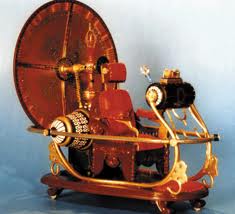
H G Wells' Time Machine“Can we travel back in time, Mummy?” asks my daughter Laura (9) as we set off for the next tourist attraction on our agenda.

We’re part way through a two-week visit from the 16 year old daughter of my old schoolfriend, an American who I met at school in Germany (yes, it’s complicated) . It’s her first trip to England and we’re trying to give her an accurate snapshot of British life and culture.

So far this has included:

– a very large quantity of rain

– seeing a live recording of “With Great Pleasure”, a BBC Radio 4 programme with the wonderful but anarchic performance poet John Hegley (what other Radio 4 programme would conclude with inviting the audience up on stage to dance to Kirsty MacColl’s “A New England”? Spot on for my agenda, Mr Hegley, so thanks for that!)

– the usual suspects for this neck of the woods: Stonehenge, Castle Combe, Tintern Abbey, the Roman Baths, etc etc

Launch of the SS Great Britain, the revolution...

Today’s destination is the SS Great Britain, lovingly and expensively restored to replicate mint condition. Brunel’s groundbreaking ship is now in dry dock in Bristol’s Floating Harbour, the very dock from which it was launched in 1843. It was rescued from the Falklands in 1970, where it was languishing after a long and varied career and refusing to sink, and returned to base. Movingly, its homeward journey included passing for the first time ever beneath one of Brunel’s many other masterpieces, the Clifton Suspension Bridge – something it had never done before, as the bridge was not complete when the SS Great Britain first (and last) sailed out of Bristol.

English: Clifton Suspension Bridge. Looking so...

As we enter the museum shed – the overture to boarding the ship itself – I spot a sign that echoes Laura’s request. “Travel Back In Time!” it invites us. Cleverly, the museum is arranged in reverse chronological order, so that we first see evidence of the ship’s return to Bristol, then pass back through its previous incarnations during the Second World War, on the Australian Gold Rush run, and on trips around Cape Horn to the Pacific coast of America.

Laura in Victorian dressBy the time we’ve passed down to the far end of the museum, we’re thinking like Victorians. We willingly don the dressing-up clothes provided to complete our transformation before we board. We pose before a backdrop that suggests we’ve just alighted in Australia. I almost believe that we’re about to visit my  Auntie Mary who lives there. Finally, we board the ship, to listen to an audio guide that uses as its script diaries and letters from real-life passengers.    We truly have travelled back in time and now see the ship and the prospect of ocean-going voyages through accurate contemporary records.

Isambard Kingdom Brunel

Can we travel back in time, Laura? Yes, I think we can and we just did.  I take my (stovepipe) hat off not only to the engineering genius that was Isambard Kingdom Brunel, but also to the very clever historians and archivists who made time travel possible for us.

Now, where did I put my crinoline?

If you enjoyed this post, you might also like another one that pays tribute to a Victorian Scottish engineer: Signally Challenged in Scotland

Posted in Travel

Foreign Holidays: Who Needs Them?

Looking up Water Street from the Brook - Castl...
Castle Combe (Photo credit: Wikipedia)

Preparing for a two-week stay by an American teenager on her first trip to England, our list of “must-sees” soon fill a page. When we try to slot them in to the available fortnight’s calendar, we find there are simply not enough days.

Most of the destinations on our roster are less than an hour’s drive from home (and I don’t drive very fast). The Roman Baths, the Cotswold Way, Berkeley Castle, Slimbridge, Castle Combe, Bristol Zoo… we are spoiled for choice. Foreign vacations: who needs them, when we have such a wealth of tourist attractions on our doorstep?

English: Nonsuch Palace by Flemish School
Nonsuch Palace, Cheam

Here is further confirmation (not that I need it) that I’ve chosen to live in an idyllic part of England. But when I think about it, I could say much the same about the other places I’ve lived.

Even in the duller bits of suburban London, (Sutton and Cheam, anyone?) unexciting in themselves, have been a stone’s throw from astonishing places of historic and cultural richness – and I don’t just mean the obvious suspects in central London. Tucked away in Cheam, for example, was the site of the former Nonsuch Palace, Henry VIII’s grandest project –  enough to set any historical novelist’s imagination on fire and a far cry from the suburb’s more famous resident, Tony Hancock of 23 Railway Cuttings, East Cheam. Similarly my home town of Sidcup, in south east London, has a wealth of historical associations including the nearby Eltham Palace, now owned (and treasured by) English Heritage. This was the childhood home of Henry VIII (he got about a bit, you know).

English: Frontage of Heslington Hall, York, th...
Heslington Hall, the administrative centre of the University of York (Photo credit: Wikipedia)

My three years at university in York were like living in a museum, though the campus itself, a couple of miles beyond the medieval walled city, has dubious architectural value, other than in the Elizabethan manor house, Heslington Hall, reserved for admin staff rather than lowly students.  (Think of the film set of  “A Clockwork Orange” and you’ll be along the right lines.)

Walter Rothschild and zebra-drawn carriage
Walter Rothschild and zebra-drawn carriage – not yet stuffed (Photo credit: Wikipedia)

Post-university, I discovered that Tring, though not renowned as a tourist attraction, had a great deal to offer the discerning visitor. Not least was the wonderful Rothschilds’ Natural History Museum, which I discovered a couple of hundred yards from my front door at 10 Frogmore Street. Its bizarre legions of stuffed zebras on shelves, once seen, justify a special trip to this small Hertfordshire town. For years, my husband or I had only to say “zebras on shelves” to each other and we’d be transported back, smiling, to many a pleasant afternoon. When, after a few years, we announced to my young nephews, frequent visitors to our home in Tring, that we were moving to Gloucestershire, their response was an anguished cry of “But when will we get to go to Tring?”

I admit that I’ve lived largely in middle-class, middle-England rather than in any gritty industrial regions, but even so, I think tourism is a state of mind rather than a consequence of postcode. There can’t be many people living in Britain who couldn’t reach somewhere spectacular and interesting within a 30 minute drive/bus ride/walk.

Cotswold Way in the setting sun...

But actually, even without that much effort, I think I could have a pretty good summer holiday just in my back garden, especially if we had the luxury of a bit of sunshine. A week ago, my daughter and I spent a lovely afternoon out there, giving our tiny pond a belated spring clean, playing badminton (very badly), and having our own mini-Olympics. We picked some raspberries. We built a bug hotel (a great way to clear the garden of sticks and stones and broken bamboo canes: another fine example of  Janet’s theory of how to get something done by doing something else). As we went  indoors for tea, I found myself looking forward to our summer holidays, not to planned trips to the Zoo or Slimbridge or National Trust stately homes, but simply to spending more time in our back garden. There’s a whole world of adventure to be found out there. All you need is the right route map.

Still prefer foreign destinations? Then you might like to read a bit about my trip to France last year! (Hypocrite? Moi?!)

Lost In France

Or Scotland:

Dorothy Was Right – There’s No Place Like Home