
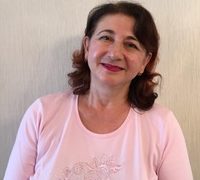
On the last Wednesday of every month, I share a conversation with an author friend, and this month I’m delighted to introduce you to novelist Hastie Salih.
I first met Hastie Salih last year at the London Festival of Writing, which is Jericho Writers‘ annual get-together, bringing together a huge variety of authors at different stages of their careers in a highly creative and supportive atmosphere. I’m involved as a speaker and advisor because I’m a mentor and course tutor for Jericho Writers – roles I adore, partly because I love helping other authors and partly because it introduces me to so many new author friends, such as Hastie Salih.
When Hastie told me about her books, set partly in London and partly in Iraq, featuring women of Kurdistani heritage like herself, and addressing complex issues of cultural and gender identity, I was intrigued. The stunning cover of her debut novel, Dahlia and Carys, was a bonus, and I immediately ordered a copy, followed by her second novel, The Cradle and the Cage, as soon as it was published. I also knew that I wanted to invite her onto my blog to tell us more about her work, exploring important, under-represented issues.
To set the context for our conversation, here are the descriptions of each book.
Dahlia and Carys by Hastie Salih
Dahlia and Carys’ tells the intriguing story of forbidden love and a woman’s heart-breaking struggle to reconcile her fragmented cultural and gender identities despite family schisms. Dahlia finds herself plagued with flashbacks of not intervening in her schoolfriend Yasmine’s kidnapping by ISIS in Iraq. Back in London, her brother Elias is showing perilous signs of affiliation with terrorists. All the while, Dahlia is slowly opening up to a captivating new presence in London: Carys. She begins to find solace in their relationship of love and trust. Yet Dahlia feels that she cannot truly move on with her life until she returns to Iraq, the place wrought with guilt. Will Carys join her on this dangerous journey to find Yasmine?

The Cradle and the Cage by Hastie Salih
Yasmine has spent her life piecing together fragmented stories of her homeland, Kurdistan—half-truths and evasions from her mother, the only remaining link to a past shrouded in silence.
Her father died long ago in a car accident, or so she was told. But the gaps in her family’s history have always felt deliberate, like a puzzle with missing pieces. Determined to uncover the truth, she embarks on her first journey to Kurdistan.
What awaits her is far from the homecoming she imagined. An embittered uncle shatters the narrative she grew up with. As Yasmine struggles to navigate the weight of her discoveries, she finds an unexpected bond with Tara, an Iranian-Kurdish sex worker whose life hangs in a fragile balance. In a land where past and present collide, Yasmine is forced to confront not just her own identity, but the harsh realities faced by those who have been silenced for too long.
The Cradle and the Cage is a haunting and powerful exploration of heritage, identity, and the meaning of family—set against the backdrop of a region where history is both an inheritance and a battleground.

Now, onto our conversation!
Debbie: Hello and welcome, Hastie, I’m so pleased to welcome you to my blog. Your own cultural background is clearly very relevant to both books, as you are of Kurdish descent, although born in Slovakia rather than Kurdestan. Can you please tell us a little more about your own heritage and how it has shaped your view of the settings in your books – both London and Iraq.
Hastie: I was born in Bratislava, Slovakia after my parents escaped Iraq and the totalitarian Baath Regime. I then spent my childhood in Wales and Germany, moving to Britain in 1999 where my daughter was born. My mother is half Armenian. As you can imagine, I have therefore been exposed to diverse cultures and contradicting social norms from a young age. My heritage has been handed down by my mother who was a great verbal storyteller. I spent some holidays in Iraq and last visited the Kurdish region in 2023 which motivated me to write the novel The Cradle and The Cage. The title reveals that Iraq, or olden day Mesopotamia, is the setting for the Cradle of civilisation but can also portray a restrictive cage.
Debbie: To what extent are your protagonists’ journeys to Iraq journeys of self-discovery for yourself? Have you ever taken the same physical journey that they take in your books?
Hastie: My protagonists’ journeys to Iraq are fictional journeys of discovery and self-discovery as I imagined them to be for a young woman, maybe a daughter, visiting her mother’s homeland, Iraq for the first time to help find her identity and place in the world. This is more prominent in the novel The Cradle and the Cage.
My first novel Dahlia and Carys tells the story of forbidden love in London and a woman’s heart-breaking struggle to reconcile her fragmented cultural and gender identities despite family schisms. The story also takes place in Sinjar, a Kurdish Yazidi area where ISIS committed their brutalities towards Yazidi women and men simply because they belonged to a different religion. In 2014, I was working as a GP in London, far removed from the events unfolding in Iraq. Nonetheless, the massacres shocked me.

Debbie: Your powerful books cover topics neglected by mainstream publishing – both in terms of oppressed ethnic minorities and in terms of same-sex relationships. Given a platform like this, what can fiction authors do about the social injustices and perils of modern-day Iraq that news reporting cannot?
Hastie: In my opinion, we have come far as a society, accepting cross cultural or same-sex love but there is still much to be done to provoke self-awareness, understanding and empathy. I think that there has been a surge in interest by publishing houses for underrepresented and non-conformist stories.
Fiction authors can build bridges using storytelling to evoke compassion and empathy by enabling readers to witness social challenges or injustices, and in my novels, perils of modern-day Iraq.
While news reporting informs us, fiction invites us inside another person’s life allowing us to feel the weight of their choices, fears and hopes. That imaginative act of stepping into someone else’s mind is where empathy begins.
Debbie: Another theme you address is family ties, identity and loyalty when political differences and ideologies pull them in different directions. How do your characters prioritise between political and family loyalties? When does it become an impossible choice?
Hastie: My characters often place their convictions and deeply held emotions above both political allegiance and family loyalty. The choice becomes impossible when those forces collide: when remaining loyal to family feels like betraying one’s beliefs, and holding onto those beliefs means losing the people closest to you.
Debbie: Your books are set in both London and Kurdestan, and as a reader, I naively expected London to be the place of safety – but you also address the potential radicalisation by ISIS of young Kurds living in London. To what extent are your themes of universal rather than regional significance?
Hastie: Sadly, radicalisation can happen anywhere including cities like London, which many people assume to be places of safety. In that sense, the themes I explore are universal rather than confined to a particular region. Issues such as people smuggling and the vulnerability of displaced or marginalised communities are global challenges. At the same time, the pressures of family, faith and societal expectations are not unique to my heritage; they exist across cultures worldwide, which I hope allows readers from many backgrounds to recognise something of their own experiences in the story.

Debbie: The Middle East, more so than Western Europe, seems to have been a place of constant migration for the sake of safety, (I’ve just been reading another book about the plight of Jewish Syrians trying to find a safe haven, who fled first to Iraq but ultimately had to flee there too, and to further countries after that.) Can any migrant ever truly feel settled in a new country, or will it always be necessary to explore and understand one’s heritage before making peace with one’s new home?
Hastie: The Middle East has experienced waves of migration partly because borders were drawn by outside powers, most notably in the 1916 Sykes—Picot Agreement between Britain and France, with little regard for the complex mix of religions, ethnicities and identities already present in the region. The consequences of those decisions are still felt today.
For migrants, feeling settled in a new country can therefore be complicated. Integration through education, community spaces and social connection play an important role in helping people feel at home.
At the same time, exploring one’s heritage can also be meaningful – but identity is rarely singular.
Most of us carry multiple, layered identities, and learning to reconcile those layers may ultimately be what allows someone to feel at peace in a new place.

Debbie: Having endured the startling upheavals and perils, your protagonists reach peaceful and life-affirming endings. How achievable are these outcomes for people like them in real life?
Hastie: My protagonists endure profound and often dangerous upheavals. They are caught not only in cultural clashes and family rifts, but also in the powerful forces of desire and passion that shape human decisions. In my novels, they reach peaceful and life-affirming outcomes when they encounter compassion and care from others.
In real life, such outcomes are not always easy to achieve, but they are possible when people’s traumas and vulnerabilities are recognised rather than ignored.
In many ways it is similar to safeguarding vulnerable children: when they are given stability, care and supportive relationships, they are far more likely to flourish.
Debbie: How has your professional training and 30-year career as a GP shaped your fiction writing?
Hastie: I have been fortunate to work as a GP for more than thirty years, which has allowed me to witness many deeply personal and confidential stories. In many ways, doctors and writers share a common quality: empathy.
My experience as a GP has given me an intimate glimpse into the complexities of human behaviour, and this invariably shapes my fiction.
I tend to write about the flaws and setbacks of my protagonists with sympathy and understanding, much as a doctor hopes to approach their patients.
Debbie: These are two wonderful books that I couldn’t put down, and I felt my world-view and understanding of international affairs was enhanced by reading them – as well as being totally absorbed by the characters as individuals. Are you planning to write more books like these? What are you writing now?
Hastie: Thank you for your kind words. I’m currently writing the first draft of my third novel and hope to complete it by the end of April, when I start a creative writing course in City Lit, London. As you might expect, the themes of the new novel will echo those in my previous books.
There is a growing appetite for stories that explore the intersections of marginalised cultural and sexual identities, and my work sits within that evolving literary conversation. I’m hoping that my novels encourage readers to reflect on the assumptions, morals and prejudices that shape our societies.
Debbie: Finally, a shout-out for your stunning book covers, which arrested my attention as soon as I saw them – and having read the books, the colours and designs seemed perfect wrappers for the stories. Can you tell us how your cover designs came about? What was your brief to your cover designer?
Hastie: For my first novel, Dahlia & Carys, I asked for a minimalist cover featuring the silhouette of a two women placed side by side, without revealing detailed facial features. I wanted readers to be able to project themselves onto the characters and perhaps identify with one of them.
For the cover of The Cradle and the Cage, my brief was slightly different. I wanted the design to evoke a young woman travelling towards her mother’s homeland, with an atmosphere of mystery and danger. I suggested incorporating symbols of Babylon, particularly the Ishtar Gate – the sixth-century BC gateway dedicated to the goddess Ishtar—through which the young woman would appear to pass. The red tones of the mountains were intended to suggest both danger and the emotional intensity of the journey.
I hope my novels allow readers to bear witness to what is happening in our world, while also offering the possibility of transcending pain and recovering hope. Books, after all, allow us to travel without moving our feet.
As Virginia Woolf wrote: ‘Lock up your libraries, if you like; but there is no gate, no lock, no bolt that you can set upon the freedom of my mind.’
Finally, I would like to thank you for giving me the opportunity to appear on your blog. I greatly enjoyed answering your questions and look forward to seeing you again at the London Festival of Writing in June.
Debbie: Thank you so much, Hastie, for your insightful and thoughtful answers. It’ll be great to catch up with you at Jericho’s Festival again!
Find Out More About Hastie Salih
- Visit her website at http://www.hastie-salih.com.
- Follow her on Instagram as @hastiesalih.
- Follow her on LinkedIn at www.linkedin.com/in/hastie-salih-201362286/
Order Hastie Salih’s Books
Hastie’s books are available in paperback and ebook from all the usual outlets. I confess I bought the paperbacks because I wanted her beautiful covers to adorn my bookshelves!
In Other News
On Saturday I had great fun on my stall at Bath Central Library, which was hosting an Indie Authors and Small Publishers’ Fair as the final event in the BANES (Bath and North East Somerset) two-week long Festival of Libraries. I really enjoyed catching up with longstanding author chums who had their own stalls and making new ones too. I’m always on the look-out for new speakers for my Hawkesbury Upton Literature Festival events, and I came away with a long list of candidates!
I also donated a copy of the first book in each of my cosy mystery series to Bath Central Library, and I volunteered to be a speaker at any of the BANES libraries in future.
I love doing library talks, and I don’t charge them a fee. It’s an easy and enjoyable way for me to support public libraries and to pay them back for the formative role they have had in shaping me as a writer. Read more about my love of public libraries here.

What I’m Reading
 By chance, this weekend I finished reading a book about another oppressed ethnic minority: Syrian Jews. And by another coincidence, this book was also by an author I met through Jericho Writers, this time as a student on my Simply Self Publish course, which I run twice a year. (The next one starts on 7th April – more info here if you’re interested in taking part.)
The author, Stella Darvey Joory, describes her biographical novel as her life’s work, and it’s certainly an impressive achievement. Her purpose was to commemorate and celebrate her remarkable mother, Rachel, as she criss-crossed the Middle East and Europe in search of a safe home.
Here’s how I reviewed it on Amazon and Goodreads…
Rachel: A Life in a Turbulent Century by Stella Darvey Joory
Wow. What a huge labour of love to commemorate the author’s mother, and at the same time to shed light on the ongoing struggles of a significant minority in the Middle East: Jewish Syrians. Rachel spent her life migrating from one country to another in search of a permanent home and peace, against all the odds. Although it’s a very long book, and a detailed imagining of Rachel’s life, the format of biographical novel divided into many short chapters and sections makes it very readable. It’s also a bold assertion of women’s rights in a region and an era in which the patriarchy was very much in charge. I learned so much about twentieth century history in general, in the kind of personal detail that isn’t taught in schools or covered in history books. Very glad I took the plunge and invested the time required to read this book, which I’ll be widely recommending.
