On the last Wednesday of every month, I share a conversation with an author friend, and this month I’m delighted to introduce you to novelist Hastie Salih.
I first met Hastie Salih last year at the London Festival of Writing, which is Jericho Writers‘ annual get-together, bringing together a huge variety of authors at different stages of their careers in a highly creative and supportive atmosphere. I’m involved as a speaker and advisor because I’m a mentor and course tutor for Jericho Writers – roles I adore, partly because I love helping other authors and partly because it introduces me to so many new author friends, such as Hastie Salih.
When Hastie told me about her books, set partly in London and partly in Iraq, featuring women of Kurdistani heritage like herself, and addressing complex issues of cultural and gender identity, I was intrigued. The stunning cover of her debut novel, Dahlia and Carys, was a bonus, and I immediately ordered a copy, followed by her second novel, The Cradle and the Cage, as soon as it was published. I also knew that I wanted to invite her onto my blog to tell us more about her work, exploring important, under-represented issues.
Actually, there are very many reasons that I love public libraries, and I’ve written about them before on this blog. I’ve also written two short stories inspired by public libraries, published in my flash fiction collection, Quick Change. But each January, I have an extra reason to be glad they exist: the annual issue of author payment statements for books borrowed by public library members.
Thanks to a scheme called Public Lending Right (PLR), in the UK, authors get paid when public library members borrow their books – something I didn’t know until I became an author myself.
Also in receipt of PLR are illustrators, translators, editors, and audiobook narrators, provided their names appear on the book’s title page. (See also Sarah McIntyre’s excellent #PicturesMeanBusiness campaign for recognising illustrator’s contributions to books).
What is PLR Worth?
The amount per book, currently 12.4p per loan, is shared between those who created it. Thus for a novel entirely written by a single author, the author claims 100%, but for an illustrated book, the payment will be split in appropriate proportions between author and illustrator. Of course, that’s a lot less earned per book than if someone actually bought it – but it’s surprising how quickly the borrows mount up into a significant sum and a useful bonus.
How Authors Claim PLR
To receive PLR for a book, the author or publisher has to register their claim online, which the British Library will verify. (If you’re an author not yet registered, you can do so here: https://www.bl.uk/services/plr#registration_)
Other countries run similar schemes, but here in the UK, the British Library adminsters the distribution of PLR royalties, using £6.6m provided by the Department of Digital, Culture, Media and Sport. That may sound like a vast sum, but there are an awful lot of books and authors who must share it. This year, my PLR share is my best ever, hurrah!
How Does the British Library Do It?
I used to wonder how on earth the British Library managed to keep track of all the borrows nationwide, but I’ve since discovered that they monitor only a representative selection of libraries. Your payment depends partly on luck: whether your books are stocked in the libraries in their sample. However, we have no way of knowing which those libraries are, and the selection changes every year.
But PLR statements do tell us how many times each of our books has been borrowed in its various formats, which is interesting to know. In 2024-2025, my most borrowed books were:
#1 Death at the Old Curiosity Shop
#2 Murder at the Vicarage (Sophie Sayers #2)
#3 Driven to Murder (Sophie Sayers #9)
So if you’ve ever had any qualms that borrowing books from public libraries deprives authors of income, you can stop worrying.
The annual PLR statements make authors very happy!
In Other News
New Event at Bath Central Library (Saturday 21st February)
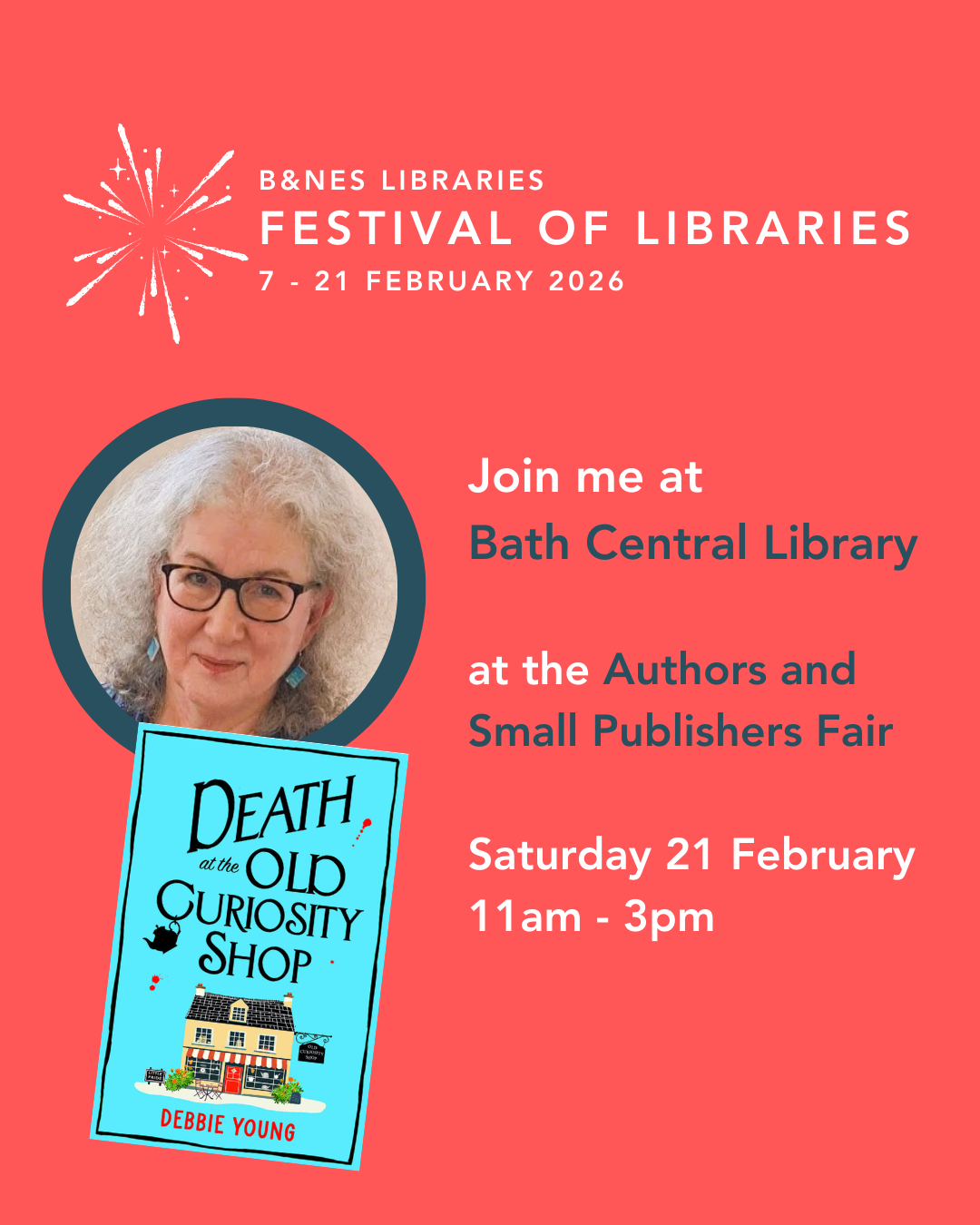
By coincidence, my first public event of 2026 will be at Bath Central Library, alongside a fantastic group of authors and publishers selling their books at the Local Authors and Small Publishing Fair as part of the Bath & North East Somerset (B&NES) Festival of Libaries. Between 11am and 3pm, visitors can meet authors and publishers informally on their stands, where we’ll be selling signed copies of our books. With tea and cake also on hand, it’ll be a relaxed and inspiring day in a creative environment. I’m really looking forward to meeting lots of readers as well as local author friends.
***Free admission***, so you can spend your money on books, tea and cake instead!
What I’m Reading
January definitely calls for cosy reads – and so far this month I’ve picked two from my collection of British Library Crime Classics. So that’s another reason to love the British Library – they publish mysteries first published during the Golden Age of Detective Fiction between the two World Wars. Some of the novels are better than others, as you’ll see from my reviews below, but they all have stunning covers, look beautiful on the shelf, and are giving a new lease of life to many authors too long out of print.
Absolutely cracking Golden Age fare, and I raced through it. Classic isolated country house set-up featuring a fun assortment of vivid characters thrown together in intriguing circumstances. I confess I guessed one of the details revealed at the end, but that didn’t diminish my enjoyment.
Poignant detail that the central character is a young man at a loose end after serving in the First World War, battle-scarred but with no employable qualifications, as so many must have been, which made me extra glad that he arrived at a happy ending in the story.
Told with a light, wry touch – although narrated in third person, includes lots of witty throwaway and judgmental comments that added to the fun. The nostalgic cover illustration, taken from a vintage travel poster, is just right.
Well, this was an oddity. Although endorsed by Dorothy L Sayers, it broke many of the rules that apply to the genre. I wouldn’t even term it a murder mystery, as there was very little mystery about it. The sense of place, the characterisation, and the writing style were all great – but coming to expecting a rollicking good classic mystery, I felt shortchanged. Could have been very much better, and I’m puzzled as to why the author (and the original publisher) let it go as it is. A good structural editor, with a few strategic tips and tweaks, would have made it very much more satisfying. Shame.
~~~~~
Read more about the Golden Age of Detective Fiction in this post from my blog archive:
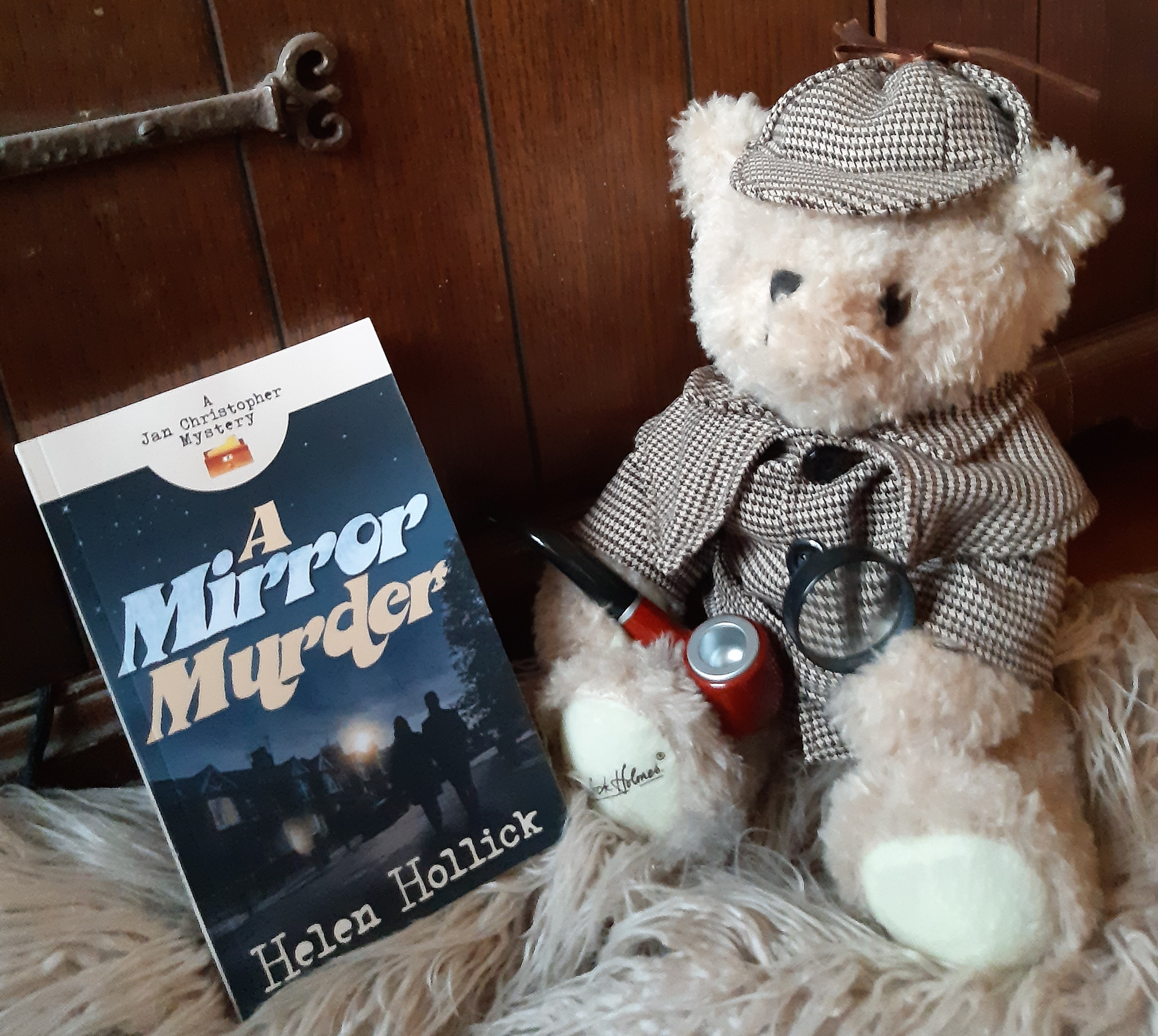
In this week’s post, I’m pleased to share an interview with my author friend Helen Hollick, who during lockdown took to crime! Cosy crime, that is (or cozy, if you’re on the other side of the Atlantic from us).
Also new this week: an interview with me has just gone live on the website of Saga Egmont, the award-winning audiobook publisher currently in the throes of publishing audiobooks of the first seven Sophie Sayers Village Mysteries. Click here to read my interview on Saga Egmont’s website.(Link will open in a separate window.)
The first satisfied borrower of the day: my husband, with Liz Howard, volunteer librarian
I was delighted to be invited to launch the new Hawkesbury Upton Village Library yesterday, and I wrote a short speech to mark the occasion. A number of people afterwards asked me for a copy of it, so here it is for anyone who would like it.
After I’d spoken, local councillor Sue Hope added her thanks on behalf of the community to the Hawkesbury Village Hall Committee, the Parish Council and the Hawkesbury Writers for their support and funding for the new facilities, for which the books and services will be provided by South Gloucestershire Libraries. A team of eight wonderful village volunteers will staff the library and open it for two hours every fortnight.
My Opening Address
It’s a pleasure and an honour to be invited to open what is going to be a wonderful new resource for our community. It feels like we’re at a little bit of Hawkesbury history in the making.
Like many of you, I was sad that funding cuts led to the closure of the mobile library that had served us so well for so long. It brought great comfort and interest to many villages and hamlets beside ours, and it was always a heartwarming sight to see it trundling down our lanes. It was like a tardis full of books, manned by kind, friendly and knowledgeable staff always willing to help us, no matter how obscure our questions, even when we forget our library cards. I don’t know whether the mobile staff realised how much we loved and appreciated them, but on behalf of our community, I’d like to thank them for the pleasure they have brought us – and to congratulate them for their driving skills to manoeuvre that great bus down the lanes to us, time after time.
So a sad loss, but, like a phoenix from the ashes, this new and different kind of library, with its permanent base in our community, is the start of a whole new chapter (groan) in our bookish lives. In a way it will bring us the best of both worlds: access to the entire stock from South Gloucestershire Libraries, not only from Yate’s stocks but from anywhere in the south west. All we need to do is request them online from the comfort of our own homes, and they’ll be served up to us by our fantastic team of volunteers, all trained to give us the help we need at a local level.
Smart new mobile shelving allows the librarians to create a pop-up library every fortnight in the village hall
You can of course still use the other South Gloucestershire libraries of your choice – in Yate when you’re shopping, or the library nearest your workplace – but just as the mobile library brought resources to those who couldn’t get to those, so will the community library. But choosing books from the Community Library will help you save fuel and time – just as the Hawkesbury Stores makes it possible for us to buy groceries close to home.
For any cynics who are wondering whether public libraries are still relevant to us in the digital age, think again. Studies show that a large proportion of library users are also regular buyers of books. Libraries are for everyone – and not just for those who can’t afford to buy books.
Why do affluent book buyers use libraries too? Library books should not be considered as second-best to buying books. The quality of books in libraries is always high, mostly as new or nearly new condition, and it’s a joy to touch and hold them – these days, with the high production values of modern books, they are an aesthetic treat as well as a literary one. You can get as much of a buzz out of walking home with an armload of library books as from buying them in shops – and you don’t have to worry about running out shelf space at home, either.
Libraries also offer a low-risk strategy to expand your choice of reading matter. Well, I like to think of a library as a tasting menu in a restaurant. Like a tasting menu, a visit to the library offers you the chance to try new things. When you haven’t paid for a book, it doesn’t matter if you don’t much like it or finish it – but at the same time, you might discover new passions and interests in the process.
A library is also like a smorgasbord because it’s an all-you-can-eat menu – only in this restaurant of reading, you don’t end your visit by paying a bill. The only money you will spend here is if you treat yourself to some tea and cake, which you can do with a clear conscience because the takings for refreshments are what will cover the hall hire costs for each session.
But that’s fine too because libraries aren’t only about books on shelves. They are also an important social meeting point, accessible and affordable to all, where everyone may meet on an equal footing. They are hugely democratic and an enormously valuable anchor in our society for all sorts of reasons unrelated to books – the books might even be considered a bonus. What matters is that we connect.
Recommended reading for everyone who loves libraries
I’ve just finished reading a fascinating fly-on-the-wall memoir by a librarian, Chris Paling, called Reading Allowed. He points out that public libraries can also be study centres, play areas, A&E departments, refuges for the homeless and much more – Hawkesbury librarians, you have been warned! I’m sure our library will serve as a brilliant coffee shop too – a safe, warm place to socialise with friends. Fortunately libraries no longer have a silence rule!
I realise not everyone may be instantly persuaded that the library is for them. “I’m not much of a reader,” they might say, or “I don’t have time to read”. I bet they still find time to watch television. In that case, I say they just haven’t met the right book yet.
The book stock has been carefully curated to match the needs and interests of our community, and it will be constantly refreshed to keep it interesting for us.
Celebratory cake – we don’t do much in Hawkesbury that doesn’t include cake
Who watches “Game of Thrones”? Of course, that hugely popular series is based on books by a very wise man, George R R Martin, who famously said about books and reading:
“He who reads lives a thousand lives. He who does not read lives only once.”
Our new community library gives us all the chance to live a thousand lives. So please do take advantage of this wonderful gift to our village, today and every time it opens, once a fortnight, in future. I’m delighted to declare it now officially open.
If you love libraries, you might enjoy these other posts from my blog archives:
Both of the stories about libraries featured in those last two posts are included in Quick Change, my collection of flash fiction, available in paperback and ebook. Click the image to buy online or quote ISBN 978-0993087967 to order at your local bookshop.




 Also new this week: an interview with me has just gone live on the website of Saga Egmont, the award-winning audiobook publisher currently in the throes of publishing audiobooks of the first seven Sophie Sayers Village Mysteries.


