
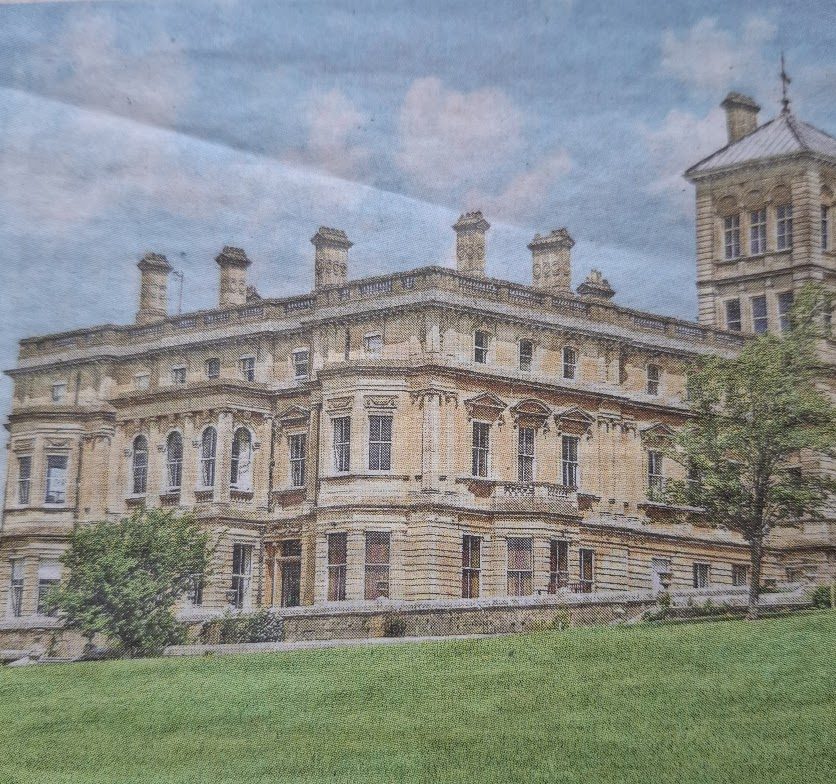
When I was writing my latest novel, Death at the Village Garden Party, my starting point was to wonder what would happen when industrial magnate Robert Praed acquires the local stately home of Bunbury House.
In the three earlier books in my Cotswold Curiosity Shop series, it’s clear that one of his sidelines is restoring and repurposing old buildings is one of his sidelines. It’s in keeping with his benevolent character to cherish his local heritage. These projects also gives him a good excuse to connect with Alice Carroll, whose shop sells cottage-core items with which he might furnish them.
The Inspiration for Robert Praed
This aspect of Robert Praed’s character was inspired by the remarkable Sir James Dyson, pioneer of the bag-free vacuum cleaner and so much more.

Fun fact: I met Dyson a couple of times when I worked at Westonbirt School, before he was quite as famous as he is now. First, I asked him to come to speak to the pupils taking part in the Young Enterprise scheme, and he was so impressive and inspiring – as well as modest and kind – that I invited him to be guest speaker at the next Speech Day. His motivational talk and charisma persuaded us all that the noblest career of all was to redesign household items! I’ve admired him ever since.
Dyson’s main residence, Dodington Park, is just a few miles down the road from me, and he’s a known buyer of local farmhouses, some of which he converts sympathetically into holiday accommodation. He is also a technical leader in farming innovations through Dyson Farming.

When Robert Praed, by contrast, acquires the Duke of Bunbury’s former stately home, Bunbury House, he plans to turn it into a health resort and wellness centre. Its beautiful setting of formal gardens and Cotswold parkland would provide the perfect getaway for stressed executives. However, part of the deal is that he must also take on the adjacent hamlet of Cold Bottom, made up of run-down tied cottages for estate workers. I had great fun in my story improving much-needed local housing stock for rural tenants.
Launch Day Coincidence in The Times
You may imagine my surprise when on the day of the book’s launch, I opened the property supplement of The Times to find an article speculating on the sale of a similar building in the Cotswolds – the spectacular former home of Rendcomb College.

Until it closed at the end of this summer term, Rendcomb College was a rival to Westonbirt School – the inspiration for St Bride’s School for Girls, the setting of my Gemma Lamb cosy mystery series.
Both Rendcomb College and Westonbirt School were originally stately homes, built in the 1860s, as the country residences of wealthy gentlemen. Each estate had a small associated village to house estate workers – Rendcomb and Westonbirt – just as Bunbury House has Cold Bottom.
School Use for Old Stately Homes
Unlike Bunbury House, Rendcomb and Westonbirt’s time as private stately homes came to an end in the 1920s. By chance, in that decade, both were turned into schools. Rendcomb School was set as up to educate boys by the Wills family, the famous tobacco magnates based in nearby Bristol, while Westonbirt School was created by the Martyrs’ Memorial Trust to teach girls. Both schools eventually went co-educational.

While Westonbirt School is now flourishing under the ownership of Wishford Education, sadly Rendcomb ceased to be a school this summer. In The Times‘ article published on my book’s launch day, property writer Hugh Graham speculates on the future purpose of the Rendcomb estate, which has now resumed its original name of Rendcomb Park.
Current Trends for Old Stately Homes
Graham favours the notion of converting former stately homes into fancy apartments, especially suitable for the retired. He also reports an emerging interest in turning them into “longevity centres” – a kind of hotel with added medical services. So it seems Robert Praed’s plan is bang on trend!
In Death at the Village Garden Party, I never specify how much Bunbury House and Cold Bottom have cost Robert, but it’s his biggest property investment yet. Given that Rendcomb Park is now on the market with estate agent Knight Frank for £20 million, I’m guessing Robert Praed must have sold more everlasting sponges than I realised.
In Death at the Village Garden Party, Robert Praed’s ambitious plans for Bunbury House quickly go off-piste – but Alice Carroll’s amateur sleuthing skills avert another Cotswold catastrophe.
Each book in the series can be read as a standalone, but it’s best to read them all and in order, I reckon!


I love reading these connections between the real world and your books, Debbie–fascinating, the way they shed light on each other! Thank you for sharing this.
Thanks, Michael! These pieces are fun to write!
What a lovely post! Fascinating too, and I love the name “Cold Bottom”! Fabulous! My only worry is that Robert may not have done a wise thing in inventing an everlasting sponge. Who’s going to buy it, once everyone’s got one? Can he really make his fortune from something which lasts for ever?
Thank you, Rory! I had fun with Cold Bottom – I’m going to write another post soon about funny village names in real life (eg the Cotswolds’ Upper Slaughter and Lower Slaughter, which are both beautiful and idyllic despite their grim names!
Fortunately, although Robert’s breakthrough product was the everlasting sponge, he has also diversified into other eco-friendly products for the home – a bit like Dyson with his vacuumn cleaner, moving on to hand driers, fans, and hairdryers! It’s a testament to his ethics that he is happy to sell something that doesn’t have built-in obsolesence!