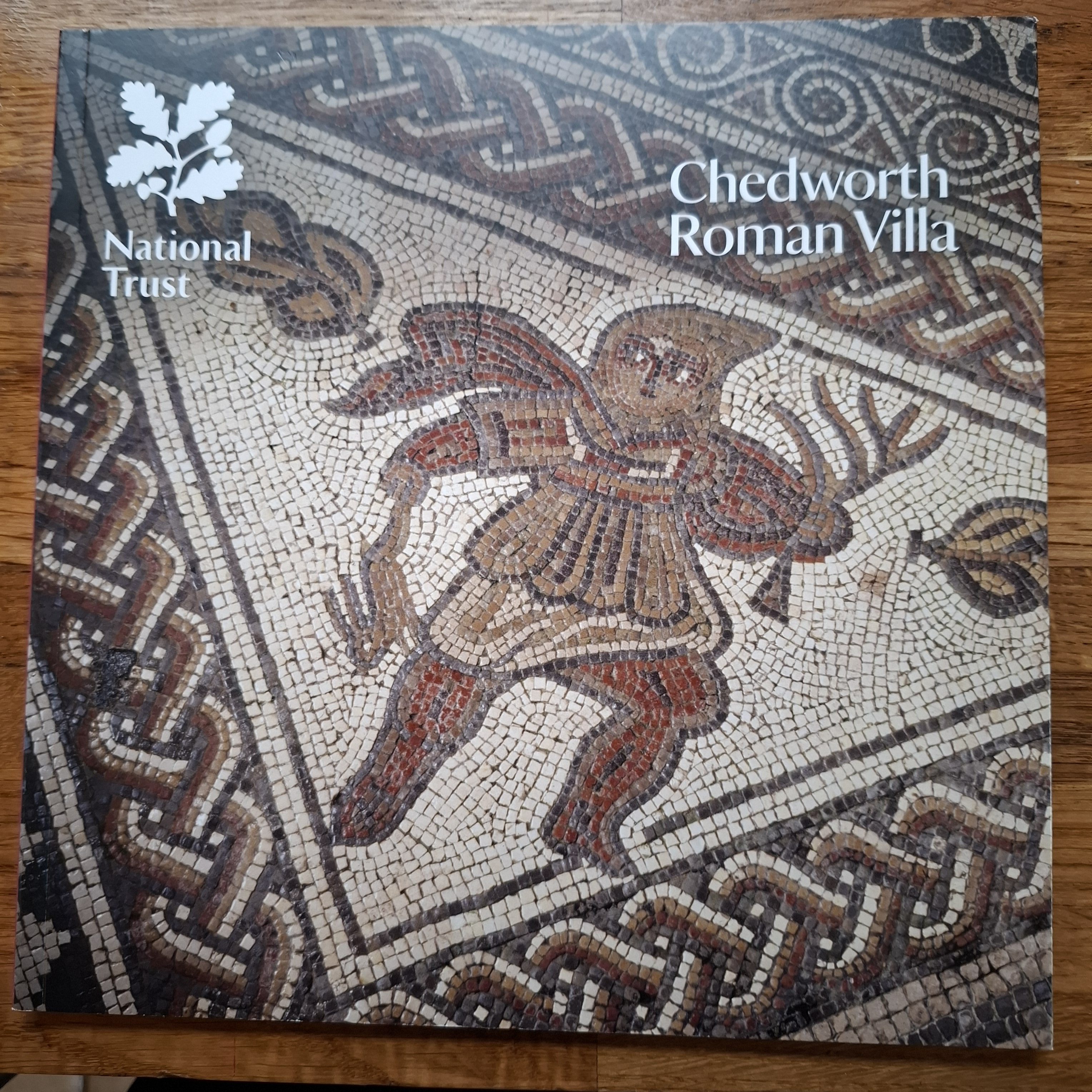
Following an afternoon out at Chedworth Roman Villa this week, my head is still full of ancient Rome, and in particular of Roman mosaics.
I went to Chedworth Roman Villa as a research trip for the novel I’m currently writing, Death at the Village Knitting Circle. As all my novels are set in the present day, the relevance of the ancient Romans may not be obvious. However, the knitting circle meets in the education room of the new Roman museum in Little Pride – the setting for my Cotswold Curiosity Shop cosy mystery series.
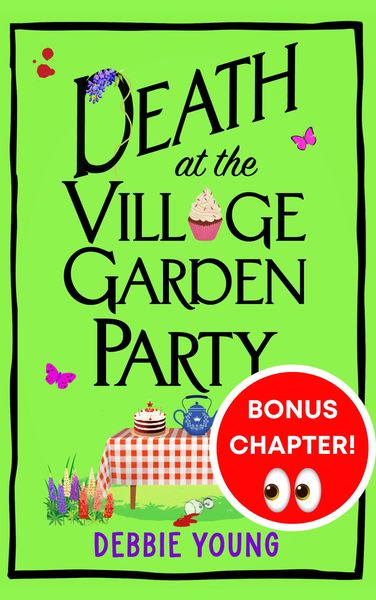
When I was writing my latest novel, Death at the Village Garden Party, my starting point was to wonder what would happen when industrial magnate Robert Praed acquires the local stately home of Bunbury House.
In the three earlier books in my Cotswold Curiosity Shop series, it’s clear that one of his sidelines is restoring and repurposing old buildings is one of his sidelines. It’s in keeping with his benevolent character to cherish his local heritage. These projects also gives him a good excuse to connect with Alice Carroll, whose shop sells cottage-core items with which he might furnish them.
Drum roll for the publication of my latest novel tomorrow (Friday 31st July)!
As part of my launch campaign, I’m pleased to be able to offer you a day early a free bonus chapter that I hope will whet your appetite for the whole book.
Death at the Village Garden Party, the fourth in my bestselling Cotswold Curiosity Shop cosy mystery series, takes place in high summer, so it’s the perfect read for right now.
When, as a child, I used to play with my grandma’s button box, I admired each button like a tiny work of art.
Born in 1900, Grandma grew up fastening her button-boots with buttonhooks. As a young woman, she embraced flapper styles. The contents of her tin gave a miniature history of twentieth-century fashion.
My mum (91) still has her own button box from when she used to make clothes for her children. Her 21st birthday present was a hand-cranked Singer sewing machine, on which I later learned to sew.
My mum’s button box
My grandma and my mum used old toffee and biscuit tins as button boxes. But my buttons live in a smart Cath Kidston tin, labelled The Book of Buttons.
My daughter uses a tartan shortbread tin to house hers.
The contents of every button box are unique. Plunging your hand in is like a lucky dip. You never know which tiny treasure you’ll pull out, nor its provenance.
Whose duffle coat did this toggle once fasten?
Which child fiddled with this little blue one on their school cardigan during a tedious lesson?
What kind of party dress did this diamante disc once adorn?
Last century, every home had a button box. These days, with fewer people making their own clothes, it’s an endangered species. Yet it’s easy to keep the tradition alive. You can buy interesting vintage buttons in any charity shop or thrift store. If you’re lucky, you’ll find something similar to the fancy fastener at the heart of the mystery in my new novel, Death at the Village Christmas Fair.
When Wendy chooses a bear-shaped button from her daughter Alice’s Cotswold Curiosity Shop and sews it onto a hand-knitted scarf, it soon becomes a vital clue in the hunt for a ruthless killer.
If you look at his tail end, you’ll see a hole that allows him to be sewn onto the scarf.
The unusual scene of the crime is a Santa Run, in which hundreds of fun-runners race dressed as Father Christmas. What’s so special about Wendy’s little wooden bear? You’ll have to read my novel to find out!
Do you have a button box in your home? What’s your most unusual button? Which is your favourite, and why?
Death at the Village Christmas Fairis now available in ebook, paperback, hardback and audiobook. The third in the Cotswold Curiosity Shop cosy mystery series, it may also be read as a standalone novel.
All three books in the series so far can be read as stand-alone novels, but it’s best to read them in order
Thanks to Sarah Chave for the photo. We didn’t let rain stop play!
I’m just recovering after a very wet and windy Hawkesbury Show, where our Hawkesbury Upton Literature Festival tent nearly blew away. I’m sure we had the most windswept spot on the showground – the wind seemed to be coming from all directions at once! However, I had great fun with fellow authors Lucienne Boyce, Sarah Siân Chave, Frances Evesham and Jack (Jackie) Chandler. All except Jackie will be speaking at the next Festival event on Saturday 27th September – and the only reason Jackie’s not coming is that she lives in Germany, otherwise she’d be there like a shot! Thanks to Sarah for the attached photo of us on the stand, dressed for the weather!
I’d just about dried out and warmed up in time to give a short talk at the traditional annual Songs of Praise service held in the Show Marquee next morning (thankfully in sunshine by Sunday morning!) At our Songs of Praise service, six local residents are invited to choose their favourite hymns and tell us why they’ve chosen them. It’s always fascinating to learn more about well-known hymns and heartwarming to learn about the personal connections for the speakers. For this service, I spoke about the power of music to unite communities and bring people to faith.
As a Lay Worship Leader, I occasionally give short talks at services. Lay Worship Leaders aren’t licensed to preach – instead we just talk about something timely or relevant for each service. I thinking of saving them up to turn them into a small book, similar to my collected columns for the Tetbury Advertiser and Hawkesbury Parish News. Let me know if that’s something you’d like to read.
A fascinating personal response to the Hafren, aka the River Severn, with something for everyone.
Following the course of the river from its source just outside Aberystwyth, Sarah Chave’s narrative Includes Welsh mythology and Welsh and English social history, as well as geography and natural history, environmentalism, and family history.
Overall it is a thoughtful, philosophical work, acknowledging and mourning the impact of industrialization and climate change, but also an effective cry for positive action going forward. While nostalgic for what we have lost, it is ultimately constructive, as evidenced by the following quote:
Pastoralism can provoke feelings of nostalgia, a yearning for an unchanging utopian idyll, but it can, instead, be a approached in a different way – as a challenge to care for and protect the wider natural world.
The author cites and embraces Rupert Reed’s argument in favour of “thrutopias” to “encourage us to live our dreams in the present where we can, change things where we cannot, and strive together towards building a more caring world for all”.
Illustrated with a route map of the river to give the reader their bearings, and gentle black and white drawings by Rachel Elinor Collis, the book also boasts an evocative, slightly dream-like cover illustration by Andy Ward. All in all it’s a slick and beautiful package, published by the University of Wales’ imprint, Calon Books, which gives it the stamp of authority.
A great gift for anyone who loves any part of the Hafren/Severn, whether Welsh or English – there’s something in there to satisfy all kinds of readers.
I downloaded this short story onto my Kindle after having a fun conversationon my Facebook author page about who we name our characters after. She named her central character Carrie after her grandmother. I’ve never yet named one of mine after my beloved grandmothers, Lily and Peggy, but I’m going to think about doing that now.
All at Sea is a gentle tale of a very English day out at the seaside – an outing that sounds as if it should be simple and fun, but in Flora McGowan’s hands, turns into a thoughtful, poignant, memorable and melancholy tale of love, loss and responsibility. I won’t say more for fear of spoiling the plot.
That is, buying more books, even though you haven’t read all those you have at home. To Western ears, that term may sound like criticism, but in the Far East it’s regarded as reasonable.
I’m clearly living in the wrong country. Despite being a speedy reader, I buy books faster than I read them. My to-read list never stops growing.
Compounding the problem is my delight in rereading old favourites. I often choose old over new.
Rereading a familiar book is like watching repeats on television. We do it because we know we’ll enjoy them. Even if we have a nagging feeling that we’re squandering time, we’re not. They make us happy.
Every time we reread a book, we notice details we missed on first reading. This is particularly true in crime writing, where we spot red herrings that fooled us before, or in any fiction featuring unreliable narrators whom we originally trusted.
Our experience of a book also changes at each reading because we have changed as people. We’re not the same person at each encounter. The longer we leave it, the more our perspective may alter. Different factors resonate with us every time.
An extreme example is rereading children’s books, which I often do. Revisiting E Nesbit’s The Railway Children last year, I identify now with the children’s mother.
As a child, I empathised with Phyllis. As the youngest of three siblings, my sympathies naturally gravitated towards the smallest child in stories. Having recently read the author’s biography added fresh insights into her fiction.
The new Books on the Bus Little Free Library bookcase, made by my husband
Even when we buy books with the best intentions, sometimes we grow out of them before we can find time to read them. There’s no shame in disposing of books you’re never likely to read, and there’s no shortage of good homes for them. Look no further than the bus stop in Hawkesbury Upton High Street, where a new, larger shelf unit built by my husband is about to be installed, thanks to the Parish Council’s kind grant for materials.
How many books are too many to have in your home?
In her debut self-help book, Japanese decluttering guru Marie Kondo recommended owning no more than 30. Never hesitate to part with books, she advised, because in the age of the internet, if you change your mind, it’s easy to track down a replacement.
At least, that’s what I think she said. I can’t check, because, I confess, my copy of The Life-Changing Magic of Tidying has long since left the building. The Japanese have a word for that too. I I just looked it up online. It’s 皮肉.* Pronounced: ai-ron-i.
*The Japanese characters making up this word literally mean “skin-meat”, but its meaning as well as its pronunciation is the same as our irony.
(This article first appeared in the June 2025 edition of the Hawkesbury Parish News.)
IN OTHER NEWS
Behold – the official unveiling of my next book, Death at the Village Christmas Fair, which will be launched on 16th August, in plenty of time for Christmas. I had great fun writing this one, with the suspect playing hard-to-get in a Santa Run, in which everyone is dressed as you-know-who! It also gave me lots of opportunities to write about knitting, one of my favourite hobbies. Yes, there is a connection between the Santa Run and knitting – but you’ll have to read it to find out what it is!
This is third book in the Cotswold Curiosity Shop series, the first two being Death at the Old Curiosity Shop and Death at the Village Chess Club. Both of these have been Amazon Bestsellers, so I’m crossing my fingers for this one to join that heady status.
In the meantime, I’m wondering what to write next – another adventure in one of my series (the others are the Sophie Sayers and Gemma Lamb cosy mysteries), a new stand-alone story, or a novelisation of my first play, which debuted in April, The Importance of Being Murdered.
I’m sending several outlines to my publisher, Boldwood Books, for them to choose. If you have a preference, do tell me, and I’ll pass it on to Boldwood. I’ll be sure to let you know what they decide.