My second post celebrating the Coronation of King Charles III, about the intriguing history of the Coronation Spoon, was originally written for the May issue of the Hawkesbury Parish News.

My second post celebrating the Coronation of King Charles III, about the intriguing history of the Coronation Spoon, was originally written for the May issue of the Hawkesbury Parish News.

My first blog post of 2023 is the column I wrote for the January issue of the Hawkesbury Parish News – a very important institution in the life of a little Cotswold village like mine!
I’m the kind of optimist who not only sees the glass as half-full, but is jolly grateful to have a glass, and assumes it must be made of the finest crystal.
That’s not to say I’m oblivious to darker times. But when life seems grim, I unleash a handy collection of mantras that make me feel better.
But as this new year dawns, I’m feeling wary. For the last few years, I’ve started every January thinking, “This has got to be a better year than the last one”. Then along comes something worse.
What a run of disasters we have had lately: Trump, Brexit, Covid, more Covid, the war in Ukraine, and all the economic and political fall-out those crises induced. Not to mention ever-stranger weather, indicative of frightening climate changes.
With apologies to Samuel Johnson, who described second marriage as “the triumph of hope over experience,” experience is threatening to triumph over hope.
Yet my inner optimist will out, and as I list those disasters, over which I had no control, bar the right to vote and to get vaccinated, I realise it’s still within my power to make 2023 a better year in small ways.
So 2023 will be the year that I will vow never to run out of teabags, or milk for my morning tea…

or the cats’ favourite treats, Dreamies:

And if I’m setting the bar that low, doesn’t that mean things can only get better? Let’s live in hope.
Wishing you a new year full of whatever makes you happy.
In my next post, I’ll be reviewing my writing achievements in 2022 and sharing my writing plans for 2023.
PS My new year’s resolution is to publish a new blog post every Wednesday! Let’s see how that goes…

In October I was invited to take part in some medical tests by the research organisation Biobank, for which I’m a longstanding volunteer. I’ve taken part in various tests for them over the years, most of which have been short and uninvasive, but my latest call-up was for a whole afternoon of full-body and brain scans.

What if the new government were to pledge to provide for every community in the land a sturdy and spacious building in which the public might seek comfort at times of crisis?
What if these buildings were on a grand scale, with ample seating for visitors and plenty of space to wander about in?
What if each one was uniquely beautiful, built from local materials to blend in with their setting, and decorated with paintings, carvings, and fresh flowers to please the eye and lift the spirits?

Preparing to visit Berlin for the first time a few weeks ago, I was unsure what I might find there.
My expectations had been partly shaped by a blend of fiction (Isherwood), film (Cabaret), and song, (Bowie’s “We Can Be Heroes”).

At school I studied twentieth century history to A Level. In those days, the Berlin Wall was an impenetrable barrier between East and West, and I was living in Frankfurt with a postal address in West Germany.

Packing for our city break, I discarded the book I’d been saving to read on the trip: a historical novel set in Berlin during the Second World War. Might it be offensive to be seen reading a story about an era Berliners would prefer to forget?
I need not have worried.
The city turned out to be full of reminders of both World Wars and the Cold War, now serving as incitements to peace.

Even parts of the hated Berlin Wall have been left standing. When the Wall fell in 1989, Berliners resisted their initial impulse to destroy the whole of this brutal divider of East and West. Instead, they kept parts of it intact as a reminder of the importance of the freedom and democracy which the Wall once denied them.
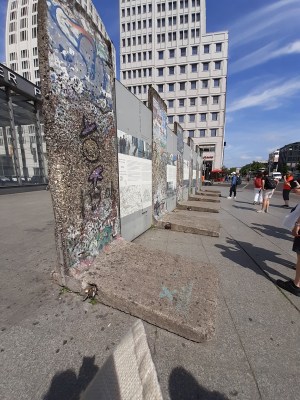
The rest of it was to be painted by local artists, then broken up for sale as souvenirs. The Wall was so huge that there are still plenty of pieces to meet tourists’ demands, and they must be a healthy source of revenue for the city’s coffers.
Berlin is now an upbeat, creative and cosmopolitan place, full of green spaces, wide tree-lined boulevards and light.
Standing outside our hotel on the Kurfürstendamm (Berlin’s answer to London’s Bond Street), we could hear not the roar of traffic, but copious birdsong.

There are very few motorists, because Berlin’s public transport system is so efficient and affordable that you don’t need a car to get around. Their trams, trains, U-bahns and buses are also very easy to use. There are no ticket barriers anywhere, as it’s assumed all travellers will be honest and buy tickets. This trust may not be misplaced, according to Lenin, who joked, “If Germans ever stormed a railway station, they’d first buy a platform ticket.”

As in British towns, electric scooters are rife. The abundance of cycle paths in this flat city allows them to operate relatively safely. I wish I’d been quick enough with my phone camera to capture a sight that seemed to epitomise twenty-first century Berlin: a stream of electric scooters gliding freely past Checkpoint Charlie, still maintained as a landmark, into what used to be East Berlin.

I had an unfortunate encounter with an electric scooter near the Brandenburg Gate, when I tripped over one left lying on the pavement. The scar on my left knee was an unwanted souvenir. But I also brought back a much better souvenir: a piece of the Berlin Wall, which now sits on my desk as a permanent reminder to myself that no obstacle is truly insurmountable. Except that electric scooter by the Brandenburg Gate, obviously.

This post was originally written for the July 2022 issue of the Hawkesbury Parish News

If you enjoyed this piece, you might enjoy this short story I wrote a couple of Christmases ago as a guest post for Helen Hollick’s blog, in which a souvenir of the Berlin Wall plays a crucial part: Christmas Ginger. It was later selected for L J Ross’s Everyday Kindness anthology in aid of Shelter, the charity for those without homes or in poor housing, and in the audiobook edition it was read by the distinguished actress and novelist Celia Imrie.
