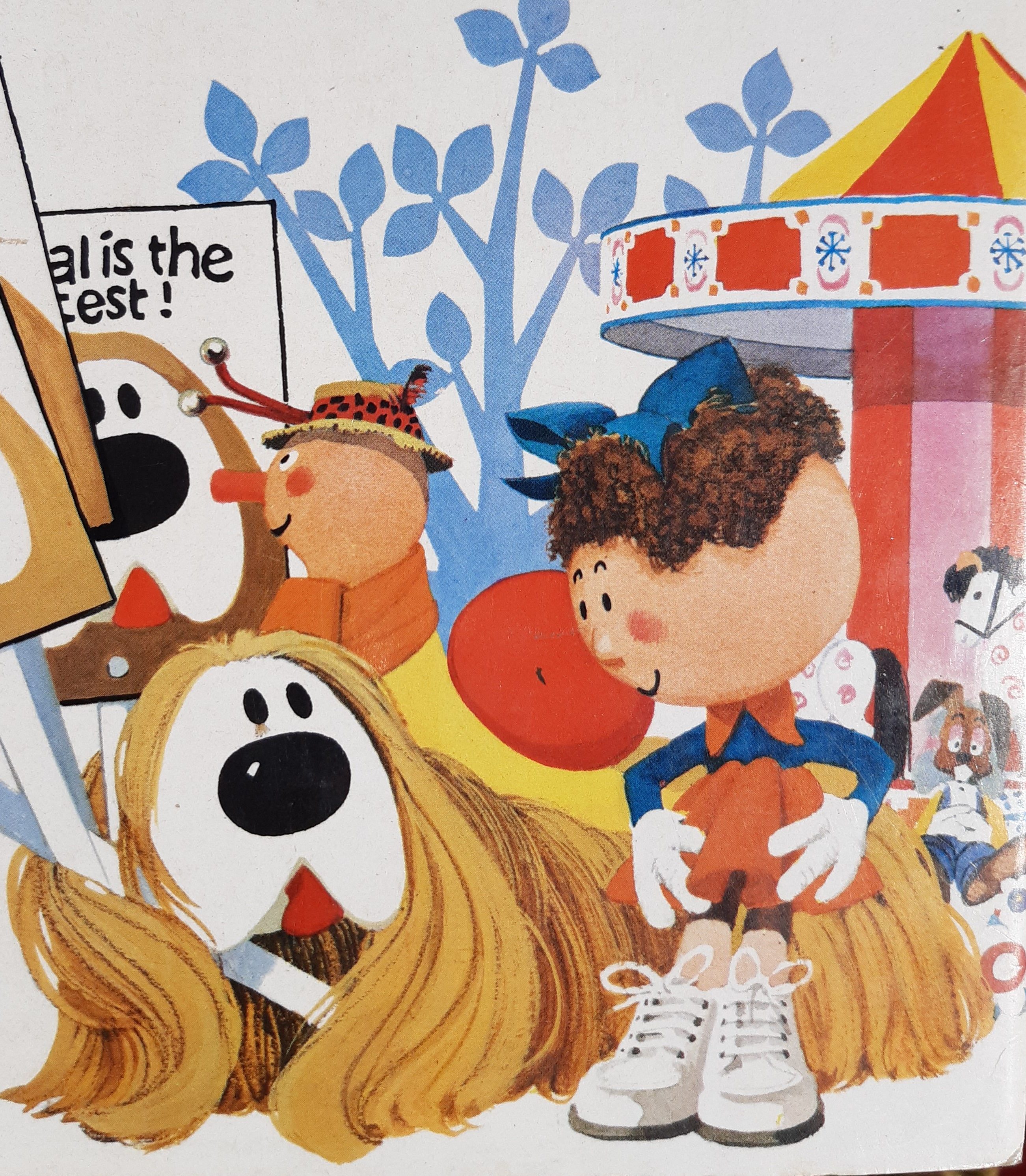
I couldn’t resist buying this secondhand souvenir book of The Magic Roundabout when my daughter was little
When I was a child, national and international news featured very little in my world view. My parents took a daily newspaper, but I would have been too preoccupied with my comics to pay much attention to their paper.
Television news didn’t feature much in our family viewing, because it was only on at tea-time and bedtime. If I caught the headlines, it was by chance rather than on purpose, because I was still sitting in front of the telly after watching The Magic Roundabout, or whatever other children’s programme preceded the news in those precious five minutes beforehand.
The gentle humour and underlying moral message delivered by Dougal and friends provided a warm feeling to brace us for whatever bad news the evening bulletin might bring. It was the televisual equivalent of lining your stomach with a glass of milk before a night out imbibing strong drink.
The radio news was even less prominent in my life, and chiefly in the form of The World at One, its opening pips the signal that it was time for me to go back to school after having lunch at my maternal grandma’s.
I’m forever grateful to BBC Radio 4 for scheduling timeless classics such as Desert Island Discs and Just A Minute at 12.25pm each weekday, when Grandma and I would be sitting down to eat.
The theme music of Desert Island Discs still makes me think of cold lamb and bubble and squeak and Grandma’s delicious gooseberry tart with a slightly metallic flavour from being stored overnight in the tin she’d baked it in.
I think Desert Island Discs must have been broadcast on Mondays, when Grandma was serving up leftovers from her Sunday dinner.
I just had to buy this book celebrating the iconic Desert Island Discs, still on air after eighty years!
That’s not to say that as a child I was completely ignorant of current affairs. I remember Grandma, born in 1900, impressing upon me the significance of Churchill’s funeral as a tribute to a great man and the end of an era. I would have just turned 5. I can even recall JFK’s assassination, more because of the unprecedented appearance in our kitchen of the sobbing next-door neighbour who ran in to break the news to us, rather than because I had any idea of the political significance. Well, I was only 3.
On our weekly visit to my paternal grandparents, my grandfather used to pass me his evening newspapers when he got home from work. Commuting from Sidcup to London, he’d buy both the Evening Standardand its rival the Evening News to read on the train home. I was only interested in the picture crosswords and the cartoons. The hard news passed me by.
How differently will the current generation of children remember national and world news when they’re my age? In our multimedia age, however their parents consume their news, newspaper, radio, TV or online, children seem to have no escape from gruelling and traumatising headlines. I just wish they’d bring back The Magic Roundabout to soften the blow, for adults and children alike.
This article first appeared in the Hawkesbury Parish News, April 2022.
My love of those old pre-news children’s shows is the reason why the village bookshop in my Sophie Sayers Village Mysteries is called Hector’s House.
I’d already decided the proprietor – and Sophie’s future romantic interest – would be called Hector Munro (more about that choice in another blog post here). As Sophie’s late Great Auntie May had been a benefactor to Hector when setting up his bookshop, and had a sense of fun, I decided she would insist that he call the shop by the name of her choice – which was Hector’s House.
Hector and Sophie are not old enough to have seen the tea-time children’s show featuring the amiable puppet dog – but I think Sophie at least would have appreciated his catchphrase and its variants that always closed the show: “I’m just a great big lovable old Hector.”
Cover design by Rachel Lawston inspired by the single-track roads of the Cotswolds in spring
When I first moved to Hawkesbury Upton, I didn’t realise that three of the four roads into the village were partly single track with passing places. Learning to drive in suburban London, my lessons had been exclusively in built-up areas. In my company car, I was clocking up most of my miles on motorways. Negotiating rural lanes required a recalibration of my driving skills.
However, I soon learned to love the local lanes all year round, enjoying seeing the seasons change in the hedgerows and verges – from snowdrops to primroses, from wild garlic to cow parsley.
A few months after moving to the village, with the smugness of the newly-converted, I laughed at a visiting townie friend perplexed by the etiquette of country driving. “Do you really know everybody round here?” he asked, having seen me exchange the usual waves of thanks with drivers who pulled over for me, or to whom I gave way.
When another driver refused to give way despite being closer to a passing place than we were, my friend was about to express his feelings in the international sign language of the angry motorist. “Best not to do that so close to home,” I advised, “as actually it is quite likely that I will know the other driver.”
He said that if he had to live in my house, he’d never leave the village at the wheel of a car.
Three decades later, meeting traffic on single-track roads doesn’t bother me, but I do prefer to have the lanes to myself, not for road rage reasons, but because when they’re deserted, there’s something other-worldly about them.
Not always in a good way: on dark, moonless nights without the familiar markers of urban streets – no streetlights or road signs, no road markings or kerbs – the lanes can be disorienting. Add thick fog, snow or torrential rain, and it can feel as if you’re heading for a Hammer Horror film set, where the undead are waiting to greet you.
But in the right light and weather, these narrow lanes can feel perfectly magical.
Earlier this year, a pleasant drive in the spring sunshine with cow parsley brushing the sides of my car gave me the idea for my new novella, Mrs Morris Changes Lanes, in which a rural journey transforms the heroine’s life by taking her to a surprising destination – and I don’t mean Chipping Sodbury Waitrose.
In this month’s Hawkesbury Parish News, as new bells arrive at our parish church, I’m reflecting on bell ringing and bell ringers in English churches and explaining why I’m taking up bell ringing.
My great grandfather, Bill Shimmans, was an accomplished bell ringer
Ever since I learned that my great-grandfather, born in 1873, was an accomplished bell ringer, I’ve felt an affinity to church bells, but never had the chance to learn to ring them. Now that I’m training to ring the new bells of our parish church, I’ve been finding out some fascinating facts about bell ringing – or rather, sounding the depths of my ignorance.
I’d never realised that each church bell has to be tuned to a precise musical pitch. I hadn’t even classified bells as musical instruments. Now I know they are the loudest musical instrument of all.
Nor had I appreciated that in other countries bells are commonly hung and struck in a different way. I thought “carillon” was the name of a tune played by bells, as in Bruges’ Belfort. Now I’ve discovered it’s the name of the musical instrument used to play tunes on the bells. It’s strung a little like a piano, and each key activates a wire that strikes hammers against the outsides of the bells. A single operator sounds all the bells.
By contrast, in so-called English-style bell ringing, bells are mounted on a headstock allowing them to swing through 360 degrees. Each bell is operated by an individual person, and when the ringer pulls the rope, the clapper strikes the inside of the bell twice during each full rotation.
While it was still being constructed in Matthew Higby’s workshop, the framework from which the new bells will be hung (Photo by Sir Ian Macfadyen)
Not for English-style ringers the dainty tunes of the carillon. We make life more complicated for ourselves by defining complex and varying mathematical sequences. Each variation in the sequence is known as a change, hence the expression “ringing the changes”.
My family still has my great-grandfather’s certificates and press cuttings for completing eight- and twelve-bell peals of over 5,000 changes apiece in churches in Bedford, London, Middlesex and Kent. The peals bear unfathomable names that characterise English-style change-ringing, such as the Treble Bob Maximus, Stedman Cinques, and the New Cambridge Surprise Major. (I’d love to know what the surprise was!) Each complete peal took at least three hours, even if the ringers did it right first time. One certificate wryly notes completion on the fifth attempt.
Just a few of my great-grandpa’s records of his bell-ringing career
My great-grandfather died three years before I was born, and he passed on his musical genes to my grandpa, who served for many years as choirmaster in the church where my parents were married and where I was christened. It’ll be a long time before I can tackle a peal of the complexity mastered by my great-grandfather. On the dumb bell in Colin Dixon’s barn, I’m still learning how to control a bell and how to ring it consistently and evenly. But the first time I ring in St Mary’s, I’ll be thinking of my great-grandpa and grandpa, and ringing for them.
My Grandpa, the choirmaster of the parish church of the Holy Redeemer, Sidcup- top right
Like to know more about St Mary’s and its new bells?
Find out more about the beautiful ancient parish church and idyllic setting of St Mary’s, Hawkesbury via our website: www.friendsofstmaryshawkesbury.com (I’m on the Friends of St Mary’s committee and manage this website.)
On YouTube, watch the historic service held to bless the bells before they are installed – it’s a service so rare that our vicar had never been involved in one before, and it’s likely that many parish priests are never called upon to do one.
Bell-ringing in fiction
I’m planning to write a story featuring bells at some point, but in the meantime, I’d like to recommend one of my favourite novels that centres around church bells, The Nine Tailors by Dorothy L Sayers – a hugely atmospheric traditional mystery in which a dead body is found in the bell tower of a village in Norfolk, and the iconic amateur sleuth Lord Peter Wimsey investigates. As you can tell from the battered state of the cover, I’ve read it many times. And yes, I named my heroine Sophie Sayers after my writing hero Dorothy L Sayers – and I have a cat called Dorothy!
In case you missed it…
My column for last month’s Hawkesbury Parish News, entitled “Trust Me, I’m a Bell Ringer“, includes a photo of me practising on the dumb bell with an anecdote of how my new hobby almost got me in trouble with the law.
In this month’s issue of the Hawkesbury Parish News, I create my own indoor spring
In the middle of a grim January in which fog and frost have rendered the local Cotswold landscape monotone, I crave the sight of colour. I know that even just looking at greenery is scientifically proven to offer mental health benefits, but I’m unable to buy any from shops as they’re not essential foodstuffs. So I ask on the local Facebook Second-to-None group whether anyone has spare houseplants in need of a good home, ie mine.
Immediately a flurry of kind offers pops up, including some plants rumoured to be unkillable.
By all accounts, the spider plants and aloe veras are likely to outlive me. I must remember to provide for them in my will.
Further investigation shows that house plants can serve other functions besides lifting your spirits, such as clearing toxins from indoor air. No less than NASA has run tests of three common houseplants to see which was best at removing formaldehyde, with spider plants emerging the clear winner.
Indoor pollution prevention in a plant pot should be handy on the International Space Station, not to mention making the place feel more homely.
Apparently certain palms, ferns, peace lilies, ivy and rubber plants are even better at extracting chemical vapours indoors, although I’m not sure what they do with them once they’ve collected them. Interior design specialists credit houseplants with reducing headaches, sore throats and other minor ailments in the workplace and the home.
Aloe vera is another plant no home should be without. Keep one by the cooker as a first aid measure and apply the juice of a leaf to burns to speed healing. Aloe vera is also anti-inflammatory, promotes circulation, and inhibits the growth of bacteria. A multi-million-dollar industry, Forever Living, has been built on aloe-vera-based products.
According to Marina Pogose, aloe vera “grows like the devil”, so I’m guessing the company never runs out of stock.
A few days after I’ve distributed my new houseplants about my home, I visit my GPs’ surgery for my annual health MOT, where I’m startled to learn that I weigh the same as I did at the start of the first lockdown and my blood pressure and pulse, which were healthy enough then, have actually improved. I’ve scarcely been out of doors for a year, and I’ve done very little physical exercise, so there can only be one reason that I’m doing so well now.
When I find out which of my new houseplants is responsible, I’ll let you know.
With grateful thanks to Chris, Jenny, Jill, Kate, Maia, Marina and Penny for all their kind offers of plants.
IN OTHER NEWS
To celebrate having lived in Hawkesbury Upton for thirty years, I’ve just published in paperback and as an ebook Still Charmed, my latest collection of columns for the Hawkesbury Parish News, written from 2016-2020 – an extraordinary period that saw huge change around the world. The book is available to buy online via the links below.
My latest book has just been launched to mark 30 years of life in Hawkesbury Upton
As regular readers of this blog will know, once a month I share here my latest column for the Hawkesbury Parish News, our local community magazine that is possibly the best-read journal in our little Cotswold village of Hawkesbury Upton, the real-life village that inspired my Sophie Sayers Village Mystery novels.
If you’ve been following my blog for more than five years, (and if so, gold star to you!), you may also recall that I gathered together my earlier columns into a book called All Part of the Charm. The columns in that book ran from January 2010, when I gave up my last full-time day-job to write, through 2015. I also included some essays I wrote about moving to the village in 1991.
As the end of 2020was approaching, being a fan of round numbers, and also to celebrate 30 years of living in Hawkesbury Upton, I decided it was time to collate my next batch of columns into a new book – 60 columns in all, one each month from 2016 to 2020. Rereading them to refresh my memory of their content before writing the introduction, I realised what an extraordinary five years they had been, and how much change – turmoil, even – they had brought to our lives. Yet throughout my columns, written for a local audience in our small corner of the Cotswolds, ran a common thread:
In an ever-changing world which seems to be lurching from one crisis to the next, it’s comforting to have some events in life that are dependably consistent – and to live in a community in which everyone looks out for their neighbours, not only in the season of goodwill, but all year round.
Wherever you are in the world, if you’d like to feel like an honorary or adoptive member of the parish of Hawkesbury, reading this little book will take you there as surely as the back of a certain wardrobe transports us to Narnia.
Below I’m sharing the introduction I wrote to this new book, which you can order now in ebook and paperback.
The paperback is now available from Amazon at a special launch price of £3.99 or equivalent in your local currency until the end of January.
It’s a slimmer book than the first volume, as it doesn’t include any additional essays, and I’ve changed the layout to be less extravagant with paper, but I hope you’ll think it’s great value at that price – and that you will be what it says on the cover: still charmed.
The watercolour by my talented father has already been much admired by friends online
Foreword to Still Charmed:
Thirty Years On
This week, in celebration of 30 years since moving to the Cotswold village of Hawkesbury Upton on 4 January 1991, I dug out my old diary to revisit my initial impressions of village life, starting with a hectic first day in our new home.
“The log man came, bringing 15 sacks of logs, then the sweep came and cleaned both chimneys amazingly cleanly. I’d expected him to be covered in soot. Felt a little out of place when I realised that not only was I straining to understand his accent, but he was straining to understand mine.”
Next day, my husband “went to the shop for eggs and bread. Lots of people friendly there – one man knew he was from the old post office already.”
The house, unoccupied for eighteen months before we bought it, was somewhat spartan, the only heating provided by a vintage single-bar electric fire in the bathroom and an inefficient open fireplace in the front room. For several weeks, we slept on the floor in front of the fire, as everywhere else was too cold and damp. But by the second day, I was already acclimatising to our new home, a mid-nineteenth century stone cottage:
“Even though it seems in some respects that we’re roughing it, the convenience and comfort are infinitely greater than they would have been for the original occupants. When I put off going to the loo here as it’s so cold and damp, I ought to remember they would have gone down the bottom of the garden to the privy.” (Two outdoor toilets, buckets beneath holes in wooden planks, were still intact when we moved in.) “I understand the attraction of chamber pots for the first time.”
In the intervening 30 years, the house has been transformed to modern standards of comfort while we’ve retained many original features and added whimsical new ones of our own. My husband is building a mezzanine floor above the kitchen as I write. We’ve also become completely immersed in village life and are charmed by it.
During that time, I’ve served on many committees and volunteered for various community organisations in one way or another, and for the last 11 years, I’ve been writing a monthly column for our local parish magazine, the Hawkesbury Parish News, which, despite our village now boasting a high-speed internet connection, is just as much the hub of local news as it was when I first moved here. If you want to know about events, developments, future plans, and the traditional hatches, matches and despatches in our community, all you need to do is invest 50p a month in the parish mag, a fee that also includes optional delivery to your door. These days, electronic delivery is also available.
Although I often write articles for the various local organisations I’m involved in, such as the annual Hawkesbury Upton Literature Festival which I founded in 2015, my monthly column has no particular brief. I just write about whatever is front of mind as the deadline looms, which is usually seasonal or otherwise topical. The aim of my contribution is to entertain, amuse, divert and share experiences that I think will make my local friends and neighbours smile. There are plenty of jokes at my own expense, and my chosen topics are often village-centric.
But although Hawkesbury Upton is surrounded by fields and reached only by winding country lanes, most of them single track, our rural idyll does not escape the harsh realities of the outside world. The period this volume covers began in the run-up to the EU referendum and ended literally on the day we in the UK left the European Union. One of the last things I did in 2020 was apply for a new passport, as my old one was due to expire on 2 January 2021. The new one will be blue, not red, and will not bear the words European Union on the cover.
Also, as I wrote the first column shared here, the US presidential election that resulted in a win for Trump was in full swing. As I wrote the final piece, Biden’s victory was assured.
Collating these columns for the collection last week, I gasped when I realised the first entry would be titled “Flu Fury”, a jokey piece written while I was on the mend from a dose of winter flu. I’m glad I didn’t know then about the coming Covid-19 pandemic, nor the disruption and devastation it would bring to the whole world. Even Hawkesbury Upton, tucked away in the Cotswolds, with its moat-like surround of agricultural land, has not escaped unscathed, and my heart goes out to all those who have lost loved ones or suffered long-term health complications.
During this extraordinary five-year period, I have lost count of the number of times I have said to my daughter while watching Trump supporters invade the Capitol, “Take note of this, we’re witnessing history in the making”, and last night, as I was planning what to write in this foreword, I said it again.
This time, she replied in her teenaged wisdom, “Everything is history these days”.
Yet truer than ever are the pieces I’ve written celebrating the joy of coming home to Hawkesbury after holidays away and my gratitude for living “in a community in which everyone looks out for their neighbours, and not only in times of crisis or the season of goodwill”. (Who Needs Wifi When You’ve Got Good Neighbours, January 2018). I also often remark upon the continuity of village life. “In an ever-changing world which seems to be lurching from one crisis to the next, it’s comforting to have some events in life that are dependably consistent.” (The Comfort of Consistency, July 2019)
During the pandemic, we may have lost the events that provide the consistency – the Hawkesbury Horticultural Show, the Hawkesbury Upton Literature Festival, the midnight carol singing on Christmas Eve – but the community spirit is stronger than ever, not least due to the continuing presence of the Hawkesbury Parish News, which appeared as regularly as ever throughout lockdown, a comforting dose of normality in the midst of the most abnormal of years. In the absence of events news to fill the pages, the editor, Colin Dixon, persuaded more villagers to write articles, reproduced copy from the archives, and kindly shared extracts from my novels to help keep people entertained.
On a brighter note, the five years represented in this volume have included the culmination of my lifelong ambition to become a novelist, with the first of my eight novels published so far unveiled on 1 April 2017. It may have been no surprise to anyone familiar with my columns that my novels have been inspired by my delight in village life, although I hasten to add that all the characters, settings, and situations in my Sophie Sayers Village Mysteries, my Staffroom at St Bride’s series, and my Tales from Wendlebury Barrow Quick Reads are entirely made up. So if you enjoy reading these columns, you should find my novels just your cup of tea – and vice versa. (You’ll find a full list of the novels published so far in the back of this book, and there are plenty more to come.)
Now writing my ninth novel, and with the deadline of my 134th column for the Hawkesbury Parish News looming, I’m grateful for the enthusiasm and support of its readers and production team spurring me on. First Fiona Rowe and now Colin Dixon have worked tirelessly and meticulously, with the support of a hardworking and efficient team behind the scenes, to take the magazine from strength to strength, growing it thicker and more interesting each year. Whatever history has in store for us, I will be proud to write for the Hawkesbury Parish News for as long as I am able, and may it forever be a source of comfort, entertainment and pleasure to its readers.
COMING SOON: Travels with my Books – a new monthly series of guest posts by authors talking about the setting for their novels
First on the list: B M Allsopp, author of the Fiji Islands Mysteries – follow my blog (click button in the sidebar to the right of this post), if you don’t already, to make sure you don’t miss this intriguing exclusive interview!


 Earlier this year, a pleasant drive in the spring sunshine with cow parsley brushing the sides of my car gave me the idea for my new novella, Mrs Morris Changes Lanes, in which a rural journey transforms the heroine’s life by taking her to a surprising destination – and I don’t mean Chipping Sodbury Waitrose.


 I’m planning to write a story featuring bells at some point, but in the meantime, I’d like to recommend one of my favourite novels that centres around church bells, The Nine Tailors by Dorothy L Sayers – a hugely atmospheric traditional mystery in which a dead body is found in the bell tower of a village in Norfolk, and the iconic amateur sleuth Lord Peter Wimsey investigates. As you can tell from the battered state of the cover, I’ve read it many times. And yes, I named my heroine Sophie Sayers after my writing hero Dorothy L Sayers – and I have a cat called Dorothy!


