Posted in Reading, Writing

In Conversation with Author Helen Hollick about Ghosts, Fate and Mysteries

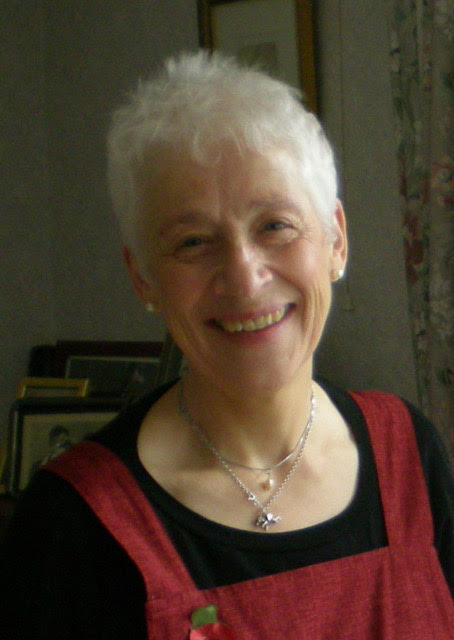
Headshot of Helen Hollick
Meet the unstoppable Helen Hollick

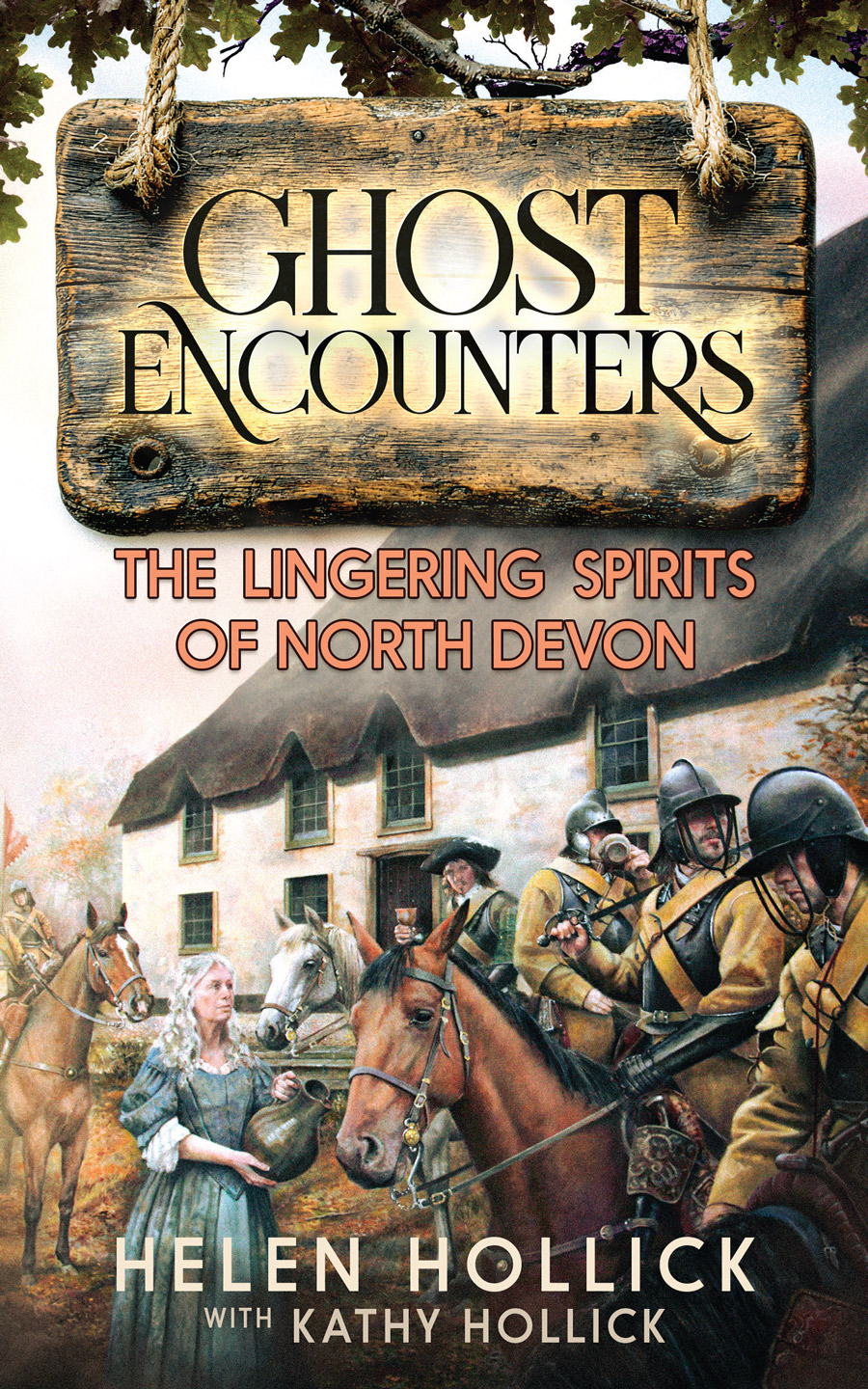
When earlier in the year, I scheduled this interview with my author chum Helen Hollick, it was going to be on the topic of ghosts, following the publication of her latest non-fiction book, Ghost Encounters: The Lingering Spirits in North Devon. Since then, she’s published another book, the ten-author anthology Fate, and is just about to launch A Mischief of Murder, the latest installment in her Jan Christopher cosy mystery series. Her productivity and her passion for what she writes are limitless – even when little things like her daughter’s wedding and her hip replacement crop up along the way!


Debbie: Helen, although you’ve included elements of the supernatural in your Jesamiah Acorne series of piratical adventures. Ghost Encounters: The Lingering Spirits in North Devon is a new departure for you, Have you always believed in ghosts?

Helen: I’ve never not believed, but I became more, let’s say ‘curious’, towards the end of the 1900s.

I was exploring the battle site at Battle, Sussex, walking down the hill in the rain when I suddenly felt the hairs on my neck stand up and an enormous sense of ‘presence’ behind me. I just knew that if I turned round I’d see King Harold’s shield wall of soldiers in front of the present Abbey.

I didn’t have enough courage to look though, so I’ll never know… but soon after I decided to write my novel, Harold The King and we went back to the site as a family several years running for the annal re–enactment days in October. Every time, my daughter ‘saw’ things that others couldn’t. It dawned on me that she could see the dead.

When we moved to our eighteenth-century Devon farmhouse, her gift became even more obvious, for she could clearly see and speak to our former ‘residents’, and others around the village and local area. I regard her ability as something quite natural and not at all scary. In fact most ‘ghosts’ are perfectly friendly – much of the ‘uncanny’ stuff on TV is over-dramatised nonsense.

array of images and quotes about Ghost Encounters

Debbie: You’ve focused on a relatively small geographical area in this book. What is it about the area that makes it particularly rich with ghosts? 

Helen: It’s purely a matter of logistics: North Devon is where I and my family live, so it made sense to write about ‘our’ ghosts! I wanted to write about our ‘extended family’, and the ghosts that can be encountered (if you’re that way gifted) in our village pub.

Originally, I was commissioned by a well-known non-fiction publisher to write the book as part of their Ghosts of England series. Despite sending them a detailed synopsis and several draft chapters, they rejected the finished book because it was ‘too personal’. They wanted me to cut out all Kathy’s encounters – which would have changed the point of the entire book. So I cancelled the contract and self-published it myself.

Debbie: You co-authored this book with your daughter Kathy. What role did she play in its research and writing?

Helen: Kathy is severely dyslexic, so reading and writing is not easy for her, (although thank goodness for technology and a laptop!) I did the actual writing, and Kathy did all the ‘supernatural’ work, relating to me who and what she encountered, and where. Between us we added a few third-party anecdotes gleaned from people willing to share their experiences. It’s surprising how many people are reluctant to share their encounters, though.

For instance, while in Barnstaple car park one afternoon, Kathy pointed up at the Norman motte-and-bailey ‘castle’  and informed me: “There are three Normans aiming crossbows at us.”

Another time she shouted at the driver of our car to “Mind that man!”

“What man?”

“The man in high-vis yellows walking down the middle of the road… there … that man!”

A car coming the other way didn’t swerve either. Not that it mattered, High-vis Man had already vanished.

Kathy regularly chats to our house residents – and they all came along to Kathy’s recent wedding!

photo of Kathy's wedding
See the empty pew on the right at Kathy’s wedding? Apparently it’s not really empty…

Debbie: What is your response to sceptics who don’t believe in ghosts and seek to explain everything scientifically?

Helen: Fair enough to not believe, but not being able to prove something doesn’t mean it doesn’t exist. Several years ago no-one could prove Black Holes existed – scientists cannot prove String Theory or Dark Matter.

When talking to a genuine medium, however, it’s hard not to believe. A genuine medium, by the way, is aware of ghosts/spirits (whatever term you prefer) at any time of day or night, and only needs to say “hello”, not “Is there anyone there?” As I said earlier, much of the uncanny stuff broadcast on TV is intentionally designed to scare and entertain. (Why do people like horror and scary things? I don’t!)

Seances and “knock once for yes” etc is a remnant from the Victorian age of pseudo-science – and might be fun, but is only clever trickery.

Debbie: I’ve never seen any ghosts, although I know people who have. But I do have a vivid memory of having to literally run out of the army museum in Paris many years ago, because I was suddenly overwhelmed by the display of hundreds, possibly thousands, of swords and guns, and the thought of how many deaths there were responsible for. Would you say that might have been caused by lingering spirits, or simply by my vivid imagination and extreme sensitivity to violence? Whatever the reason, I know I’ll visit Pompeii or Herculaneum, much as I’d love to, as I’d be too distressed by thoughts of so unfortunate victims of Vesuvius now uncovered by archaeologists. 

Helen: I’ve never seen a ghost either – but as I mentioned above at Battle Abbey I’ve felt something supernaturally awesome. I think many of us do when entering certain sites – old churches for instance. That feeling of something…? I’d say your reaction is sensitive empathy – genuinely aware of the horror of battle, possibly fed by imagination. It’s what makes us good writers, after all!

But the fear of ghosts has been ‘groomed’ into us, mostly by religions which saw anything unexplainable as the devil’s work or presence. Yet those who were later seen as saints seem to have been believed about spiritual presences or voices. Let’s face it, the most famous ‘ghost’ is the Holy Spirit!

Halloween and the persistence of spooks and nasty hauntings has perpetuated our common fear. But most of the spirits which linger among us are perfectly benign, and are probably as unaware of us as most of us are of them.  Graveyards, by the way, have very few ghosts, because these residents really do ‘rest in peace’. Some newly passed-over spirits might be hostile because they are confused and bewildered, uncertain what has happened and are in a state of shock. A genuine medium, (and I include Kathy here) can sensitively, quietly and calmly move them on to where they should be.

Are there ghosts at Pompeii and Herculaneum? Possibly, probably, but I doubt any of them are hostile or intent on malicious haunting. Any who are still there are very probably as intrigued by us, as we are of them, so there is nothing to be frightened of.

Debbie: Apart from your experience at Battle, has there been any other inciting incident that prompted you to believe in ghosts? 

Helen: One puzzling thing has stayed with me… not exactly a ghost, but a very vivid dream, which I describe in Ghost Encounters. I dreamt of a Great Western steam engine coming too fast into a station. The locomotive was much bigger than myself, so I had the impression that I was a child. I could clearly hear all the alarming sounds and saw the loco’s name and number. I woke up and wrote both down, then later on Googled for it – to discover this was a genuine Great Western locomotive Torrington 34031. Now, I like steam trains, but the only ones I actually know are Mallard and the Flying Scotsman. Was this a dream, a past life memory… or what?

Debbie: Wow! That’s pretty uncanny. So, how should people behave when first encountering the kind of vision you describe in your book? 

Helen: If you do meet a ghost, take a deep breath, keep calm, smile and say hello. And remember that ghosts are not like the stars or false teeth, they don’t only come out at night! And they dislike cold, dark, damp cellars as much as we do!

Debbie: You whet readers’ appetites for ghost fiction with two short stories included as a bonus feature at the back of Ghost Encounters, but it seems that wasn’t enough to satisfy your interest in the supernatural, because you’ve gone on to create a new multi-author anthology, Fate: Tales of History, Mystery, and Magic. Among its ten stories by different authors, your contribution is another ghost story, and there are supernatural elements in other stories too. Can you please tell us a little more about your vision for this anthology, and how it has turned out?

Helen: I wrote “In The Shadow Of Ghosts” after I’d published Ghost Encounters, but had no idea what to do with my story, which is based around some English Civil War ghosts that linger in our village pub. (I wrote the story because I wondered how and why they were there in the first place!) “I know,” I thought, “what about doing another anthology?” Most of my writer friends pen historical novels, mysteries or fantasy, so the general theme was an easy one to come up with: history, mystery and magic.

Although I say so myself, I think this anthology is an absolute cracker!

promotional image of Fate anthology in ebook and paperback
(Promotional image by Jean Gill, contributing author to “Fate”)

Debbie: Thank you so much for inviting me to be one of the anthology’s contributors, Helen. I was so pleased to have this prompt to write a suitable story set in the world of my Sophie Sayers cosy mystery novels, “Saints Alive”, in which young Sina has a close encounter with St Bride, the patron saint of the ancient Cotswold parish church in her village of Wendlebury Barrow.

And speaking of cosy mystery set in the English countryside, you’re now about to launch a new book in your own cosy mystery series, featuring Jan Christopher, inspired by your former career as a librarian on your former home turf of North-East London on the borders of Essex. Young Jan comes to spend a lot of time in North Devon as it’s home to her fiancée, a young detective, and together they solve murder mysteries both in the London Borough and in Devon. This new novel is based around an event dear to my heart: the annual village fruit and vegetable show! Can you please tell us a little more about it?  

We have an annual show here in Chittlehamholt and I thoroughly enjoy entering various items – flowers mostly, as I’m not a very good veg grower. But I did win with my damson gin the other year, and have been successful with the creative exhibit class. One year I won with ‘an exhibit based on a film’ – I did “Pirates of the Caribbean” (naturally!). Another year I won with ‘based on a book title’ my entry was “Cider With Rosie.” And in 2023 I came 1st with an exhibit depicting the coronation.

photo of Helen Hollick's award-winning exhibit on The Coronation
First prize to Helen Hollick at Chittlehamholt Village Show!

This year (2025) the theme is “A Jane Austen Novel”. Except I can’t tell you what my entry will be as it’s still secret!

I decided to use the village show idea as my next Jan Christopher mystery because there’d been quite a bit of teasing about the hanging baskets entries between my husband and one of our village friends, and, of course, someone had mentioned about all the shenanigans that go on behind the scenes with attempts at cheating – or making mischief. I had great fun writing this sixth episode!

A Mischief of Murder is available for pre-order here and will be launched on Tuesday 16th July.

promotional image for A Mischief of Murder
Now available to pre-order – launching on 16th July

Debbie: Where I live in the Cotswolds, our Hawkesbury Show  is the longest continually running one in the country and the highlight of the community’s year, so I’ll especially enjoy A Mischief of Murder! Finally, Helen, when you’ve had such a busy year so far, I hardly dare ask this question – but what will you write next?!

Helen: I’ve already started Jan Christopher Episode 7, A Matter of Murder. This one takes place in Hertfordshire at a place called Dobbs Weir, a tributary of the River Lee, and involves a sailing dinghy, a gypsy caravan, a swan or two … oh, and a mystery to solve. It’ll be out either later in 2025 or early 2026, depending on how fast I can write it! And then there will be Episode 8 … and another in my “Sea Witch Voyages” series. And perhaps another anthology?

Debbie: Helen, thank you so much for taking time out from your intensive schedule to update us on your three latest books. I don’t know how you do it!


About Helen Hollick

Debbie Young with Helen Holllick
Helen and I go back a long way! Here we are at my first book launch, which appropriately enough seems like ancient history now!

Known for her captivating storytelling and rich attention to historical detail, Helen’s historical fiction, nautical adventure series, cosy mysteries, and short stories, skilfully invite readers to step into worlds where the boundaries between fact and  fiction blend together.

Helen started writing as a teenager, but after discovering a passion for history, was initially published in 1993 in the UK with her Arthurian Pendragon’s Banner Trilogy and two Anglo-Saxon novels about the events that led to the 1066 Battle of Hastings, one of which, The Forever Queen (USA title – A Hollow Crown in the UK) became a USA Today bestseller. Her Sea Witch Voyages are nautical-based adventures inspired by the Golden Age of Piracy. She also writes the Jan Christopher cosy mystery series set during the 1970s, and based around her, sometimes hilarious, years of working as a North London library assistant. Her recent release, Ghost Encounters, is a non-fiction book about the ghosts of North Devon – even if you don’t believe in ghosts you might enjoy the snippets of interesting history and the many location photograhs..

Helen and her family moved from London to Devon after a National Lottery win on the opening night of the 2012 London Olympics. She spends her time glowering at the overgrown garden, fending off the geese, chasing the peacocks away from her roses, helping with the horses and wishing the friendly, resident ghosts would occasionally help with the housework…

Website: https://helenhollick.net/

Amazon Author Page: https://viewauthor.at/HelenHollick

Facebook: https://www.facebook.com/helen.hollick

Bluesky: @helenhollick.bsky.social

X/Twitter @HelenHollick https://x.com/HelenHollick

Blogsupporting authors & their books https://ofhistoryandkings.blogspot.com/

Monthly newsletter : Thoughts from a Devonshire Farmhouse


Posted in Writing

In Conversation with Author Howard Lovy

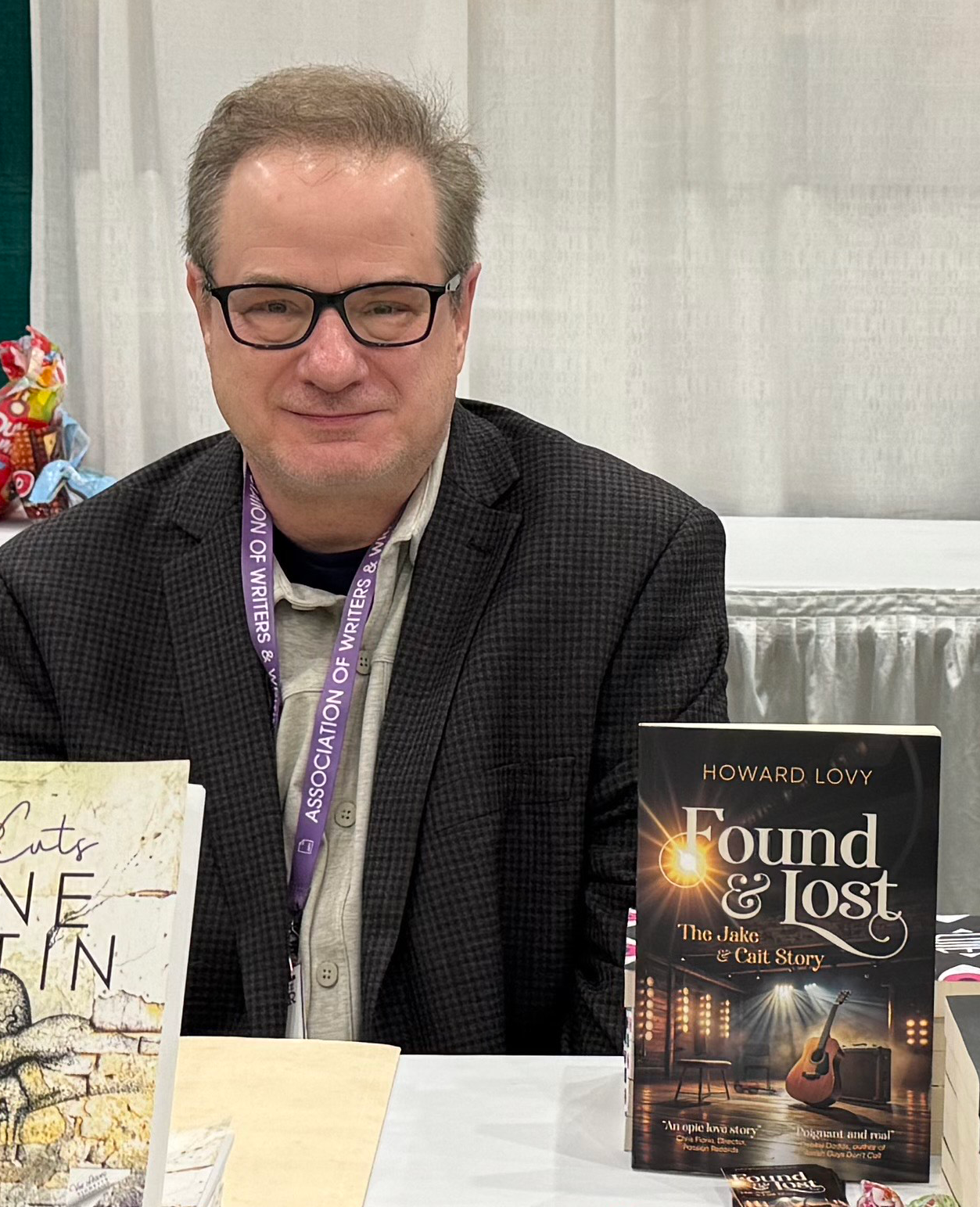
cover of Found & Lost - the Jake and Cait story by Howard LovyI’ve known Howard Lovy, American journalist, podcaster, and editor for eons, through our work for the Alliance of Independent Authors. I was surprised and delighted for him when he told me he was also about to become a published author. His debut novel, Found and Lost: Jake and Cait’s Story, was published by Vine Leaves Press, run by another longstanding author friend of mine, Jessica Bell. As Howard’s novel focuses around the music industry, and the multi-talented Jessica is also a singer/songwriter, I knew the story would be good.

Sure enough, when I received an advance review copy, I was gripped – and as soon as I’d finished it, I invited Howard to be this month’s guest on my blog, to tell us the story behind the story.


Debbie: You came to novel writing relatively recently, via a long path of all kinds of writing. Please briefly describe your journey to becoming a published author.

Howard: Okay. Let’s see if I can do this briefly, because it’s been a forty-year journey.

I spent the first half of my career as a journalist, beginning with small weekly papers, then big-city dailies and then international wire services and magazines. I covered everything from politics and business to science and religion.

Then, the news industry changed and I needed to adapt in order to make a living. I’m proud to say that I launched a pioneering blog covering nanotechnology in the early 2000s that was read by Congress and the White House!

That led to gigs writing about business and technology for Wired magazine among other publications. I got into the publishing world when I became executive editor of Foreword Reviews, which covered and reviewed books from independent and university presses, along with self-published authors.

After that, I was hooked on indie publishing and launched my own editing business in addition to podcast production and hosting for the Alliance of Independent Authors.

A throughline through all this has been my interest in Jewish issues, which I’ve covered for Publishers Weekly, the Jewish Telegraphic Agency, the Jerusalem Post, and many other publications. I’m also nonfiction editor for a Jewish literary publication called Judith Magazine.

Debbie: And then you wrote a novel about music! It’s notoriously tricky to write novels about music because of copyright issues, so presumably you had to write the song lyrics that appear in the novel. Are you also a songwriter and/or musician, or was this a new experience for you?

Howard: Other than the clarinet in middle school, I’m not a musician. However, I am knowledgeable about music, all kinds of music, and know how to appreciate great musicians. And I ran this by real musicians, who told me that I really captured what it feels like to play for an audience.

As an editor, I advise clients not to include song lyrics in their books, so I knew that if I were to include them, I’d have to write them myself. This was a new experience for me, but I found that writing lyrics was simply an extension of storytelling.

I don’t know if I could write lyrics “as me,” but I could imagine the lyrics that the teenage versions of my protagonists, Jake and Cait, would write.

How would Cait write a song from her Christian religious point of view? How would Jake contribute lyrics in his character as a secular Jew who is more cynical, and how could those words meld into songs that go viral forty years later? What I came up with seemed to be successful. A couple of reviewers said they could almost hear the music as they read the book and they wished Jake and Cait were real.

Debbie:  Praise indeed! Howard, you are well known as a writer on Jewish matters, but you chose to write about an interfaith relationship in your novel, and you did so in a very even-handed way. What were the challenges, risks and rewards of tackling this sensitive area?

Howard: When I wrote this novel, I was taking a quick break from writing about antisemitism and other Jewish issues. I was a little burned out. So, I decided to get out of my comfort zone and write this piece of fiction. This was before October 7, 2023, when the world changed for many Jews, including me, and frankly I don’t know if I could have written this kind of optimistic book in the last year-and-a-half.

I’m very glad that reviewers are calling it even-handed when it comes to faith. I’ve always been a student of religion—all major religions—not necessarily out of belief, but because I think it’s important to learn what motivates people. I try not to fall into the trap of caricature.

Religion is a powerful motivator for people, and it is for my protagonists, Jake and Cait.

There are many reasons I chose an interfaith couple, and there are risks in doing this, but I thought it was important to the story I was telling. They’re opposites—Jake is Jewish and rough around the edges; Cait is a classically trained Christian violinist searching for a simpler kind of faith. But when they play music together, it’s magic. They finish each other’s musical sentences. The way they make music together overrides everything else.

That idea of opposites finding connection—of working through regret, misunderstanding, and difference to make something beautiful together—feels especially meaningful right now. There is a Yiddish expression for this. It’s called beshert, or destiny. It’s usually used interchangeably with the English word “soulmate.”

But my book asks the question, what if your beshert is not exactly what you expected?

Debbie: You follow an interesting route with the timeline in the novel, not only combining flashbacks and present day, but continuing some years beyond the publication date. That took me by surprise! I admire your boldness there. Why did you choose such a far-reaching timeline rather than stopping at the present day, and what were the challenges of projecting that far ahead?

Howard: Among the themes in my book is a look at the culture of fame and also the morphing shape of memory. I’ve always been fascinated by books and stories that look at what happens to people over time. In the documentary about their lives, Jake and Cait look at their experiences through the lens of forty years.

We are all unreliable narrators of our own stories. Sometimes, we remember only the bad or only the good and choose to forget the memories that contradict the story we’ve told ourselves. In the “flash-forward” scenes toward the end of the book, I imagined this unreliable memory on a societal scale as it applies to the musical phenomenon of Jake and Cait. People remember them through the lenses of their own political, religious, or societal points of view.

Plus, “Time” is practically a character in this novel, so I thought I’d give it a little more room to develop.

Debbie: The novel is set in Michigan. To what extent is it a hymn to your homestate?

Howard: Well, they say to write what you know, and I know Northern Michigan very well.

I’m hoping the setting is a character in itself—both Interlochen, Michigan, in the present day and as the way I present it in memory.

Many people visit Northern Michigan on vacation and have childhood memories of it. To me, my memories of Interlochen Arts Camp took on this kind of mythic quality. It’s strange, just going to the camp now to promote the book. There is a mixture of things I remember from 40 years ago, and things that exist today. So, I walk through it all in a haze of reality and memory. And that’s what I wanted to show for the characters, too: There’s what they knew in 1985, and the reality of 2025 along with all the baggage that goes with it.

I also set part of the book in New York City, though, where I’ve also lived.

Debbie: The book is flying high in the Jewish fiction charts, but what other genres does it fall into?

Howard: Yes, I was very pleasantly surprised that it reached, at one time, the top three in Jewish American Fiction, even though Judaism is just one of many themes in the book. It helped that the Jewish Book Council ran a favorable review. Amazon also has it listed under “Literary Sagas,” and “Contemporary Literary Fiction“. Frankly, I just think of it as a good book.

Debbie: What does the interfaith element add to the story, and why would the book be less effective if faith didn’t come into it?

Howard: My original vision for the book had age more as a factor than faith—both their youth and their middle age—but as I developed the backstories for these characters, I found the faith angle to be more compelling.

Jake’s Judaism and Cait’s Christianity are not just aspects that stand alone as part of their characters, but they are wholly ingrained in who they are.

Their relationship with music, with the world, and with one another would not be the same without the dynamic of faith and how they can both clash and harmonize. It wouldn’t be the same book without that element.

Debbie: Late-in-life renewals of old romances are popular in fiction. How does your book go beyond the norms for this sub-genre of romance?

Howard: When I wrote the book, I had no idea that some would consider it a romance novel. In fact, it could be a subgenre called “second-chance romance.” I’m completely ignorant of all the tropes involved, though, so any regular romance readers might be disappointed—or maybe even angered—that I broke some of the rules. To say more would be a spoiler!

Debbie: This is your first novel. What’s next for you in your fiction writing life?

I found fiction to be very freeing. I could say more about “reality” through made-up characters than I could in my nonfiction work. I don’t think I’m quite done with what I’ll call the “Jake and Cait Universe.” I picture two more books in the series, the first one imagining what happened during that 40-year gap. It’s not a prequel or a sequel. I’ll call it a “middle-quel“.

Debbie: How interesting – I don’t think I’ve come across a middle-quel before! Now, if readers like (insert other author name here), they’ll love Howard Lovy.” Please fill in the blank!

Howard: Taylor Jenkins Reid, Ann Patchett, and Jennifer Egan

Debbie: Your publisher is Vine Leaves Press, a thriving small indie publisher, Why are you especially pleased that they picked up your book?

Howard: I have nothing but wonderful things to say about Vine Leaves Press! They’ve been incredibly communicative and supportive throughout the editing and publishing process. I’ve enjoyed working with them—especially publisher Jessica Bell’s amazing cover design.

Debbie: Finally, Howard, could you please provide a brief extract to give readers a flavour of your novel. 

As it turned out, they would record “Love Moves On” a few months later in a place far away from the tall grass, hemlock, and pine of Northern Michigan. Then the song would sleep for forty years before awakening into the ears of millions in a nuclear explosion that would change their lives forever and wreak untold collateral damage.

And that was only their first song.


ALL ABOUT HOWARD LOVY

photo of Howard Lovy with his debut novelHoward Lovy is a veteran journalist, book editor, and author with 40 years of experience covering topics ranging from science and technology to Jewish issues. His work has appeared in Publishers Weekly, Longreads, The Jerusalem Post, and many more. A former executive editor of Foreword Reviews, he also hosts a podcast for the Alliance of Independent Authors. Howard lives in Northern Michigan with his wife, Heidi, and their dog, Henry. You can find him at https://howardlovy.com/


MY REVIEW OF FOUND & LOST: THE JAKE & CAIT STORY

cover of Found & Lost - the Jake and Cait story by Howard LovyI was pleased to receive an advance copy of Howard Lovy’s debut novel, having enjoyed his podcasts and journalism, but I wasn’t sure what to expect – and this gentle, slow-burn romance surprised me in the best possible way.
It’s a gentle, sensitive tale of youthful love forged by a shared musical talent, which ends in a sudden break-up unexplained until the end. Forty years later the revival of the couple’s music as a viral internet sensation – written long before viral social media posts were a thing – brings them back together in a storm of supportive publicity.

Although bound by an almost telepathic ability to play so well together, the young couple face other challenges brought about by their differences. She is a sincere Christian investigating different kinds of belief and he a Jew; she is a classically-trained, highly-educated musician, he is self-taught.

The unusual structure of the story is not only divided by two timelines decades apart, but also by the interspersal of transcripts of a TV documentary delving into their past as they reunite after 40 years apart. The insights into the music industry, past and present, and the occasional appearance of real-life musicians and producers such as the great Suzanne Vega add further depth and interest to this rewarding novel.

Highly recommended to anyone who enjoys clean romance reuniting past lovers, or who likes intelligent and original feel-good fiction.


HOW TO ORDER HOWARD’S NOVEL

Found & Lost: The Jake & Cait Story can be purchased through Vine Leaves Press here or on Amazon here.


Posted in Events, Publishing, Writing

In Conversation with Linda Alvis – Artist, Author & Poet

As regular readers of my blog will know, my final post each month is a conversation with an author friend, talking about their creative process and other topics that I hope you will find of interest. This month, it’s perfect timing to welcome Linda Alvis to celebrate the launch of her latest travel memoir, the third volume in her series Hoovering Up the Holy Carpet.

photo of Linda Alvis in her studio with all three of her travel memoirs
Linda Alvis in her studio at her latest book launch

Debbie:  You’re best known as an artist rather than an author. Please can you tell us a little bit about your background and your achievements as an artist.

Linda: I have written little poems and stories since early childhood as well as painting and drawing.  My first memory of drawing is at Bristol Museum when I was four years old. Later I had a small den in the roof of my home where I wrote stories and poems.  I have only one poem from that time and it is very over romantic and rather ‘Wordsworthy or Byronesque’. It isn’t in my poetry book!

I have won an award for one of my paintings and two works have been exhibited at The Mall Galleries in London. One with The Pastel Society and the other with The Society of Women Artists at their Annual Open Exhibitions. Over the years I have had many commissions.

Debbie: What made you decide to start writing books?

Linda: I always loved writing essays at school but it wasn’t until I broke my right wrist very badly in 2007 that I started a ‘pamphlet’ for my art class, using the computer and my left hand. I couldn’t use my right hand for many months. I got so carried away with family history and my journey as an artist that, when I found I had written ten computer pages and was still in the 1940’s, I decided to carry on.

Debbie: This month, you’ve launched the third in your series of entertaining travel memoirs. How do those relate to your art?

Linda: From the age of 6 or 7 I was sent off to the Saturday mornings children’s cinema by my busy shopkeeping parents and loved the black and white films shown then.  ‘Cowboys and Indians’, Roy Rogers and Hopalong Cassidy etc., as well as Heidi with Shirley Temple and other cultural offerings. I was especially hooked on anything relating to the indigenous peoples of North America. Having friends and relations in Australia, Canada and the USA I have been able to meet with many indigenous peoples who have been gracious enough to allow me to photograph them and paint their portraits.

Debbie:  On just about every trip, you tap into local art and culture of the indigenous people. What are your most memorable encounters of this kind?

Linda: My meeting with Tanya Nungari in the Alice Springs area. She and her husband were just sitting in the shade under a tree near an aboriginal centre. Tanya was an aboriginal naive artist and I was able to purchase a painting that she was carrying. I wanted to talk more to her but very suddenly she and her husband Wesley just ambled off into the bush. However she had allowed me to photograph them for a future portrait.

My mother and I were privileged to visit Vietnam in 1993 as part of the first group, rather than single travellers, to enter since the American war. It was led by the late great Tony Soper. It was amazing, experiencing Vietnam on the cusp of change.

Another most memorable was with Aaron Lee, a Cree artist  and leather/bead worker in Edmonton, Canada. He had an incredibly strong face and I just had to ask if  I could take a photograph of him for a portrait and he replied ‘Do you want me to look dangerous?’ We both laughed. He used the eventual portrait on his website which was an honour.

My portraits of Ukrainian people are the most poignant, ’The Bandoura Player’ in Kiev, The Cossack boy and Ivan Petriovich, the retired hydroelectric power engineer in Zaporozhya, a Dancing girl in Novaya Kakhovka and the beautiful Lilya in Sevastopol.

front and back cover of Linda's third travel memoir
Linda shares a taster of her art on the covers of each of her travel memoirs

Debbie: Your trilogy of travel memoirs has a surprising title: Hoovering Up the Holy Carpet. How did that come about?

Linda: I was in the RWA in Bristol, looking at various works of art when a voice boomed across the gallery:

Alvis, get to my art class. I would prefer a good Catholic, but you’ll do!  We only do pastels as I have to hoover up the holy carpet!

Monday afternoons in the Roman Catholic Cathedral. I feeI I have been hoovering up the holy carpet, so to speak, ever since.

My trilogy is for those who love family sagas, art and travel and hopefully will inspire readers to be brave in their endeavours, travel to wonderful places or just accompany me on the journey.

Debbie: I was astonished at how many countries you’d visited. If there are any countries left that you’d still like to visit, which are they and why?

Linda: Once I had an opportunity to go to Papua New Guinea, always a dream, but it didn’t happen  and that is a regret. I love ‘off the beaten track adventures’ and was most fortunate to go outback camping on Aboriginal land in the Northern Territories of Australia. It was quite rugged but marvellous.  I have been to Guatemala in Central America for a wedding but would love to see more of South America.

Debbie: Although this month we’re celebrating the launch of your third travel memoir, you have other books to your name. Can you please tell us a little bit about these too.

Linda: I first wrote my children’s books, Worrall and Robin and Worrall, Robin and the Garden Visitor after a memory that had been buzzing around in my head for years. When first married I was planting some flowers in the garden when I  unearthed a very large colony of huge earthworms. I was so shocked I had sit down with a cup of tea. So, in the story, the large chief worm Worrall looks after his community and especially the naughty Jimmy Wriggle who is always getting into trouble with the Robin. Mainly for  approximately 4-9 year olds, they are garden dramas with humour and a cautionary tale, with some new characters in the second story.

cover of Worrall and Robin by Linda Alvis

cover of Worrall, Robin and the Garden Visitor

After the ‘Worrall’ books I decided to do something with my largish collection of poems so Dawn Rising came about. A series of life poems each accompanied by one of my paintings. I was asked to be part of the Poetry Slam at the Hawkesbury Upton Literary Festival  back in 2017 and was thrilled to come joint first!

cover of Dawn Rising poetry book by Linda Alvis

Debbie: What would be your advice to anyone else thinking of writing travel memoirs, eg should you keep a daily journey on your travels? Is it best to allow time to process your experiences before you write them up?

Linda: Yes, I do make notes, especially when travelling in places like India as I would never remember all the names of towns and villages I passed through  and events witnessed there but as photography has always been one of my first and great loves I take many photographs for reference and make brief notes in situ. It is best to strike while the iron’s hot so you don’t forget  anything.

Debbie: What are you working on at the moment?

Linda: Recovering from launching Volume Three of Hoovering Up The Holy Carpet but I now have ideas for a novel.

Debbie:A novel – that’s exciting! Keep me posted! Now, final question: you often host or take part in art events in your home city of Bristol. Are there any coming events that you’d like to tell us about today?

Linda: My partner and I always hold our own summer exhibition of art and, weather permitting, open up the gardens for visitors to sit awhile and enjoy the peace and colour. We are also always involved in the West Bristol Art Trail which is a huge event each mid-October and is extremely popular with visitors.  My books are alway available at these events. Recently I was a guest speaker with two other authors at a lively and well-attended event at Clifton Library. Hopefully more opportunities like that in the future.

Linda has kindly allowed me to whet your appetite for her latest volume of travel memoirs with these two short extracts. 

array of trilogy of travel memoirs by Linda Alvis


Cruising along the Rhine and reaching Melk in Austria

I had read about Melk in the cruise information pack but could have no idea of the true magnificence of this Abbey. We arrived at our mooring in the early morning and, as usual, I was up at the crack o’ dawn to have a short sprint around the deck when I was stopped by staff at the foyer desk.

‘Have a walk through the forest to see Melk. You can do it and be back for breakfast.’

Ooh, yes, I was definitely keen to do that and off I set. I found a path through the forest and passing a man jogging and lady walking her dog, neither over friendly, pressed on wondering if I was doing the sensible thing. It seemed a very long way to go. Eventually, with some relief, I saw daylight through the woods and as I arrived at a river in welcoming daylight I was stopped in my tracks. I gasped in absolute amazement as there above me, and appearing to fill the sky, was this immense and most spectacular Baroque abbey, perched above the town and gleaming gold against a clear blue sky. It quite took my breath away. Walking over a bridge into the town I passed a pure white heron searching for breakfast. I would soon have to return to the boat for my own breakfast but, walking through the quiet streets, the town was beginning to wake up. Men walked to work and
ladies with baskets headed for the market as the shutters of a small hotel were being opened as I passed by. I decided to have a quick coffee before the trek back to the boat and sit a while to take in the loveliness of that pure morning.

I approached the hotel desk and hoping my rusty school German would suffice asked … ‘Eine kleine kaffee bitte, mit melk.’ Praise be, I was understood. Sitting outside under an umbrella for shade, I was served a delicious coffee, beautifully presented on a silver tray and with a glass of water. I relished this heavenly moment before speeding back to the boat in time for breakfast. I would never forget the loveliness of that morning.


Arriving in Guatemala for a wedding

After changing flights in very pleasant Dallas airport, I arrived at night, in sprawling Guatemala City, a forest of lights as we descended. Slightly overtired by this time, but trusting, I hoped the arranged transfer to Antigua would arrive. It did and, with four other guests from the USA, we travelled for an hour to our destination, the Hotel Porta. Slightly discombobulated by this time and longing for bed, I followed a porter to my lovely garden room. On the bed was a ‘welcome’ package’ containing Guatemalan liqueur, sweets and toiletries from Megan and Sergio. What a delightful touch. By that time it was midnight and I was so tired I had to get to bed. I decided I would catch up with the Harveys the next morning. I quickly fell fast asleep but was suddenly woken by the bed heaving backwards and forwards.

What was this? Had I been given the honeymoon suite? Dazed, my whole body jerked up and down and then, just as suddenly, it stopped and off to sleep I went again, thinking I would have a lie-in the next morning.

At much too early an hour, I was woken by loud squawkings from a family of macaws just outside my bedroom window. How strange, I thought, I expected to wake up much later but never mind, I’ll get off to breakfast and meet up with my friends. Outside my room was a shady corridor filled with exotic flowering plants, including a magnificent Strelitzia, and some species I had never seen before. The macaws had settled down by then and I walked across leafy grounds by a swimming pool to the semi-open dining room. Kelly and Rodger, parents of the bride, were already there and we hugged each other quite emotionally. How lovely to see them again and on such an occasion.

‘How did you cope with the earthquake?’ Kelly asked.

I told her about the bed at midnight.

‘No, the big earthquake this morning. Well over 5 on the Richter scale!’

Goodness, I had slept through it. No wonder the macaws were disturbed.


For more information about Linda’s work, and to view her beautiful artwork, visit her website: www.alvisfineart.co.uk.

All Linda’s books are available from Amazon.

Click here to view the Amazon page for her travel memoir trilogy, Hoovering Up the Holy Carpet. 

View Linda’s gallery of art, including many pieces inspired by her travels, here. 

View Linda’s completed commissions here. 


IN OTHER NEWS

photo of Debbie speaking with microphone
(Photo by Félice Hardy)

As you can tell from Félice Hardy’s photo of me in action, I had great fun last week as a guest speaker for the Frome Writers’ Collective, talking about different paths to publication. Tickets sold out in advance, and when I arrived at the venue – the gorgeous and historic Archangel Hotel in Frome – I was slightly startled to see posters just about everywhere advertising my appearance!

The room was jam-packed with enthusiastic writers at all stages of their careers, many of whom had great questions at the end.

cover of The Tennis Champion Who Escaped the NazisHuge thanks to Félice for inviting me. I first met Félice when she offered to speak at my Hawkesbury Upton Literature Festival about quite a different kind of memoir to Linda’s – a family history called The Tennis Champion Who Escaped the Nazis. The book is as compelling as that extraordinary title suggests, and if you’ve not yet read it, I highly recommend it.
Now, after a short break visiting my daughter in Aberystwyth, I’ll be glued to my desk for the rest of the month, completing my next book Death at the Village Christmas Bazaar (working title), due to launch on 4th September 2025 – you can already pre-order it here.


Posted in Events, Reading, Writing

In Conversation with Liza Perrat, Historical Novelist

headshot of Liza Perrat in sunshine
Meet Liza Perrat!

In last month’s In Conversation post, Scottish author Lorna Fergusson and I discussed writing about a sense of place, with particular focus on Lorna’s latest book, One Morning in Provence, in which the lives of British characters are changed by trips to France.

This month, I’m talking about books set in France again, this time with Australian author Liza Perrat, and with a different perspective. In Liza’s France-based books, the characters are French, and the reader is immersed in French life and culture from down the ages.

So how did an Australian come to write such convincing novels set in another country? In her younger days, Liza would have been surprised about this too! Over to Liza…

Continue reading “In Conversation with Liza Perrat, Historical Novelist”

Posted in Reading, Writing

In Conversation with Dr Carol Cooper

cover of The History of Medicine in Twelve Objects by Dr Carol CooperWhen I heard that my wise, witty and smart author friend Dr Carol Cooper had been commissioned to write a book called A History of Medicine in Twelve Objects, I was impatient to read it. I love any book that makes history more accessible via the lens of a well-chosen list.

I first came to know Carol through her compelling novels, two set in London and one in Alexandria, Egypt, where Carol grew up, and we’ve long been members of a wonderful writers’ group called The Sanctuary. Carol has also had a distinguished career in medicine as a practising doctor, as a lecturer, and medical journalist, and is a fellow of Newnham College, Cambridge, her alma mater.

I knew this new book was going to be a great read, so was glad to receive a review copy prior to publication. I couldn’t put it down.

It’s the sort of book where you find yourself reading aloud fascinating snippets to whoever else is in the room.

In accessible, easy-to-read style, Carol describes the stories behind the invention of the titular twelve objects and how they each revolutionised a branch of medicine. She also includes fascinating anecdotes about the characters involved along the way, including patients as well as the pioneers behind the inventions.

Available in hardback, ebook, and audiobook narrated by Carol, The History of Medicine in Twelve Objects would make an excellent Christmas present for anyone interested in public health and medical matters, and for readers who enjoy popular science books.

I’m very pleased to welcome to join us on my blog today to share more insights into her new book.


Debbie: Carol, you were commissioned to write this book when your publishers identified a gap in the market for a history of medicine viewed through a number of key objects. What made you the perfect person to write it? 

Carol: It was an idea that my agent and I had tossed around. While I loved the concept, I wasn’t that keen to write the book at first because I was engrossed in drafting a novel. But as you see I gradually came round to it. Why me? Well, I’m not a historian, but I do sometimes feel like a relic from days of old. I’ve been a doctor for many years, worked in several different major specialities including orthopaedics and chest surgery, and seen many changes over time. I suspect it was my long experience of medicine along with an almost equally long career as a journalist and author that helped convince publishers.

Debbie: For a while now there has been a vogue for viewing particular aspects of the human experience through the prism of a list, eg Neil MacGregor’s A History of the World in 100 Objects. Was the number twelve imposed on you or did you choose the quantity – and if the latter, what were your criteria for choosing them?

Carol: You can see the appeal of those lists. Each of my objects tells a story. It speaks of the ingenuity applied to solve a problem, which in many cases is a life-or-death situation. Objects come from a particular time, and may be typical of a certain culture. Ten was the number that my agent first had in mind, but I thought it would be impossible to cover the range of medicine in just ten objects, so we stretched it to twelve.

I could have chosen thirty or fifty, but I wanted to delve into the lives of the trailblazers and their patients, not just describe the tools.

I selected objects that were developed primarily for treating people, a criterion that excluded such things as thermometers. Each one also had to be important in helping to develop a particular speciality or, as in the case of the microscope, for instance, to lead to discoveries that completely changed medicine. While the chapters chart a progression over the centuries, you could read each one on its own, or in a different order.

Debbie: Of course it’s really far more than 12 objects because in each section you elaborate on various iterations of a particular item over the centuries, and in some cases across millennia. Do you have a personal favourite chapter or object?

Carol: I love the heart-lung machine. It goes back to the early 1950s, so I never knew a time when it didn’t exist. But, when I was a junior doctor at Harefield Hospital, Northwest London, I learned about the era before cardiac bypass, when surgeons could only attempt open-heart surgery by reducing the patient’s metabolism.

That’s because the brain can only last four minutes without oxygen-rich blood, which, as you can imagine, severely limits what surgeons can do.

Thomas Holmes Sellors and his team at Harefield made use of hypothermia. They literally dunked their patients into an ice-cold bath to bring down their core temperature and reduce their metabolic need for oxygen. And that enabled daring new operations that gave new life to blue babies and others with congenital heart disease. Many of these conditions can now be totally corrected with the help of the heart-lung machine, along with the appropriate expertise.

When I worked at Harefield, wards were full of children from all over the world with various types of cardiac problems that would have been lethal only a short time before.

As I recount in the book, the heart-lung machine was the pipedream of a young doctor called John Gibbon at Massachusetts General Hospital. It was 1931 and he was at the bedside of a desperately ill patient for whom he could do nothing, other than sit with her through the night and watch her die. What if, he wondered… That patient died, but twenty years later Gibbon and his wife Mary, who was also a scientist, had developed his madcap idea into a workable heart-lung machine.

Debbie: Which of the 12 objects has saved the most lives or had the biggest impact on the welfare of mankind?

Carol: That’s a tough question. The humble hypodermic is essential to modern healthcare, but I think my answer would be either the microscope or the X-ray machine. The microscope brought with it the germ theory of infection. Without it, we might still  be clinging to wrong-headed notions about disease, like the “four humours” that so convinced Hippocrates and Galen.

  • The microscope led to vaccines, antibiotics, and accurate ways to study tissues (for instance, in a sample taken at biopsy).
  • The X-ray machine has revolutionised both diagnosis and treatment by allowing doctors to see inside the body without relying on guesswork, or operating to take a look, or waiting for the post-mortem.

Even today, many parts of the world don’t have access to X-rays and other imaging procedures.

An invention in itself doesn’t save lives. It has no value unless it’s made available to those that need it.

Debbie: You’ve gone into tremendous and fascinating detail. (It would make a great source book for the “Elves” who research the TV programme QI!) How did you go about the necessary research and how long did it take you? 

Carol: I’ve no real idea how long it took because I enjoyed it so much. But I can tell you that I had around nine months to write the book and I spent a lot of it in Cambridge’s splendid University Library which holds a copy of every book ever published, along with most of the journals. I was also privileged to use the library in my own college. As well as having delightful buildings and gardens, Newnham has one of the best-stocked college libraries in the university. As a women’s college, it always had to. For a long time, women students at Cambridge were barred from using the university’s facilities.

Debbie: What surprised you the most among the facts you uncovered?

Carol: One surprise was that, sometimes, the person I’d always thought had made a particular discovery was not, in fact, the first to do so. I’ve included several examples of this, for instance, in the chapter on X-rays. Writing up one’s work is a good way of establishing priority of discovery, hence the saying “Publish or perish,” but there’s often more to it.

The person that posterity celebrates is sometimes the more prominent person, or the more academic, or the one with friends in high places.

There’s also that other well-known saying: “It’s not what you know, it’s who you know.”

Debbie: It’s much more than a history through objects, because these objects didn’t spontaneously generate – they are the result of the tremendous inventiveness, imagination and perseverance of bold, extraordinary thinkers. Many of these were also incredibly brave, first testing their theories and creations on themselves. If you could give your own version of the Nobel Prize for Medicine to the most remarkable of these pioneers from down the centuries, which would you choose, and why?

Carol: The first Nobel prizes were awarded in 1901, so there are many innovators who missed out on a laureate because they were born too soon. That makes it hard to choose just one to honour, but I think I would nominate French doctor René Laennec who invented the stethoscope in 1821.

The normal way of listening to a patient’s chest in those days was to put one’s ear directly onto the chest. One particular day, however, Laennec’s patient was a curvaceous young woman. It was awkward. On the spur of the moment, he picked up a notebook, rolled it up, and used it as a tube to listen to his patient’s chest.

This serendipitous invention led to a more scientific approach to medicine, especially diseases of the chest like TB. Laennec studied all the different sounds that could be heard with a stethoscope, and correlated them with symptoms. He then published his work in a massive tome that became a classic. Less well-known is the fact that Laennec listened to his patients as they told him of their worries.

He was a true scientist, but he was also patient-centred, and I think he deserves the highest accolade.

Debbie: Fast forward to the 21st century, and are there still opportunities for individuals to make a huge difference like a modern-day Pasteur, for example, or are we now in the hands of big pharma and capitalist businesses bent on profit rather than the common good? (Many of the pioneers you describe made very little money from their inventions.)

Carol: I think there are still lateral thinkers who will come up with valuable ideas, but we live in a different world.

Nowadays any new advance has to be evidence-based, so the clinical trial is king.

And that’s often expensive. These days more than ever, an innovator needs backers to supply necessary funds for trials, and then, if those are successful, to help their ideas gain traction.

Debbie: You also write novels, each with a medical element – can you please tell us a little about each of your works of fiction. 

Carol: My first two novels are contemporary stories set in London. In One Night at the Jacaranda, the characters are looking for someone special, and each one of them is lying. For instance, the ex-con conceals his stretch inside, the charity worker keeps quiet about his terminal cancer diagnosis, and the GP lies about his job because he’s sick of people telling him their symptoms. It’s light in tone, but the serious point is that you can’t build a relationship on a foundation of lies.

cover of One Night at the Jacaranda by Carol Cooper

Hampstead Fever continues the story for some of the characters and introduces new ones as they grapple with work, children, ageing relatives, and the other challenges life throws at them.

cover of Hampstead Fever by Carol Cooper

The Girls from Alexandria is different in that it takes place mainly in Egypt, where I grew up, and much of the action goes back to the glamorous fifties and sixties. The main character is seventy-year-old Nadia who’s losing her mind. If she doesn’t find her sister, who is her one surviving relative, she will end up in a care home. The snag is that Nadia’s sister disappeared some fifty years ago, and nobody believes she even existed.

cover of The Girls from Alexandria by Carol Cooper

All my novels are multicultural and have a medical thread running through them – there are sick children, stressed doctors, confused seniors, and a number of medical conditions even if they’re not always the main thrust of the story. I believe that writing what you know makes a story more authentic and more believable.

Debbie: Carol, thank you so much for taking the time to join us here on my blog today. It’s been an absolute pleasure, and may The History of Medicine in Twelve Objects be a Christmas bestseller! 


More About Dr Carol Cooper

headshot of Dr Carol Cooper by Mat Smith PhotographyDr Carol Cooper is a doctor, journalist, and author. She taught students at Imperial College Medical School for almost twenty years, for which she received the Outstanding Contribution to Teaching Award in 2022. She was elected President of the Guild of Health Writers in 2014, and is a Fellow of Newnham College, Cambridge, her alma mater. Carol has authored and edited a string of non-fiction books on health and medicine, including an award-winning book on general practice. She also writes novels with a medical strand. Best of all, she has three amazing sons.

Follow Carol on her website at www.drcarolcooper.com and on Instagram at @drcarolcooper, where she often shares fascinating facts related to her books and her writing life.