
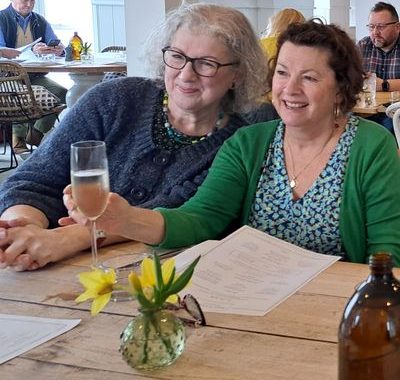

In last month’s In Conversation post, Scottish author Lorna Fergusson and I discussed writing about a sense of place, with particular focus on Lorna’s latest book, One Morning in Provence, in which the lives of British characters are changed by trips to France.
This month, I’m talking about books set in France again, this time with Australian author Liza Perrat, and with a different perspective. In Liza’s France-based books, the characters are French, and the reader is immersed in French life and culture from down the ages.
So how did an Australian come to write such convincing novels set in another country? In her younger days, Liza would have been surprised about this too! Over to Liza…
Liza: First of all, many thanks to Debbie for having me as a guest. I really admire your writing, Debbie, and it’s an honour to appear on her blog.
I’m an Aussie-born girl and grew up on the stunning New South Wales coast, never imagining I’d live anywhere else. Fast forward 28 years and I was in for a big surprise!
Back in 1988, working as a general nurse and midwife, I secured a midwifery job in Saudi Arabia, and decided to spend three months beforehand visiting Thailand, Nepal and India.
Meeting someone certainly did not feature on my list of holiday “to-do” list but, as fate would have it, on my first day in Bangkok I met a Frenchman.
37 years later, we are still (mostly!) happily married.
We settled in France, and my entire life abruptly changed in every possible way, and I must say it was a bit of a struggle to adapt to French life. I missed my Aussie friends and family and the beautiful beaches terribly for many years, but fortunately I was too busy with three young children to have the time or energy to dwell on homesickness.
Then, unannounced, creative writing popped into my life, and saved me from myself.
I’d always been a history buff and voilà, I was now living amidst all of this amazing European history. After obtaining a degree in French, I found myself (with real conscious decision), writing historical fiction. Of course, I often got lost down the rabbit warrens of research and my French historical trilogy, The Bone Angel, took far longer to write than it should have.

I based my fictional village for the three books on the rural French village in which I live.
Debbie: My home village in the Cotswolds, where I’ve lived since 1991, is also the inspiration for my Sophie Sayers novels, and my new Cotswold Curiosity Shop series. Our books are very different, and it’s interesting to see what different paths we have taken with a similar starting point!
Liza: My village is also the headquarters for the regional historical society (l’Araire). Needless to say, I paid the Araire a lot of visits and they were incredibly helpful with many historical aspects of the village, from the 14th–20th century, encompassing the Black Plague, the French Revolution, and the French Resistance of World War II. Many of the villagers (including a few ex-resistance fighters) were also keen to tell me about their heroic and dangerous tales as they answered General de Gaulle’s call to liberate France from the Nazi occupiers.
This group of small, close-knit villagers are proud of their history, their heritage and their bravery against the many and varied foes across the centuries, and I consider myself very lucky to have had their help in writing my novels.
The Bone Angel trilogy is available as an e-book HERE.
Debbie: What a wonderful resource you have tapped into – no wonder your French historical novels ring true! I bet the villagers are very pleased and proud that you have chronicled their history so faithfully. But you haven’t only written about France, have you?
Liza: No, I’ve also written three Australia-based, coming-of-age novels set in the 70s.

Embracing the social changes of 1970s Australia, against a backdrop of native fauna and flora, The Silent Kookaburra is a haunting exploration of the blessings, curses and tyranny of memory. This unsettling psychological suspense story is available HERE.

Reflecting the social changes of 1970s Australia, The Swooping Magpie is a chilling psychological tale of love, loss and grief, and, through collective memory, finding we are not alone.
The third book, The Lost Blackbird, is the tragic story of child migration based on real events.

Then I returned to French settings, for another historical fiction trilogy, The Women of the Lake. These stories are set more recently, in the late 60s and early 70s, as France teetered on the cusp of women’s liberation and feminism. The first book, Lake of Echoes is an emotional French village tale of a missing child. The second (though all are standalones), Lake of Widows, explores the complexities of marriage, family secrets and self-discovery in 20th-century France.

Debbie: This is another fascinating era to write about. Did you have a similar experience of gathering information from friends and neighbours, or did you have to do some other kind of research?
Liza: Once again, family and friends were very helpful in recalling the important beginnings of women’s lib and feminism, and only too keen to talk about it.
Debbie: Clearly your first French trilogy could only have been set in France, due to the historical context. Is the same true of The Women of the Lake? How was that era different for women in France from how it was in other countries?
Liza: I think life was similar for women in France during this time as in other countries of the Western World. Though it seemed the French were highly influenced by events in the USA, such as music and fashion and, notably, the hippie counterculture movement, rejecting what they saw as the staid, old-fashioned mores of traditional French life. As in the USA, some adopted communal living and vegetarian diets, and participated in “peace and love” events like Woodstock. So, to answer your question, I think The Women of the Lake could be set in any Western country, but I wanted to capture the essence of the traditional French culture coming up against the social changes of women’s lib, feminism and equality for both sexes in other parts of the Western World.
Debbie: You clearly love writing trilogies! We all know that readers love series, and trilogies are a bit of a magic number for book series. What is it about trilogies that appeals to you as a writer?
Liza: I never planned to write trilogies; they just seemed to happen on their own! As a reader, I do love revisiting characters and settings that I’ve enjoyed, so I hope my readers do too. I also like to portray how society and times have changed in a certain place, over the years … or centuries.
Debbie: How different is it for you to write novels set in your adopted homeland and your native homeland? Do you go through a similar process? Is your motivation different?
Liza: The Australian-based novels turned out to be a bit of a trip down memory lane, since I could identify with the time and place, and I felt quite nostalgic, writing those stories.
Debbie: So in your latest series, we have Lake of Echoes and Lake of Widows, with some continuity of characters and setting between the two. Which will the third “Lake” be? Can you whet our appetites with a little more detail?

Liza: Ah, that’s the big question, Debbie! I’m having a writing break now, as I’ve just retired and need to organise the next “chapter” of my life. That said, I recently read an article about the sculptress, and lover of Rodin, Camille Claudel, after whom we named our eldest daughter. Her sad life intrigues me, so a last novel in the trilogy could well address Camille Claudel, and thus could be titled: Lake of Madness.
Debbie: Oh wow, that sounds fascinating, Liza – I’ll look forward to reading that one too!
Liza, thank you so much for joining us here today to share those fascinating insights into your writing life. I urge anyone who hasn’t tried your books yet to pick a series and give it a go – they’re in for a treat of intelligent, lyrical writing with a vivid sense of place, complex characters, and moving stories. Enjoy!
Liza: And many thanks to you, Debbie, for having me on your blog today.
FOR MORE INFORMATION ABOUT LIZA PERRAT AND HER BOOKS
Please visit her website: www.lizaperrat.com.
You can also find her on Facebook here and on Instagram at @liza_perrat_author.
All of Liza’s books area available as ebooks and in print to buy online and to order from good bookshops everywhere.
***And if you’re wondering who is the genius behind Liza’s gorgeous book cover designs, it’s Jane Dixon-Smith of J D Smith Designs. Every cover a work of art!***

IN OTHER NEWS

While Death at the Old Curiosity Shop, my first book in the Cotswold Curiosity Shop mystery series continues to sell well (at #2 in the Cosy Mystery UK Kindle charts as I type!), I spent yesterday writing launch material for the next in the series, Death at the Village Chess Club, which will be published by Boldwood Books on Monday 3rd March. I enjoyed giving a sneak preview of the new book in a talk at Thornbury Library last Saturday, a double-act with my new author chum Anna Britton, who writes police procedurals. Hoping to have her on here as a guest soon too!
Also last week, I went to the first cast read-through of my new murder mystery play, to be premiered by Hawkesbury Drama Group on Friday 25th and Saturday 26th April. It’s about an amateur dramatic club whose intended production of The Importance of Being Earnest is scuppered by the murder of one of the cast. Here’s the graphic the design wizard of Hawkesbury Drama Group has just produced to promote the play. Full poster to follow soon!

