
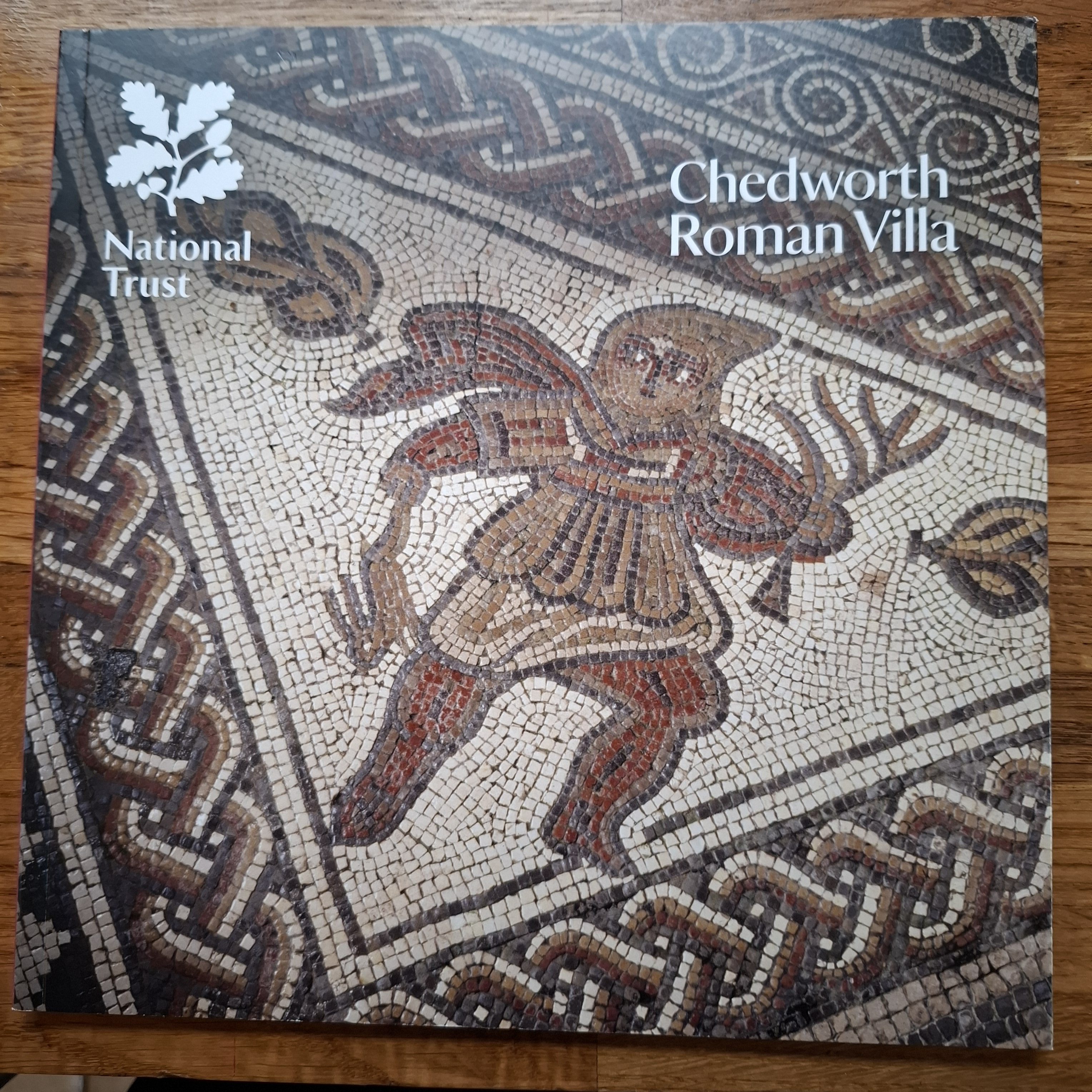
Following an afternoon out at Chedworth Roman Villa this week, my head is still full of ancient Rome, and in particular of Roman mosaics.
I went to Chedworth Roman Villa as a research trip for the novel I’m currently writing, Death at the Village Knitting Circle. As all my novels are set in the present day, the relevance of the ancient Romans may not be obvious. However, the knitting circle meets in the education room of the new Roman museum in Little Pride – the setting for my Cotswold Curiosity Shop cosy mystery series.
At the start of the novel, the new Roman museum is about to open next door to the Alice Carroll’s Curiosity Shop. The museum will house the Roman mosaic discovered beneath a paddock there in the first in series, Death at the Old Curiosity Shop.
What I Learned at Chedworth Roman Villa
My fictional museum is much smaller than the vast site at Chedworth, with a single mosaic floor on display. However, my visit to Chedworth helped me to get in the right frame of mind to write my story. It also familiarised me with the proper terms of reference for Roman remains, and I learned useful details of other Roman interior design.

As seems usually to be the case with Roman villas, a substantial part of the walls of Chedworth Roman Villa have long since fallen down. Their destruction was probably accelerated after the retreat of the Romans by local Britons cannibalising the buildings for materials to build their own homes.
Fortunately, the little tiles, or tesserae, that made up the mosaic floors, must have been too small to be of any practical use to these raiders. Thankfully, this means that the many mosaic floors remained largely intact, protected by grass and soil as the sites fell into disuse.

There’s also a fine nymphaeum, a kind of shrine to water gods. More prosaically, its spring now feeds the National Trust visitor centre’s toilets!

The water from the spring must also have fed the extensive baths, of which much are still intact.

It was stray tesserae that led to the discovery of Chedworth Roman Villa in Victorian times. A local gamekeeper, out hunting with his ferret, was intrigued by small coloured cubes scattered around a bumpy stretch of ground on the third Lord Eldon’s estate. I’m guessing they’d been disturbed by wild animals building warrens in the area, perhaps rabbits and badgers inadvertently bringing them to the surface. Eldon’s nephew James Ferrer, an archaeologist who had examined sites on Orkney, recognised what they were, and he went on to lead the excavation of the large villa complex.

Ferrer also had the foresight to build a museum to house any interesting finds, and to cover the exposed remains of the village with protective buildings.

Interestingly, there’s still one mosaic there that you cannot see, because it was reburied to preserve it. Apparently, this is quite a common practice, as with the vast Orpheus Mosaic at nearby Woodchester, last uncovered in 1973, and reburied ever since.

Chedworth Roman Villa was acquired by the National Trust in 1924. Each time I visit, they have improved the visitor experience further. They are also continuing to excavate on site. As their guidebook says, “You’ll have to keep coming back to see what we’ve uncovered”. I, for one, will be very glad to do so.
Find Out More About Chedworth Roman Villa

Find Out More About the Cotswold Curiosity Shop
Death at the Village Knitting Circle will be published by Boldwood Books in February 2027.

