Posted in Writing

In Conversation with Author Howard Lovy

cover of Found & Lost - the Jake and Cait story by Howard LovyI’ve known Howard Lovy, American journalist, podcaster, and editor for eons, through our work for the Alliance of Independent Authors. I was surprised and delighted for him when he told me he was also about to become a published author. His debut novel, Found and Lost: Jake and Cait’s Story, was published by Vine Leaves Press, run by another longstanding author friend of mine, Jessica Bell. As Howard’s novel focuses around the music industry, and the multi-talented Jessica is also a singer/songwriter, I knew the story would be good.

Sure enough, when I received an advance review copy, I was gripped – and as soon as I’d finished it, I invited Howard to be this month’s guest on my blog, to tell us the story behind the story.


Debbie: You came to novel writing relatively recently, via a long path of all kinds of writing. Please briefly describe your journey to becoming a published author.

Howard: Okay. Let’s see if I can do this briefly, because it’s been a forty-year journey.

I spent the first half of my career as a journalist, beginning with small weekly papers, then big-city dailies and then international wire services and magazines. I covered everything from politics and business to science and religion.

Then, the news industry changed and I needed to adapt in order to make a living. I’m proud to say that I launched a pioneering blog covering nanotechnology in the early 2000s that was read by Congress and the White House!

That led to gigs writing about business and technology for Wired magazine among other publications. I got into the publishing world when I became executive editor of Foreword Reviews, which covered and reviewed books from independent and university presses, along with self-published authors.

After that, I was hooked on indie publishing and launched my own editing business in addition to podcast production and hosting for the Alliance of Independent Authors.

A throughline through all this has been my interest in Jewish issues, which I’ve covered for Publishers Weekly, the Jewish Telegraphic Agency, the Jerusalem Post, and many other publications. I’m also nonfiction editor for a Jewish literary publication called Judith Magazine.

Debbie: And then you wrote a novel about music! It’s notoriously tricky to write novels about music because of copyright issues, so presumably you had to write the song lyrics that appear in the novel. Are you also a songwriter and/or musician, or was this a new experience for you?

Howard: Other than the clarinet in middle school, I’m not a musician. However, I am knowledgeable about music, all kinds of music, and know how to appreciate great musicians. And I ran this by real musicians, who told me that I really captured what it feels like to play for an audience.

As an editor, I advise clients not to include song lyrics in their books, so I knew that if I were to include them, I’d have to write them myself. This was a new experience for me, but I found that writing lyrics was simply an extension of storytelling.

I don’t know if I could write lyrics “as me,” but I could imagine the lyrics that the teenage versions of my protagonists, Jake and Cait, would write.

How would Cait write a song from her Christian religious point of view? How would Jake contribute lyrics in his character as a secular Jew who is more cynical, and how could those words meld into songs that go viral forty years later? What I came up with seemed to be successful. A couple of reviewers said they could almost hear the music as they read the book and they wished Jake and Cait were real.

Debbie:  Praise indeed! Howard, you are well known as a writer on Jewish matters, but you chose to write about an interfaith relationship in your novel, and you did so in a very even-handed way. What were the challenges, risks and rewards of tackling this sensitive area?

Howard: When I wrote this novel, I was taking a quick break from writing about antisemitism and other Jewish issues. I was a little burned out. So, I decided to get out of my comfort zone and write this piece of fiction. This was before October 7, 2023, when the world changed for many Jews, including me, and frankly I don’t know if I could have written this kind of optimistic book in the last year-and-a-half.

I’m very glad that reviewers are calling it even-handed when it comes to faith. I’ve always been a student of religion—all major religions—not necessarily out of belief, but because I think it’s important to learn what motivates people. I try not to fall into the trap of caricature.

Religion is a powerful motivator for people, and it is for my protagonists, Jake and Cait.

There are many reasons I chose an interfaith couple, and there are risks in doing this, but I thought it was important to the story I was telling. They’re opposites—Jake is Jewish and rough around the edges; Cait is a classically trained Christian violinist searching for a simpler kind of faith. But when they play music together, it’s magic. They finish each other’s musical sentences. The way they make music together overrides everything else.

That idea of opposites finding connection—of working through regret, misunderstanding, and difference to make something beautiful together—feels especially meaningful right now. There is a Yiddish expression for this. It’s called beshert, or destiny. It’s usually used interchangeably with the English word “soulmate.”

But my book asks the question, what if your beshert is not exactly what you expected?

Debbie: You follow an interesting route with the timeline in the novel, not only combining flashbacks and present day, but continuing some years beyond the publication date. That took me by surprise! I admire your boldness there. Why did you choose such a far-reaching timeline rather than stopping at the present day, and what were the challenges of projecting that far ahead?

Howard: Among the themes in my book is a look at the culture of fame and also the morphing shape of memory. I’ve always been fascinated by books and stories that look at what happens to people over time. In the documentary about their lives, Jake and Cait look at their experiences through the lens of forty years.

We are all unreliable narrators of our own stories. Sometimes, we remember only the bad or only the good and choose to forget the memories that contradict the story we’ve told ourselves. In the “flash-forward” scenes toward the end of the book, I imagined this unreliable memory on a societal scale as it applies to the musical phenomenon of Jake and Cait. People remember them through the lenses of their own political, religious, or societal points of view.

Plus, “Time” is practically a character in this novel, so I thought I’d give it a little more room to develop.

Debbie: The novel is set in Michigan. To what extent is it a hymn to your homestate?

Howard: Well, they say to write what you know, and I know Northern Michigan very well.

I’m hoping the setting is a character in itself—both Interlochen, Michigan, in the present day and as the way I present it in memory.

Many people visit Northern Michigan on vacation and have childhood memories of it. To me, my memories of Interlochen Arts Camp took on this kind of mythic quality. It’s strange, just going to the camp now to promote the book. There is a mixture of things I remember from 40 years ago, and things that exist today. So, I walk through it all in a haze of reality and memory. And that’s what I wanted to show for the characters, too: There’s what they knew in 1985, and the reality of 2025 along with all the baggage that goes with it.

I also set part of the book in New York City, though, where I’ve also lived.

Debbie: The book is flying high in the Jewish fiction charts, but what other genres does it fall into?

Howard: Yes, I was very pleasantly surprised that it reached, at one time, the top three in Jewish American Fiction, even though Judaism is just one of many themes in the book. It helped that the Jewish Book Council ran a favorable review. Amazon also has it listed under “Literary Sagas,” and “Contemporary Literary Fiction“. Frankly, I just think of it as a good book.

Debbie: What does the interfaith element add to the story, and why would the book be less effective if faith didn’t come into it?

Howard: My original vision for the book had age more as a factor than faith—both their youth and their middle age—but as I developed the backstories for these characters, I found the faith angle to be more compelling.

Jake’s Judaism and Cait’s Christianity are not just aspects that stand alone as part of their characters, but they are wholly ingrained in who they are.

Their relationship with music, with the world, and with one another would not be the same without the dynamic of faith and how they can both clash and harmonize. It wouldn’t be the same book without that element.

Debbie: Late-in-life renewals of old romances are popular in fiction. How does your book go beyond the norms for this sub-genre of romance?

Howard: When I wrote the book, I had no idea that some would consider it a romance novel. In fact, it could be a subgenre called “second-chance romance.” I’m completely ignorant of all the tropes involved, though, so any regular romance readers might be disappointed—or maybe even angered—that I broke some of the rules. To say more would be a spoiler!

Debbie: This is your first novel. What’s next for you in your fiction writing life?

I found fiction to be very freeing. I could say more about “reality” through made-up characters than I could in my nonfiction work. I don’t think I’m quite done with what I’ll call the “Jake and Cait Universe.” I picture two more books in the series, the first one imagining what happened during that 40-year gap. It’s not a prequel or a sequel. I’ll call it a “middle-quel“.

Debbie: How interesting – I don’t think I’ve come across a middle-quel before! Now, if readers like (insert other author name here), they’ll love Howard Lovy.” Please fill in the blank!

Howard: Taylor Jenkins Reid, Ann Patchett, and Jennifer Egan

Debbie: Your publisher is Vine Leaves Press, a thriving small indie publisher, Why are you especially pleased that they picked up your book?

Howard: I have nothing but wonderful things to say about Vine Leaves Press! They’ve been incredibly communicative and supportive throughout the editing and publishing process. I’ve enjoyed working with them—especially publisher Jessica Bell’s amazing cover design.

Debbie: Finally, Howard, could you please provide a brief extract to give readers a flavour of your novel. 

As it turned out, they would record “Love Moves On” a few months later in a place far away from the tall grass, hemlock, and pine of Northern Michigan. Then the song would sleep for forty years before awakening into the ears of millions in a nuclear explosion that would change their lives forever and wreak untold collateral damage.

And that was only their first song.


ALL ABOUT HOWARD LOVY

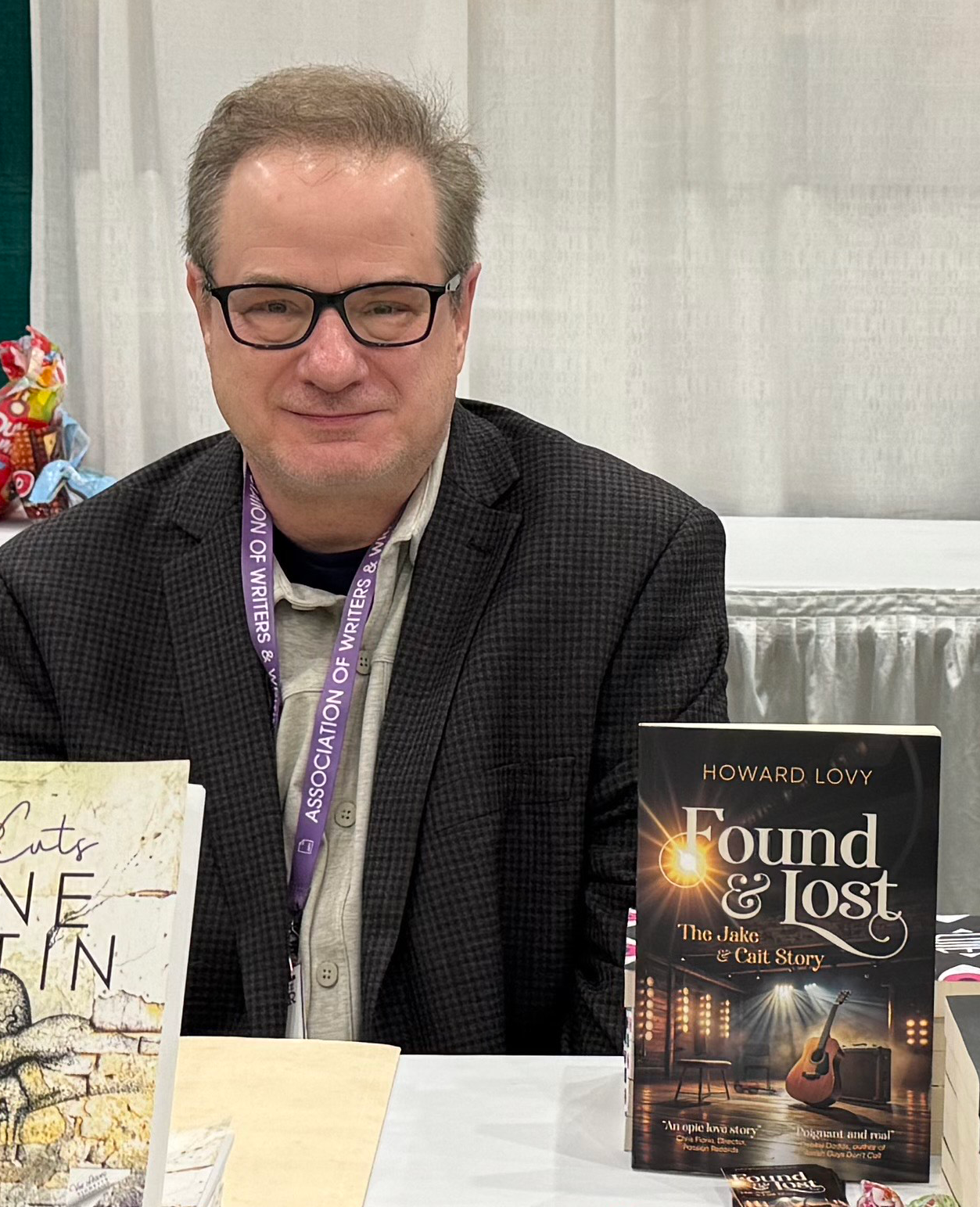
photo of Howard Lovy with his debut novelHoward Lovy is a veteran journalist, book editor, and author with 40 years of experience covering topics ranging from science and technology to Jewish issues. His work has appeared in Publishers Weekly, Longreads, The Jerusalem Post, and many more. A former executive editor of Foreword Reviews, he also hosts a podcast for the Alliance of Independent Authors. Howard lives in Northern Michigan with his wife, Heidi, and their dog, Henry. You can find him at https://howardlovy.com/


MY REVIEW OF FOUND & LOST: THE JAKE & CAIT STORY

cover of Found & Lost - the Jake and Cait story by Howard LovyI was pleased to receive an advance copy of Howard Lovy’s debut novel, having enjoyed his podcasts and journalism, but I wasn’t sure what to expect – and this gentle, slow-burn romance surprised me in the best possible way.

It’s a gentle, sensitive tale of youthful love forged by a shared musical talent, which ends in a sudden break-up unexplained until the end. Forty years later the revival of the couple’s music as a viral internet sensation – written long before viral social media posts were a thing – brings them back together in a storm of supportive publicity.

Although bound by an almost telepathic ability to play so well together, the young couple face other challenges brought about by their differences. She is a sincere Christian investigating different kinds of belief and he a Jew; she is a classically-trained, highly-educated musician, he is self-taught.

The unusual structure of the story is not only divided by two timelines decades apart, but also by the interspersal of transcripts of a TV documentary delving into their past as they reunite after 40 years apart. The insights into the music industry, past and present, and the occasional appearance of real-life musicians and producers such as the great Suzanne Vega add further depth and interest to this rewarding novel.

Highly recommended to anyone who enjoys clean romance reuniting past lovers, or who likes intelligent and original feel-good fiction.


HOW TO ORDER HOWARD’S NOVEL

Found & Lost: The Jake & Cait Story can be purchased through Vine Leaves Press here or on Amazon here.


Posted in Writing

When Life Imitates Art: Some Writers Share Their Experiences

In this post, I share the experiences of writers who have dreamed up novels which at least in part becomes reality true post-publication.

My process is the same every time I write a novel – and I’ve written 12 of them now – I start by jotting down ideas in a notebook.

Once they’ve had a chance to percolate in my unconscious, usually for many months, and sometimes fpr years, I wrestle the ideas into a rough outline of the plot. Then I begin to write, using the outline as a prompt, chapter by chapter, until I reach the end.

Continue reading “When Life Imitates Art: Some Writers Share Their Experiences”

Posted in Reading, Travel, Writing

Travels with my Books #2: From the Caribbean to Exmoor with Helen Hollick

sea witch banner ad

As a longstanding fan of the Pirates of the Caribbean ride in Disneyland, which I first visited in the original theme park in California at the age of eight, I was delighted to discover when I first met Helen Hollick that one of the series of historical novels she writes has as its hero a charming pirate Captain Jesemiah Acorne whose adventures often take him to the Caribbean.

The smash-hit Jack Sparrow films came much later than the theme-park ride,  and I believe it’s the only case of the ride inspiring the film rather than the other way around.

Just like the ride and the films, Helen’s pirate novels plunge you into the Caribbean, amongst other places, including, closer to her home and mine, the rolling hills of Exmoor in Devon. I’m delighted to welcome Helen to my blog today to tell us all about her travels with her books!


headshot of Helen Hollick
Helen Hollick, author of historical, fantasy and contemporary fiction

Hello, Helen, and welcome! To set the scene, could you please your books’ setting on the globe

Now, this is going to be one of those ‘which one shall I use?’ moments. You see, my Sea Witch Voyages are set in various locations because they are, well, voyages aboard a ship – the Sea Witch – with a pirate and his crew. Captain Jesamiah Acorne finds himself getting into trouble from Jamaica to Devon, from Virginia to the Bahamas via Cape Town, South Africa! However, as it is rather cold here in the UK at the moment, let’s head for somewhere warm …Port Royal, Jamaica!

Please briefly describe the books you have set in the Caribbean.

When The Mermaid Sings is a prequel novella to my Sea Witch Voyages series telling the story of how Jesamiah fled his home in Virginia because of his bullying elder half-brother. He is seeking a sailor friend of his father – but ends up finding more than he bargained for: the ghost of his father, Captain Morgan, a mermaid – and the start of a life of piracy!

What makes Port Royal, Jamaica, such a great setting for fiction?

Back in the late 1600s Port Royal was known as ‘The Wickedest Town In The World’ because of all the pirates and privateers who dropped anchor in the harbour. So much looted Spanish treasure was taken there, even servants were well off financially.

Unfortunately, in 1692 a massive earthquake destroyed most of the town and killed thousands of people.

The harbour remained, but the town was never rebuilt – Kingston was established on the other side of the bay instead. I wanted to make When The Mermaid Sings a partial ghost story, so Port Royal was an ideal location for Jesamiah to go to.

What is your relationship with Jamaica and how much of your life have you spent there?

None at all! I’ve never been to the Caribbean – however, later in the series (Ripples In The Sand, Voyage Four and On The Account, Voyage Five,) I bring Jesamiah and his wife (he’s grown up since When The Mermaid Sings) to Devon, England, so I have many scenes set in and around Barnstaple on the North Devon coast, and on Exmoor, both of which I know very well as I live nearby!

What is special about the people native to Devon?

May I mention one real person in particular? My previous editor, Jo Field, now retired, used to live at Instow not far from Barnstaple. I used to live in East London, so visited her twice a year for a writer’s chinwag and a holiday. It was because of where she lived that I decided to bring Jesamiah (and his ship, Sea Witch) to Devon, and consequently I also fell in love with the place. In 2012 we won the lottery (on the opening night of the London Olympics) and decided to move to Devon.

I hadn’t realised, all those times that I came on the train to visit Jo, travelling from Exeter to Barnstaple, that I would be passing right by the house I now live in!

I can see a section of the Tarka Line railway as it winds through the Taw Valley from my bedroom window – it’s like looking down on my very own real model railway!

If your protagonist or other characters come from elsewhere, what challenges do they face dealing with the local people?

Jesamiah was born in Virginia, the son of an English privateer and a Spanish mother. I rather assume he would have a typical Colonial Virginian accent – which is quite far removed from the Devon dialect. When he first sets foot ashore at Appledore he has a bit of a job understanding some of the Devonshire words, as the following excerpt from Ripples In The Sand shows:


banner ad for Ripples in the Sand

The rain had started to lash down as Jesamiah kicked open the door to the Full Moon and negotiated his way through, taking care not to scrape or bump Tiola enfolded in his arms and wrapped in a swathe of blankets.

    The landlady, a homely woman in her early thirties, bustled from behind the counter concern bubbling from her as energetically as the wisps of hair escaping beneath her lace cap. “Oh my, the poor maid looks nigh on exhausted.” She shooed away an elderly man sitting before the fire, ushering him to another seat. “Set ‘er down ‘ere Cap’n. The girl’s lighted the vire upstairs an’ put a pan in t’warm the sheets. It be a nice corner room overlookin’ the harbour, it’ll do you cheerily.” She pursed her lips and tutted. “I suggest you keep them shutters closed ‘cross the smaller side winder though, sir. The view o’ the drang oft’n be not respec’able.”

     Grumbling beneath his breath the old man, as bald as a coot but with a great bush of a white beard, took his half empty tankard of cider along with his pipe and baccy pouch, and shambled to a settle near the window. He sat, sniffed disdainfully and wiped his nose on the cuff of his coat, which he ostentatiously drew closer around his chest, then turned the collar up against the draught. “It be goin’ t’snow on them moors,” he predicted. “Prob’ly ‘ere an’ all. Vruzzen in us’ll be.”

     “Drang?” Jesamiah queried, not recognising the word and struggling to understand the conversation. Tiola had a slight Cornish burr, but his ear was not attuned to this unfamiliar Devon dialect. He shrugged, guessed he would pick it up soon enough.

     The old man chuckled. “Nowt wrong with Cock Lane tha’ an ‘ealthy man can’t be makin’ good use ov.”

     Getting the gist of the statement Jesamiah raised an eyebrow, was about to repeat his ‘drang’ question, but let it pass.

The typical ‘pirate speak’ that we think of (‘arr’ and such) actually originates from Robert Newton who played Long John Silver in Treasure Island. He was a Cornishman so improvised his West Country accent. Many sailors – and pirates – came from Cornwall, Devon and Bristol, so all had a similar accent, including Sir Francis Drake and Sir Walter Raleigh.

What are the distinguishing features of one of the destinations you write about in terms of geography, geology, flora, fauna or any other detail you care to mention?

I will take us to Exmoor, as I know it better than Jamaica. (Although as I write this, in mid-January, I believe it is snowing up on the moors, so Jamaica would be warmer!)

Wild Exmoor ponies

Exmoor is a wild place – it is even home to the wild Exmoor ponies (we have three moorland bred ponies of our own on our farm). The moor was made famous by RD Blackmore’s Lorna Doone, and indeed I have borrowed the Doones and used their fictional descendants in Ripples and Account.

Valley of the Rocks, Exmoor (photo copyright Cathy Helms)

The north coast of Exmoor rises steeply from the sea, giving glorious views, although usually also windswept ones. There is a particular geological features of rocky outcrop that looks a little like the ruins of a castle. Many Victorian poets visited this incredible geological feature, Robert Southey in August 1799, was impressed, describing it as ‘… the very bones and skeletons of the earth’.

In On The Account, Jesamiah’s wife, Tiola Oldstagh (who is actually a white witch) spends the night on Exmoor, described in the following extract:

banner ad for On the Account

An hour after dusk had settled into the star-frosted night, Tiola fed another stick into her meagre fire. The wood was damp and it gave off more smoke than heat, but it was better than nothing up here on the windswept openness of Exmoor’s exposed coast. She was sheltered in the hollow behind the magnificent tor of rocks that separated the valley from the sea, three hundred feet below. A place steeped in myth, legend and mystery. It was said that the Devil had resided in a castle of rock with his many wives, but angered at their infidelity he had blasted the eyrie to pieces. All that remained were the bare, jagged bones; the skeleton rocks piled stone upon stone. Nothing but a story, an old tale to explain the strangeness of a natural glacial formation – the Devil did not exist, but Tiola was aware that something was lurking out there in the darkness, watching her.

     The stick flared into flame and the light caught the glint of an eye a few yards off. Tucking a loose strand of her black hair behind her ear, Tiola calmly added more wood to the fire and smiled to herself. This was the Valley of the Rocks, known also for the herds of feral goats that thrived on the coarse sea-salt grass. A huffed snort and a stream of misted breath evaporated into the cold air. A wild pony then, not a goat; one of the distinctive two-thousand-year-old Exmoor breed with their thick, weather-resistant, shaggy coats and light-coloured muzzles. Had she borrowed such a pony from the stables at Tawford Barton she would be at her destination by now, but her mission was secret and she wanted to know who had been watching her these past seven days, and had followed her, this night, up on to the moor.

What are your top tips for any readers planning to travel to the setting of your book?

To Jamaica – watch out for pirates, and parrots who have learnt to sample the beer from kegs in the taverns … of course, that only applies if you can also time travel back to the 1690s!

To Exmoor – take stout walking boots and something warm and dry to wear. Even on sunny days it is windy up there… but breathtakingly beautiful.

Helen Hollick hangs on to her hat on Exmoor!

‘Only in Port Royal…’ name three things that could only happen there!

  1. In November 1720 you would have seen the trial of Anne Bonney and Mary Reed, the female pirates who sailed with Calico Jack Rackham. Mary died in gaol, Rackham was hanged, but no one knows what happened to Anne.
  2. Time travel back a little further, and you could meet Captain Morgan, who was a privateer against the Spanish, but then became Governor of Jamaica … and yes, he is the Captain Morgan who gave his name to the rum!
  3. ‘Jamaica Gold’ – pineapples – used to be  highly valuable because Jamaica was one of the few places where they grew, were easy to harvest and transport back to the Colonies – and even England.
stone pineapple on a building
Spot the pineapple!

Because of its rarity, and the difficulty in keeping it fresh during a long sea voyage, the pineapple was regarded as the food of the wealthy. For the well-to-do, ‘visiting’ either for afternoon tea, or to dine, was one of the prime sources of entertainment. Social intercourse was a way to show off what you had, and an essential way to keep up with the local gossip and news. Status, and the ability to show it, was an essential element. Keeping up with the Joneses is nothing new!

The Colonial hostess would seek subtle ways to brag about what she had, and would take great pains to outdo her neighbours. Elegant furniture, sumptuous and elaborate gowns, exquisite china and silver tableware, fine linens, expensive tea… Food was displayed on platters and arranged in elaborate pyramid styles, often dripping with sugar. Dinner was a culinary delight and always extravagant.

The laid table would be kept as a surprise, behind closed doors until the moment to reveal all came. Fresh fruit was a grand thing to be displayed, but topping it all would be the pineapple. It was rare, expensive, and wonderful to look at, touch – and eat. It was the crowning celebrity-status glory of the feast.

Have you ever noticed stone pineapples outside houses? To have one on display at a dinner party meant you’d made it to the top of the tree – but fruit doesn’t stay fresh for long, so it soon became popular to place stone ones on gateposts and such to indicate a wealthy household, and also as a sign of welcome. So keep an eye out for the not-so-humble pineapple!

Are there any other authors’ books with the same setting that you’d like to recommend?

Dozens, but I am going to cheat and select Jamaica Inn by Daphne du Maurier.  It was – still  is – a real pub, on Bodmin Moor, Cornwall, named by the Trelawney family who founded it in 1750, from the money they made in Jamaica – and for the smuggled rum which passed through on its way from Cornwall to London. Du Maurier wrote her story after being stranded there in thick fog one night.

Where is your latest book set?

Helen’s latest novel takes us to Chingfod, Essex

Somewhere completely different! A north-east London suburb, Chingford, where I was born in 1953, brought up and worked until the early 1980s. A Mirror Murder is a cosy mystery set in 1971 with the lead character, Jan Christopher, working (as I did!) as a library assistant.

I decided to give writing a murder mystery a go after being inspired by Debbie’s wonderful Sophie Sayers Series! (I confess, I am a little in love with Hector – although this might be because he owns a bookshop!)

Here’s an introduction to A Mirror Mystery:

Eighteen-year-old library assistant Jan Christopher’s life is to change on a rainy Friday evening in July 1971, when her legal guardian and uncle, DCI Toby Christopher, gives her a lift home after work. Driving the car, is her uncle’s new Detective Constable, Laurie Walker – and it is love at first sight for the young couple.

But romance is soon to take a back seat when a baby boy is taken from his pram,  a naked man is scaring young ladies in nearby Epping Forest, and an elderly lady is found, brutally murdered…

Are the events related? How will they affect the staff and public of the local library where Jan works – and will a blossoming romance survive a police investigation into  murder?

Where will your next book be set?

Which one? *laughs* I really must write the sixth Sea Witch Voyage – which starts in Gibraltar, and will feature Exmoor and Devon again – but also Spain, possibly Portugal and France as well, I’m not sure because I’m never quite certain where trouble will lead my Jesamiah…

I am also writing the second in my planned Jan Christopher Mystery series: this one will be set in Devon at Christmas. Great fun with lots of snow and murdered victims.

I’ll look forward to reading them all, Helen! Thank you so much for taking us on this virtual journey around your books today. 

(All images in this post are the copyright of Helen Hollick unless otherwise stated)


ALL ABOUT HELEN HOLLICK

Helen Hollick taking inspiration from atmosphere at Instow, Devon

Helen Hollick and her family moved from London in January 2013 after finding an eighteenth-century North Devon farm house through being a ‘victim’ on BBC TV’s popular Escape To The Country show. The thirteen-acre property was the first one she was shown. She loves her new rural life, and has a variety of animals on the farm, including hens, ducks, geese, dogs, cats, Exmoor ponies and her daughter’s string of show jumpers.

First accepted for publication by William Heinemann in 1993 – a week after her fortieth birthday – Helen became a USA Today Bestseller with her historical novel, The Forever Queen (titled A Hollow Crown in the UK) with the sequel, Harold the King (US: I Am The Chosen King) being novels that explore the events that led to the Battle of Hastings in 1066. Her Pendragon’s Banner Trilogy is a fifth-century version of the Arthurian legend, and she also writes a pirate-based nautical adventure/fantasy series, The Sea Witch Voyages.

Despite being impaired by the visual disorder of glaucoma, Helen is now branching out into the cosy mystery genre with a new series of quick-read novellas. The first in her Jan Christopher Mysteries series, set in the 1970s, is out now. A Mirror Murder  incorporates often hilarious memories of working for over a decade as a library assistant.

Her non-fiction books are Pirates: Truth and Tales and Life of A Smuggler. She occasionally gets time to write…

Click the link to order A Mirror Murder in ebook or print: getbook.at/MirrorMurder 

Visit her website: https://helenhollick.net/

Like her Amazon Author Page: http://viewauthor.at/HelenHollick

Subscribe to her newsletter: http://tinyletter.com/HelenHollick

Follow her on Twitter: @HelenHollick


Next month: join Alison Morton for a trip to the fictitious land of Roma Nova, evolved from the ancient Roman empire in her series of alternative history novels – and for a trip to France in her new contemporary thriller, Double Identity

(To receive each new post in your email inbox, just type your email address in the box beneath the “Follow Blog” button in the sidebar to the right of this post.)

Posted in Publishing, Writing

1 Simple Tip to Boost Your Writing Productivity: Learn to Touch-Type

A post in praise of touch-typing

This post originally appeared on the Alliance of Independent Authors’ Self-publishing Advice blog here, where it was obviously aimed at indie authors and aspiring writers, a startling number of whom don’t touch-type. I’m reproducing it here because I believe the content is equally relevant and helpful to anyone who uses a computer keyboard for any purpose, business or pleasure.

Why the old-fashioned skill of touch typing can be a real boon to twenty-first century indie authors, and why you should add this accomplishment to your repertoire to help you increase your output as a writer.

Blog posts and books abound about how indie authors can increase their self-publishing productivity by various means, primarily by focusing on increasing daily word counts. Different methods exist for boosting your writing output, such as getting into a daily habit of writing a fixed number of words per session or day, or by writing in sprints, against the clock, or using popular schemes such as NaNoWriMo to squeeze out a fixed word count in a set time frame.

Image of keyboard with most of letters rubbed off

True touch typing means it doesn’t matter if you’ve written so much, you’ve worn the letters off your keyboard

Missing a Trick

But most of these schemes fail to mention one of the most straightforward practical tips there is: to learn to touch-type.  In an informal survey I’ve just conducted of over 100 indie authors, around 40% of them admitted they didn’t touch type. This included writers of multiple books. I wondered how much more prolific they might be if they mastered this important art.

What is Touch-typing?

Touch typing means typing accurately without looking at the keyboard. Thanks to an ALLi member in Russia, Alexander Kirko, I can tell you that in three other languages, touch typing is known as “blind typing”, which I think is a more graphic description.

When you can touch type efficiently, you can set down many more words per minute than you can when you have to look at the keyboard. This frees you to concentrate on picking the right words, rather than hunting for the right letters.

There’s no such thing as a “sort of” touch typist. It’s like being “a bit pregnant”. You either are or you aren’t.

Many Ways to Learn

Many of the respondents to my informal poll reported that they’d learned to touch type early in their careers, either at school or at college or on first entering the world of work, and plenty went on to say it was the most useful skill they’d ever learned.

But the good news is, it’s never too late to learn, and by throwing a little time at the task each day, you can quickly acquire the skill. It’s simply a question of putting in a certain number of hours to program your brain.

How you do it is up to you, and there’s plenty of choice.

  • I learned fresh out of university, using a tried-and-trusted traditional approach: a typing manual with a cardboard chart that taught you to match the right fingers to the right keys, building up your skill one row and one new finger at a time till you’d mastered the alphabet.
  • These days there are plenty of automated programs available online to make the process more fun.

Whichever route you choose, make sure you pick one that serves the layout for whatever language you write in. When I went to work in Switzerland in my twenties, I had to reprogramme myself to use a German keyboard, in which the Y and the Z trade places.

If you’ve learned to drive a car, you can learn to touch type. And you won’t even have to master hill starts or parallel parking.

So if you haven’t mastered the art of touch typing yet, and are seeking to increase your writing output, don’t dismiss this simple technique. Once you’re hammering out 80 words a minute (my current rate – I just checked on this fun online gadget), you’ll be glad that you persevered.

http://www.allianceindependentauthors.org/?affid=?885
All for one and one for all – the Alliance of Independent Authors’ cute pen logo

If you’re an author or an aspiring author, you’ll find more posts like this, with a new one published every day, on the Alliance of Independent AuthorsSelf-publishing Advice blog, of which I’m Commissioning Editor.