Posted in Reading

Why I’m Supporting Read With Me – A Charity Helping Children to Read

children reading in a school library


In this week’s post, I’m sharing news of a great cause that I’ve recently discovered called Read With Me.

Whether or not you have children of your own, I’m sure you’ll agree that anything that helps children to become competent and enthusiastic readers can only be a good thing. That’s why I really enjoyed my three years spent working for national children’s reading charity Read for Good.

headshot of Linda Cohen
Linda Cohen, founder of Read With Me

While Read for Good does a great job at a national level by running sponsored Readathons in schools, Read With Me currently operates solely within Gloucestershire and sends adult volunteers into schools to hear children read one-to-one. This individual attention and social interaction makes a vast difference to children’s progress, especially to those who get little or no support at home.

More About Read With Me

Read With Me was founded by Linda Cohen of Wotton-under-Edge,  just a few miles from where I live. As Linda explains on Read With Me’s website, children need to be able to communicate and to read. Without those basic skills their life opportunities are reduced and they face a bleak future.  The inability to read will impact on not only their outcomes but those of their children.

image of adult sharing story with children in park
The joy of reading should start at an early age

Teachers and head teachers agree that the ability to read is the key to all learning.

Children who are unable to read properly by the age of 7 never catch up. In the UK, 1 in 5 children leave primary school unable to read. These children do less well at school, have dramatically reduced employment choices and earning opportunities, and a greater chance of going to prison. The UK has the worst literacy rates in the developed world.

In addition to attending school every day, ideally each child should have 15 minutes of one-to-one time when they can be heard to read by an adult and have verbal and social interaction. But with large class sizes and busy timetables, it’s nigh impossible for teachers to provide this.

Read With Me has therefore developed a unique programme where local employers give employees half an hour twice a week to hear two children read in their schools.

“It’s amazing how something so simple can be utterly transforming,” says Linda.

Linda started by rolling out Read With Me’s service in Gloucester, because it’s an area with a huge need. She will be extending the service across Gloucestershire, but Read With Me will also support anyone outside the area who wanted to set up something similar, even if it was only for their local school.

“We want to create a blueprint which everyone can use,” says Linda.

Outside of term time, Linda also organises The Not So Secret Book Club, offering some fabulous free opportunities for children to meet to read in Gloucester parks, providing free books so necessary when many children don’t have any books of their own at home. They offer a huge selection, from simple board books to teen fiction. They also have craft materials available and inspiration for simple creative projects, and story sessions too.

Why Read With Me is Fundraising Now

Although volunteers donate their time to Read With Me for free, the organisation needs to cover essential running costs. One of the ways Linda planned to raise funds this autumn was by selling Christmas cards, and three local shops had kindly agreed to stock them: Fish Out of Water, The Cotswold Book Room, and The Subscription Rooms in Stroud. Unfortunately, lockdown has temporarily put a stop to that.

In the meantime, young volunteers have set up an online shop to sell the cards, so below I’m sharing more details in case you’d like to support this great cause by placing an order.

About Read With Me’s Christmas Cards

Designer and illustrator Molly Bult created three designs in mixed media of gouache paint and digital collage using scanned materials, which have been printed on quality board with a choice of brown kraft or festive red envelopes. They are sold in packs of 9 for £3.99 each, or £10 for 3.

The Christmas cards are one of two festive initiatives to raise funds for Read With Me. There is also an online shop of stocking-filler toys, generously donated by the new proprietors of The Cotswold Book Room.

group shot of christmas cards

Other Ways to Support Read With Me

  • Buy toys online The Cotswold Book Room generously donated their stock of pocket-money toys to Read With Me, and these are now available to order on its website here: https://readwithme.org.uk/product-category/toy-sale/
  • Volunteer to read with children in school If you’re in Gloucestershire, you can become a Read With Me volunteer, donating just two hours a week to go into a school to hear children read.
  • Donate books Donations of books for children of all ages, from board books to young adult novels are always welcome.
  • Donate craft materials Craft materials and activity books are really useful at Read With Me’s Not So Secret Book Clubs.
  • Help out at the Not So Secret Book Clubs Subject to restrictions, these will next be running on 22nd and 23rd December – announcements will be made on Read With Me’s website, Facebook page and on all the community websites.
  • Help sort books Volunteers are needed to help sort donated books to be sent to schools either to bolster their libraries or to provide children who have no reading material at home a selection of their own books.
  • Share fundraising ideas Linda would love to hear from anyone with creative fundraising ideas to boost Read With Me’s funds.
  • Support on social media “Like” Read With Me’s Facebook page and share their posts with your friends.
  • Make a donation There’s a donate box on the home page (scroll down till you see the yellow banner “Support Us” and its right underneath that.)

If you can help in any of these ways, please contact Linda via the Read With Me website.

Read on if you’d like to find out more about Read With Me via my informal interview with Linda and about the Christmas card designer Molly Bult, who has sent me her bio for anyone interested in her other design work. 

Interview with Linda Cohen

It’s great to be able to sell Christmas cards and stocking filler toys online, but how do fundraise at other times of year?

We are a start-up, so fundraising is in the early stages. We’ve been established as a social enterprise, so the aim is to be relatively self-sufficient, but we’ve received some wonderful help from Gloucestershire Community Foundation. We’ve held a number of virtual events, including the Wotton 10k in which our supporters took part across the world, some even in Hong Kong – a combination of elite runners and some more sedate walkers who punctuated the walk with tea and cake stops.

What will the proceeds from the sales of Christmas cards and toys be used for?

The proceeds from the cards, like all the other money we raise, goes towards the shoestring running costs of delivering our service.

It only costs £50 a year to deliver twice-weekly sessions to each child, but we need to be able to support 500 more places immediately after Christmas.

You mentioned the three shops kindly stocking your cards, and the amazing contribution of stock by The Cotswold Book Room.  Are there any particular local businesses that you’d like to mention as key supporters of the scheme?

Gloucester Services have been amazing. All their profits go back in to the community, so make that a destination stop for petrol! I’ve also set up reading schemes with partner schools for some of my PR clients.

What would Read with Me like from Santa this year?

I think Santa must have been operating throughout the year as we’ve already been the recipients of astonishing generosity from a number of the organisations and individuals, from teenagers to the retired.

The greatest gift would be the ability for our fantastic volunteers to all feel able to go back in to school safely and get on with their work.

However there is nothing to match the gift of a child’s face lighting up when they make a breakthrough or one of our littlest readers rushing to tell you that they’ve started reading at home.

Meet Molly Bult

stylised image of Molly Emilia RoseRead With Me’s Christmas card designer Molly Bult shares her bio.

“Hi! I’m Molly, Manchester based illustrator and print designer behind Molly Emilia Rose. Coming from a printed textiles background, my designs are led by my passion for colour, texture and pattern. I love to create mixed media artwork, marrying both digital and analog techniques. 

“Growing up in the South Wales countryside, my love of art and nature has grown hand in hand. My work is inspired by the biophilic connection we share with nature, a celebration of the abundance and variety of life and colour in the natural world. 

“More recently, I have become fascinated with people, human interaction and relationships which you can see has fed into my portfolio of work – often with elements of humour thrown in!”

 Follow Molly on Instagram at @Mollyemiliarosedesign, on Facebook at @mollyemiliarosedesign and at her Etsy store: https://www.etsy.com/uk/shop/MollyEmiliaRose.

Thank you for reading this post – I hope it inspires you to help this excellent cause if you can, or to emulate its success in your neighbourhood. Please don’t hesitate to contact Linda for more information.

Posted in Personal life, Reading, Travel

The Serendipity of Secondhand Books

In my column for the September 2020 issue of the Tetbury Advertiser, I’m musing about my love of secondhand bookshops and the unexpected treasures to be found in them.

cover of September issueAh, the joy of browsing through secondhand books! – one of the few things I missed about not having a summer holiday this year. Wherever we go, we always end up in vintage bookshops. They’re my main source of holiday souvenirs and more besides.

Last August in Norfolk, the proprietor of The Old Station Bookshop in Wells-next-the-Sea introduced himself to us as Harry Potter’s potter. Some years before, a film company’s properties scout had spotted the bookseller’s side-line in ceramics, nestled between the books. A few days later an order arrived, presumably delivered by owl, for two sets of matching pots in different sizes – one small version for Harry Potter and chums, the other scaled up for Hagrid the giant.

The film scout had clearly adhered to

my golden rule of second-hand bookshop shopping: never look for anything in particular.

On no account take a shopping list because you won’t find what you’re looking for. Instead, browse the shelves with an open mind, and let the books find you.

Timely Reading

The best second-hand books leap out at me with extraordinary timing. A vintage copy of Where No Mains Flow, Rebecca Warren’s witty memoir of restoring an old cottage, kept my sense of humour intact as we did up our own place.

 cover of Where No Mains Flow
I was so pleased to find another copy of this mid-century book, having loaned my original copy and never got it back


Just after I’d joined a VE Day 75 committee, the first book I saw at the Bookbarn near Wells was a slim hardback of The White Cliffs, Alice Duer Miller’s novel in verse written in 1940. (Yes, it predates the Vera Lynn song.) I’d never heard of it, but in its heyday it sold a million copies and was even credited with bringing the Americans into the Second World War.

cover of The White Cliffs
This book was the first one I saw displayed cover outwards when entering the Bookbarn – an extraordinary coincidence when i was working on a WWII community project

Just after my sixtieth birthday in January, I decided to reread Graham Greene. On my next visit to a secondhand bookshop, I picked up A Burnt-out Case. Wondering when it was published, I opened the book at the copyright page: 1960, same vintage as me. Suddenly I felt very old.

cover of A Burnt-Out Case
Same vintage as me – but I think I have aged a little better than the chap on the cover

For the Love of Covers

Then there are the books I’ve acquired simply for the sake of their covers. Naturally, it was during Storm Ciara that a vintage hardback of Joseph Conrad’s Typhoon leapt out at me, its cover so atmospheric that you can practically hear the wind roar.

cover of Typhoon
I can feel the winds howling every time I look at this gorgeous cover

Best of all are the curiosities bought as talking points. Who could resist Sir Arthur Conan Doyle’s The Return of Sherlock Holmes printed entirely in Pitman shorthand? Now all I need to be able to read it is an old copy of Teach Yourself Pitman Shorthand. But I’d better not go searching, or I’ll never find one.

sample pages of Sherlock Holmes novel in Pitman Shorthand
I confess I cant read Pitman Shorthand, but this was an irresistible find!

Sneak Preview of Developments in Wendlebury Barrow

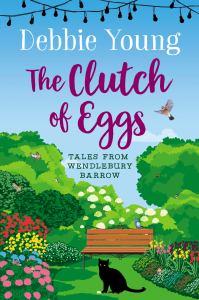
cover of the Clutch of Eggs
My next book will be out in October

Such is my love of secondhand books that in my Sophie Sayers Village Mysteries series, I’m planning to make Hector Munro to start a vintage section in Hector’s House, the bookshop at the heart of this series. He already has a large private collection of what he refers to as his “curiosities”, and these occasionally play a part in my stories, such as a festive short story that I wrote last year – you can read it here for free if you can bear to think about Christmas just yet!

His curiosities collection also gets a mention in my new book, The Clutch of Eggs, the next in my Tales from Wendlebury Barrow Quick Reads series, which will be out in October – more news of that to follow shortly. (You can join my Readers’ Club mailing list here if you want me to notify you of the publication date.)

Then in the eighth book in the Sophie Sayers series, one of his “curiosities” will be at the heart of a mystery that takes Sophie and Hector from Wendlebury Barrow to the Scottish Highlands.  But first I must write the seventh – Murder Lost and Found, my November project, for the first draft, anyway!

Posted in Events, Reading, Writing

Back to School for a World Book Day Reading Competition

Every day last week I had the pleasure of spending some time at Westonbirt School, talking to English classes in Years 7, 8 and 9 (11-14 year olds), sharing insights into an author’s life and writing advice that I wish I’d been given at their age.

World Book Day logo 2020On the Thursday, for World Book Day, I returned in the evening to co-judge the school’s annual inter-house reading competition, alongside the award-winning poet Shirley Wright and two sixth-form pupils. We judged the pupils’ readings were on four criteria: clarity, confidence, choice of passage and overall performance. The overall standard was really high, and, in the stunning setting of the school’s Grade 1 listed library, being a judge was a very enjoyable experience.

Congratulations to all those pupils who performed, and to the English department, so ably led by Miss Sheehan, for staging such a streamlined and impressive evening of entertainment.

But before the readings began, I had to give a small performance of my own: a brief motivational speech to all those taking part. In case you’re interested, here’s the transcript.

My Address to the Readers

People often assume that being a professional writer is a lonely business, spent in isolation. But as I’ve been explaining in these classes, the writer’s life is all about collaboration. It’s team work. Editors, proof-readers and cover designers help turn my manuscripts into books, before the books are sent out into the world.

Reaching readers is by far the most important stage in any book’s journey, because a book’s success stands or falls by what its readers make of it. Every reader interprets the writer’s intention in their own way. Furthermore, the same reader, reading the same book at different times in their life, may find it a completely different experience.  Books you love now may leave you cold when you get to my age. On the other hand, in later life you may find you love books that you struggled to enjoy at school.

Those who read books aloud to entertain others add another layer of interest to a writer’s words.

In the audiobook publishing world, these people are called voice artists. Good voice artists add value and interest to a book and inject it with their own personality. They also make the process look easy. But even when you know a text really well, reading it aloud is hard work, as I know from my own experience. At the launch of my first novel, performing an extract from Best Murder in Show, instead of reading about “Rex’s elegant girlfriend”, I managed to call her “Rex’s elephant girlfriend”. That’s quite a different thing and an error I’ll never forget. (Click here to witness my gaffe!)

Using your voice to engage an audience is a valuable life-skill in any setting. If you apply the skills demonstrated in this competition in other settings, such as the classroom, the boardroom or in government, you can change lives and may even change the world.

Last Friday, in the rain and the mud in Bristol, Greta Thunberg spoke for just four minutes. Her immaculate delivery of  her succinct and perfectly polished script moved not only the tens of thousands on College Green, my own daughter among them – but, thanks to the internet, her voice resonated around the world, mobilising millions to support her cause – including you, here, at Westonbirt School, as you watched her speech streamed live in the Great Hall. (Watch her speech on Youtube here.)

Those of you who are reading to us tonight may be reading words written by someone else, but in years to come, when you use the power of the spoken of word to deliver your own messages, we may find ourselves as mesmerised by you as we were by Greta.

You have already proven your exceptional skills by being chosen to represent your houses in school-wide heats. No matter who wins this competition tonight, your houses should be proud of you all and you should be proud of yourselves.

Now let the stories begin.


Cover image of Secrets at St Bride's
My own take on school stories – one for the grown-ups!

The Story Behind the Story

My time spent working at Westonbirt School (1997-2010) was the inspiration for my new St Bride’s School series, which begins with Secrets at St Bride’s. However, the situation, the plot and the characters are completely made up!

To read the first chapter for free and to find out more about this jolly romp of a novel, click here

Posted in Reading, Writing

My Favourite School Story: Anne of Green Gables – with Guest Author Jean Gill

photo of hardback of Anne of Green Gables as part of a set of children's classics
My copy of “Anne of Green Gables” had been gathering dust unread on my shelf, until Jean Gill alerted me to the joys of this classic children’s novel

There can’t be many people who didn’t love a school story of some kind when they were growing up.

Cover image of Secrets at St Bride's
My own take on school stories – one for the grown-ups!

That’s one reason I decided last year to write a new series set in a classic English girls’ boarding school, St Bride’s. My series gives an old premise a new twist: it’s a school story for grown-ups, revolving around the intrigues among the staff, including the headmistress, commonly known as Hairnet, the teaching staff, including newcomer and narrator Gemma Lamb, and the support staff including Max Security, trying to keep everyone safe from harm.

Talking about it among friends, I soon became aware that I was not the only adult to still care passionately about school stories aimed at children.

Among the keepers still on my bookshelf are:

  • Anthony Buckeridge’s Jennings and Darbyshire series, which I loved for their laugh-out-loud humour
  • Classic girls’ boarding school tales, such as the Chalet School series by Elinor Brent-Dyer and Enid Blyton’s Malory Towers books
  • Richmal Crompton’s “Just William”, whose antics were originally intended for an adult audience

Fascinated to know which school stories some of my author friends most enjoyed, I’ve now decided to start a new monthly blog series in which a guest author shares their favourite. I’m pledging also to read the books they recommend – although I’m sure I’ll already be familiar with some of them. You might like to read along with us.

Jean Gill’s Choice: Anne of Green Gables

photo of Jean Gill with book and dog
Author Jean Gill with her vintage copy of “Anne of Green Gables”, guarded by her dog Watson!

Kicking off the series is Jean Gill, who has written a huge array of books across a multitude of genres. Jean is an award-winning writer and photographer who lives in the south of France with two scruffy dogs, a beehive named Endeavour, a Nikon D750 and a man.

Jean’s choice is a book I confess I’d never read before: Anne of Green Gables by L M Montgomery. First published in 1908, this Canadian novel is now considered a world-class  classic for readers of all ages. Over to Jean to describe what makes it so special for her…

Hi Jean, it’s a pleasure to have you as the first ever guest in this new series, and I was captivated by your choice when I read it. Such a beautiful natural world conjured up there, in a stunning corner of rural Canada, and I enjoyed that as much as I did Anne’s blossoming under the care of her adoptive family. How old were you when you first read it, and how often have you read it since?

My aunt, who lived in Canada sent it to me as a Christmas present when I was eight years old. I read it two or three times when a child and revisited it thanks to the recent television series.

How has your perception of the book changed with later readings?

When I was a child, I accepted Anne’s world as it wasn’t so very different from the one I knew in its sexism, physical punishment, demands that children be seen and not heard, that they work to earn their keep and should think themselves lucky if they were adopted after being orphaned. Later on, I was horrified by the adults’ behaviour and by the social norms but still recognised them in the historical context.

What did you particularly like about this book and about the author – and was there anything you disliked?

I love the misfit heroine, a ‘swotty girl’ if ever there was one, who lives and loves with passion, fired by her own imagination, a rule-breaker whenever the rules are wrong. What makes the book timeless is that Anne wins hearts while staying true to herself. The phrase ‘kindred spirits’ stays with me still and, like Anne, I’ve found kindred spirits to treasure, sometimes across the potential divides of age and culture. The development of Anne’s relationship with her new parents is beautiful, without being mawkish, and Montgomery portrays so well the change brought to their suffocating lives by this child.

And who couldn’t love Gilbert Blythe? – competition in the classroom and temptation outside of it, even though Anne knows love is bad for a girl’s high aims in life. That is another element which makes this book amazing for its time – falling in love is not the be-all and end-all for a girl. There is more to life!

The answer’s is probably obvious already, but which character did you identify with?

Anne, without a doubt!

The books that we love when are young often leave a lasting impact on us as we grow up. How did Anne of Green Gables affect you as a child and influence you as an adult?

The criticism ‘too much imagination’ was shown to be ridiculous. Imagination is Anne’s superpower as it was – and I hope still is – mine.

It was one of many books that allowed me to develop a sense of self that did not fit into all those rules about what I was supposed to do and be. Unlike Anne, I had a lot of self-control, and it was very satisfying to lose my temper vicariously through Anne’s fiery responses to life’s injustices. I too suffered from a permanent sense of unfairness, and the way Anne is blamed in school and at home for other people’s wrong-doing or for well-intentioned disasters hit exactly the spot where I felt wounded.

I remember being spanked when I was seven because early one morning I’d let out into the garden a dog we were looking after and he barked. I still don’t understand why (possibly) waking the neighbours was a hitting offence – and we were very rarely spanked, so my father must have felt strongly that this was an act of serious disobedience.

That was very much an Anne-type action and consequence, within a world that made no sense. I still react strongly to the unfairness of Anne being punished for acts of empathy and for rule-breaking.

How did it affect your writing?

I like breaking rules 😊

Anne goes to a small rural school in which all the ages are together in one schoolroom, and her ambition is to become a teacher. How did your own education compare to hers?

Mostly army schools. My father was a soldier, so the longest we stayed in any one place was two years. Sometimes we moved after only six months. I went to one school for only four months, so each time I had to start again, trying to make friends, following a different curriculum. I was taught the Tudors eight times, and at one time shifted for a few months to a school that taught Maths via Cuisenaire rods – all very confusing and lonely. I was told off by teachers for holding my pen wrongly and being too advanced a reader – and for dumb insolence 😊 So inevitably, like Anne, I became a teacher and I like to think I looked out for the misfits.

My older sister went to boarding school, and we’ve compared notes on our very different schooldays. I think Secrets at St Bride’s would make her smile and reminisce!

Were your friends also fans of Anne,  or did you feel that this was your own private world?

I don’t remember talking about the world of books in which I spent most of my time, when I was eight but later, from eleven onwards, I definitely shared book recommendations with friends. A friend who met me at eleven remembers us being the only ones allowed to read the top shelf books (Dickens was up there).

Do you think Anne of Green Gables would still resonate with young readers today?

I think so and I’ve found out that Anne is big in Japan! The television series has highlighted the books again and the French translator for my books. Laure Valentin, has translated Anne of Green Gables into French – another example of kindred spirit serendipity!

BANNER AD for Jean Gill's eco-fantasy novel

I like to think that Anne of Green Gables would enjoy Jean Gill’s latest eco-fantasy novel, Queen of the Warrior Bees, in which a teenaged girl who doesn’t fit in with her peers finds her true purpose in working with nature to save their world – by shape-shifting into a bee! 

Click here to find out more about Queen of the Warrior Bees and to buy a copy. 

To find out more about Jean Gill and her wide-ranging work as an author and photographer, visit her website: www.jeangill.com.

COMING SOON:

  • Helena Halme on The Adventures of Pippi Longstocking by Astrid Lindgren (February)
  • Clare Flynn on The Prime of Miss Jean Brodie  by Muriel Spark (March)
  • Helen Hollick on Riding School stories by Ruby Ferguson (April)
  • Madeleine D’Este on The O’Sullivan Twins series by Enid Blyton (May)
  • Julie Cordiner on The Chalet School by Elinor Brent-Dyer (June)
  • Linda Gillard on Molesworth by Ronald Searle (date tba)

DON’T MISS OUT!

To make sure you don’t miss a post, subscribe to my blog, and then you’ll receive every new post in your inbox. (Click the “Follow” button towards the bottom of the sidebar to the right of this post.)

And if you meantime you’d like to read the first two chapters of Secrets of St Bride’s for free, click here and scroll down to find the opening. 


Posted in Reading

Reading Tag #1: In Which Robinson Crusoe is “It”

As a long-standing Desert Island Discs fan, I can’t help speculating Crusoe’s choice of music

If you’ve ever looked something up on Wikipedia, I bet you’ve found yourself clicking on a link in one article that takes you to another. Then in the second article, you find another that leads you to a third… and before you know it, an hour’s flown by.

It’s especially easy to play reading tag online like this, where hotlinks provide easy stepping stones. Playing the same game with physical books requires more planning and patience, but I still find it hard to resist.

The most recent bout for me took Daniel Defoe‘s novel Robinson Crusoe as its starting point. To mark its three hundredth birthday, we chose it earlier this year as our Book of the Month at the BBC Radio Gloucestershire Book Club, hosted by Dominic Cotter as part of his lunchtime show, with Caroline Sanderson and me as his regular panel.

This wonderful 1964 children’s television series is now available to buy as a DVD

I’d read Robinon Crusoe at university and really enjoyed it, as well as Defoe’s Moll Flanders, but that was long enough ago for me to have forgotten most of the content. To be honest, my most vivid memories of the story stemmed from the old French television series, dubbed into English, which made a strong impression on everyone of my vintage who saw it, with its stirring theme music (do click the link to listen!) and compelling narrative, mostly true to the original novel.

Robinson Crusoe…

For a three-hundred-year-old novel, it was surprisingly accessible. Written in the voice of Crusoe, the novel fooled many of its early readers into thinking it was a memoir. As well as the familiar story of his shipwreck and solitary status on the island for most of his stay, there is wrapped around it a substantial tale of how he came to go to sea in the first place, including an earlier adventure along the coast of Africa, and the saga of his journey home. Rereading it now, I found it compelling and intriguing, although as a twenty-first century reader, his condescending attitude to non-Europeans jars.

… and Other Castaways

Hearing the Book Club broadcast, my author friend Edward James recommeded a new non-fiction book to complement it: Crusoe Castaways and Shipwrecks in the Perilous Age of Sail by Mike Rendell. On request, the publisher, Pen and Sword, kindly sent me a review copy.

Tales of real-life castaways and shipwrecks

The book was a pleasure to hold as I read it – it felt like a luxury item. Here’s how I reviewed it on Amazon UK:

This is a beautifully presented book, the cover immediately getting you into the frame of mind for the era that it describes. I had it recommended to me after reading Defoe’s “Robinson Crusoe”, which is, as the title suggests, the jumping off point for this guide to the real Crusoe (and Defoe), other castaways of the era, and victims of shipwrecks, some famous, some infamous, some little known but worth knowing about.

It’s a very readable guide for the casual reader, as well as for serious historians, with a high level of detail about the various journeys. The author’s style is personal and personable, authoritative without ever being stuffy.

Having read it, I realise that Crusoe was not untypical of this dangerous age, and reading about the hazards of the journeys even when plain sailing (the nutrition, the piracy, the mutinies) made me wonder that anyone arrived at their destination intact at all.

This would be a good gift for anyone interested in Robinson Crusoe and Defoe in particular, or in historical sea voyages in general. My only criticism is that the captions on the very attractive colour plates, which added atmosphere to the narrative, were absurdly short. There is a list of image acceditation at the back, but I thought it would have made more sense to add this detail to each picture, rather than have the reader turning back and forth between the plates and the text. Otherwise, an engrossing read and aesthetically enjoyable too.

… including a Castaway Cat

At around the same time, by chance I cam across another Crusoe-inspired book, (and goodness knows, he’s inspired plenty of spin-offs over the years, from The Swiss Family Robinson to Lost in Space). Visiting the fabulous Old Station Pottery and Bookshop in Wells-next-the-Sea, Norfolk, I spotted The Nine Lives of Island Mackenzie by Ursula Moray Williams, its cover featuring an Edward Ardizzone illustration referencing Robinson Crusoe.

A heartwarming castaway tale for all ages

Ardizzone’s evocative line drawings are scattered throughout Moray Williams’ gentle and witty text, intended as a chapter book for younger readers, but a delight to Crusoe fans of any age, especially if they also love cats! Not wishing to spoil the plot of this delightful read, suffice to say there are plenty of parallels to Defoe’s story, as well as a satisfying ending.

Over to You

So now I’m all Crusoed out – but feel free to share via the comments box news of your own reading tag adventures.

I wonder how many degrees of separation there are between books? I’d love to know!

Join My Mailing List & Receive a Free Ebook

To be among the first to know about my new booksspecial offerscoming events and free downloads, just type your email address into the box above and click the grey button. You’ll also receive a free download of a short novella, The Pride of Peacocks, a lighthearted quick read in the Sophie Sayers Village Mystery series, available exclusively to my subscribers. I promise I won’t share your email address with anyone else and you may unsubscribe at any time. Thank you!