Posted in Family, Personal life, Reading, Writing

Scenes from my Cotswold Cottage #1: Reading After Breakfast

This is the first post in a new monthly series of blog posts inspired by Dame Joanna Lumley’s charming memoir, No Room for Secrets, in which she tours her London house giving a commentary on her possessions. I’m going to show you snapshots of the Victorian Cotswold cottage in which I write my books, with a commentary on what the objects in each picture mean to me.

My travels may not have taken me as far as Dame Joanna’s, and my friends and relations may not be as famous, but I hope you will enjoy these little insights.

So without more ado, here is the photograph I took this morning of where I like to read for a little while each morning after breakfast – a habit I got into during the first lockdown, when it provided a source of comfort amid so much uncertainty.

photo of my reading chair surrounded by other interesting artefacts

The armchair is in the modern extension that my husband built a few years ago. The old part of our cottage has thick, solid stone walls and small windows, which keep it snug in winter and cool in summer, but they also make it very dark. Previously, we could only see our cottage garden from the utility room and my upstairs study.

The new room was therefore designed to give us a panoramic view of the garden and a space filled with natural daylight. We also wanted a high ceiling, in contrast with the low ones elsewhere in the cottage. The stairs lead to a mezzanine floor, added above the old kitchen to make the most of the height.

During Covid restrictions, this light and spacious room, with its view of the great outdoors, really benefitted our mental health.

Now for a commentary on the details of the photo…

  • The armchair, facing the French doors, may seem unremarkable, being standard-issue IKEA, but I bought it because its mid-century design reminded me of the green sofa in the lounge of my childhood home in Sidcup, on the edge of London. I was very happy there.
  • The jade-green cushion with embroidered bumblebee, one of my favourite emblems as my name is Hebrew for “bee”, was a Christmas present from my old school friend Jane.
  • The woollen blanket I knitted during the first lockdown, when I discovered “lockdown blankets” were a thing, because they are a great source of comfort during the knitting as well as on completion. I chose shades of the Scottish Highlands in Rowan Felted Tweed pure wool, becaues for the previous 20 years we had spent many holidays in our camper van in Scotland, and I was missing it very much. It was a bonus that my blanket won first prize in the knitting category at Hawkesbury Village Show this year. (Last year’s village show was postponed due to restrictions.)
  • The rocking horse behind the chair was made by my father, hand-carved with love, when my daughter – his only granddaughter – was two years old. She’s now 18, but you’re never too old for a rocking horse made by your grandpa. It will forever be a family heirloom.
  • The little table came from a charity shop, and on it is an iBeani bookrest (the purple beanbag) recommended by my friend Carol Turnham, who belongs to my Cheltenham writers group. It’s really useful if your hands are affected by arthritis, as mine are.
  • The bottom book, Seven Spiritual Laws of Success by Deepak Chopra, was recommended by my writer friend, Michael McMahon.
  • The book above it, The Bullet Journal Method by Ryder Carroll was bought just after Christmas at TK Maxx – a shop I never usually visit, but my sister had recommended it, and sure enough, there waiting for me was a single copy of this book that I’d been meaning to read for a while. I snapped it up, along with half a dozen beautiful notebooks. (Well, a writer can never have too many notebooks.)
  • The dressmaker’s dummy was given to me by my Auntie Sheila, 91, and the Paisley shawls draped over it are from her daughter, my late cousin Frances. Frances loved wool and textiles, and elsewhere we have felt pictures and cloth that she had spun and woven. We think of her every day.
  • The fez is a souvenir of a hugely enjoyable Madness concert at nearby Westonbirt Arboretum.
  • On the end of the banister is a Sherlock Holmes deerstalker hat which I gave to my daughter a few Christmases ago for her Sherlock collection.
  • The basket and parlour palm were acquired from a neighbour during lockdown, when  lots of people in our village put unwanted items on their front walls for others to take home. Treasure-hunting like this was a fun diversion when we were living such restricted lives.
  • Out of sight, behind the dressmaker’s dummy, is a wooden goose, made by my husband as an accessory for my scarecrow of St Wulfstan, which I made for the Hawkesbury Scarecrow Trail two years ago. St Wulfstan was formerly the priest of our parish church of St Mary the Virgin, where I sing in the choir and ring the bells. Why the goose? Find out more here. 
  • Less interestingly, there’s also a length of copper pipe, left over from some plumbing my husband was doing. I’ve no idea why it’s there or how long it’s been there, and I must find it a more appropriate home!
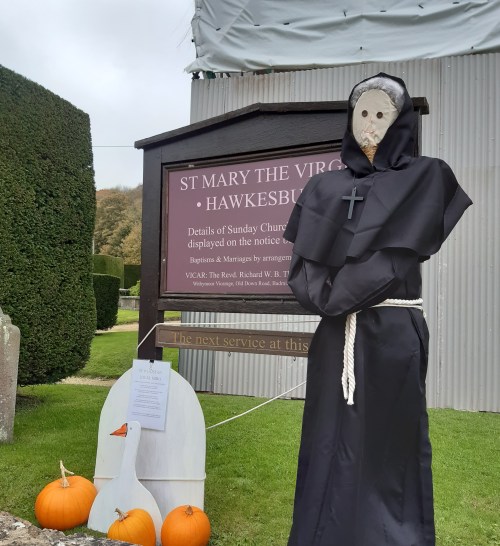
photo of St Wulfstan scarecrow and his goose
St Wulfstan and his goose

It was only in compiling this list of artefacts that I realised the reason I love sitting here so much. It’s not just the view of the garden or the comfy chair, but that I’m surrounded by associations with people and places that I love. Where better for comfort reading?

Seasonal Comfort Reads

cover of Murder by the BookSpeaking of comfort reads, if you fancy a lighthearted and cheery story set at this time of year, Murder by the Book, a laugh-out-loud village mystery tale of love, friendship, loyalty and family ties.

It’s available in paperback and as an ebook for Kindle (also in Kindle Unlimited).

Order Murder by the Book here.

Now I must get back to writing my next book, Scandal at St Bride’s, also set at this time of year. It should be launched in the spring.

Both Murder by the Book and Scandal at St Bride’s culminate on Valentine’s Day – happy ending guaranteed!

In the meantime, I wish you a very happy new year, with lots of great books and comfy reading chairs!

Posted in Family, Personal life

Suit Yourself

Although it’s nearly a decade since I last worked in an office, I couldn’t help but cheer at recent reports of the demise of the suit as business wear. While some blamed working from home, journalists were making predictions pre-pandemic that lounge suits were on their way out. About time too, considering they first became fashionable in the 1860s.

Why didn’t this sartorial shake-up come sooner?

Starting my career under Thatcher’s government and the era of the power suit for woman, I spent a large part of my working life in an environment in which formal suits were expected, but I never felt comfortable in one, resenting their depersonalising effect.

My favourite pinafore dress is almost exactly the same shape as my old school uniform. Made of thick denim instead of gabardine, it is about as sturdy too.

This may seem surprising, considering how much I liked wearing a school uniform, albeit a more modern version than the one imposed on my sister, six forms ahead of me. Hers was the last class to have to wear berets, for example, on their journey to and from school. For my cohort, the old-fashioned gymslip was replaced by a straight-sided, waistless polyester tunic. In the third form, we switched to an A-line skirt of the same material. Our blue blouses were nylon instead of cotton, presumably chosen for their drip-dry, no-iron properties.

Whoever thought kitting out adolescents entirely in artificial fibres was a good idea had clearly never worked in a classroom in high summer.

Changing schools at 14 to one without a uniform added a new source of stress to my morning routine. I dithered over what to wear to fit in with my peers while remaining true to myself. For the rest of my teens, I lived largely in jeans, a habit that eventually went the same way as my slender teenage waist.

Looking back, my changing attitude makes perfect sense. As teenagers, we were still working out who we were and took comfort in looking like everyone else, but by the time I entered the workplace, I knew who I was, and I certainly wasn’t prepared to be just another suit. When I gave up my last day-job to stay home and write, my wardrobe underwent a revolution.

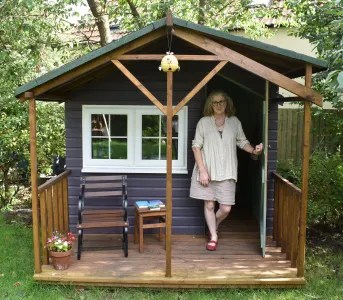
Best commute ever: strolling down to the hut at the bottom of my garden in the comfiest of clothes

Except that, fast forward to the present, as I put my summer clothes away and dig out my winter ones, I spot a startling similarity between my current wardrobe staples and my old school uniform, only now my clothes are in natural fibres. There are abundant straight tunics and pinafore dresses, of which my favourite is in my school’s standard navy blue; plain cardigans and jumpers; and sensible Mary-Jane flats.

Addicted to berets, I’m frequently told when bumping into someone who doesn’t know me very well, “Ooh, I didn’t recognise you without your hat!”

Group photo of Caroline, Claire and Debbie
Seldom seen without a beret – this time in the BBC Radio Gloucestershire studio with fellow writer Caroline Sanderson and BBC presenter Claire Carter

A recent newspaper article bemoaning the sudden ubiquity of elastic-waisted trousers strikes me as a positive step to wean ourselves off lockdown pyjamas. While M&S may have stopped stocking suits in half their stores, the shop-floor space will surely come in handy for housing more trousers to accommodate our newly expanded waists. And that suits me very well indeed.

This post was originally written for the October issue of the Tetbury Advertiser.


On the subject of school uniform…

cover of Secrets at St Bride'sI had fun devising the uniform list for the fictitious pupils in my Staffroom at St Bride’s series of romantic comedy mystery novels, giving the girls at this quirky English boarding school crisp white shirts and purple kilts. When new English teacher Miss Gemma Lamb first meets them in Secrets at St Bride’s, she is impressed:

“You all look very smart,” I began, surveying their neat shirts and ties. “I expect it feels strange to be back in uniform after the summer holidays.”

A red-headed girl with straight plaits gave an enormous sigh. “Oh, it’s a blinking relief, Miss Lamb. No more worries about what to wear or what other people are wearing. I mean, no-one cares what they look like here.” 

“Well, I think you all look lovely.”

“So do you, Miss Lamb,” one of them replied. I didn’t mind whether or not she was just being polite. It was first time anyone had told me that for a very long time. I liked these girls already.

Miss Lamb is particularly impressed that the little girl assigned to escort her to her first school meal is sporting a prefect’s badge, even though she’s in the youngest class in the school – as are all the girls on the table of Year 7s that she heads for lunch, as she remarks later to her colleague, maths teacher Miss Oriana Bliss.

“I feel honoured to be put in charge of – or is it in the care of? – so many prefects.”

Oriana raised her immaculate eyebrows. “Oh, Miss Lamb, did you not look around you at all? Did you spot a single girl who wasn’t wearing a prefect’s badge?”

I had to admit I hadn’t. 

When she sat down beside me to explain, I took the opportunity to sneak another forkful of egg.

“A father of a particularly undeserving daughter insisted she wouldn’t return to the school for her final year unless she was made a prefect. The Bursar was quick to agree, to make her father sign on the dotted line and stump up the annual fees. When Hairnet found out, she said she’d rather make every girl a prefect than honour that obnoxious man’s child for the wrong reason.” 

I laughed. My respect for Miss Harnett was going up by the minute.

“I don’t suppose the girls objected?”

“No, nor their parents. It’ll look good on everybody’s CVs and add perceived value to what they are getting in return for their school fees. Still, it’s not as good as what happened in a similar incident three years ago.”

“What was that?”

“She made them all Head Girl.”

Like to read more about the intrigues and adventures of the staff and girls in this extraordinary school? Both Secrets at St Bride’s and Stranger at St Bride’s are available in ebook and paperback, and the first in the series is also available as an audiobook. I’m also currently writing the third in series, Scandal at St Bride’s, and I’m very much enjoying being back in the lively company of Miss Lamb and friends!

cover of Stranger at St Bride's

Order Secrets at St Bride’s

Order Stranger at St Bride’s

(DID YOU KNOW? Secrets at St Bride’s was shortlisted for The Selfies Award 2020, given to the best independently-published adult fiction in the UK by publishing industry news service Bookbrunch. )

Posted in Family, Personal life

The Wasp and Goliath

Thanks to the copious sunshine and rain this summer, our annual glut of tree fruit arrives early in our garden. Soon we’re in a race against time to pick up the windfalls before they start to rot.

One afternoon in August, I’m so intent on my task beneath a plum tree that I don’t notice a wasp lurking in the grass until I have knelt on it and it has stung me. Pesky wasps, I think, retreating indoors to treat my throbbing knee.

Remembering my grandmother’s mantra, “Bicarbonate for bees and winegar for wasps”, I head for the larder.

Only after applying a splash of Sarson’s does it occur to me that medical knowledge has moved on since my grandmother’s day, so I grab my phone to search for more modern remedies. Before I can raid the bathroom cabinet for the recommended antihistamine tablets and cream, I fall down a Google rabbit-hole, looking up the difference between wasps and bees.

I’m wondering why we feel so contemptuous for wasps, when spotting bees in the garden feels like a celebration. Both can sting us. Is it only because wasps don’t make honey or beeswax that we can divert for human use?

What’s the Use of Wasps?

If so, that’s a short-sighted attitude, because it turns out wasps have a very important role in nature.  The BBC website tells me:

  • wasps kill pests that prey on crops
  • wasps are the farmer’s friend and the gardener’s ally, protecting our produce and helping us to maintain yields
  • they also eat insects that spread human disease

How very helpful of them.

Lyn’s Ladybirds

I knew ladybirds eat greenfly, because my late friend Lyn, an early proponent of organic gardening, used to collect ladybirds in matchboxes and release them into her greenhouse in place of chemical insecticides.

Apparently, wasps are sometimes used the same way in agriculture, presumably without the matchboxes.

For a moment I picture swarms of wasps stinging predatory pests to death like a miniature militarised attack force, leaving a battlefield full of tiny dead bodies in their wake. Then I discover wasps eat their victims or take them home for their young. Unlike bees, they are carnivorous. Wasps are also the evolutionary forerunner to bees.

“Bees are wasps who have forgotten how to hunt,” says Professor Seirian Sumner of University Collect London. Bees have had other things on their minds, such as developing wax-making glands that wasps lack. (See this Guardian article for more details.)

The Jobsworth Wasp

Thus the wasp that stung my knee was only doing its job of protecting the plum crop. To the wasp, I was a giant crop-destroying predator, and its duty was to repel me. Like David’s slingshot and stone that felled Goliath, the wasp’s sting was highly effective: I instantly fled the scene and left the plums alone.

In future I’ll be more respectful of this tiny breed of busybodies and let them get on with their pest patrol.

After all, there are plenty of plums for us all. 

photo of basket of plums offered free on my front wall
A permanent feature on my front wall during this year’s plum season: free plums for passers-by. The reason there is a catfood box in the basket is because by this point we had run out of punnets to put plums in and were having to improvise with any container that came to hand.

This article was originally written for the September issue of the Tetbury Advertiser,
holder of the Queen’s Award for Voluntary Service


TO READ MORE ARTICLES LIKE THIS

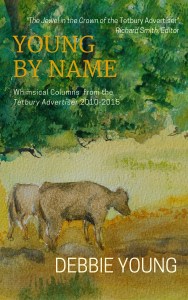
cover of Young by Name
The first volume covered 2010-2015.
The second volume includes 2016-2020

If you enjoy reading my columns from the Tetbury Advertiser, you might like to know that I’ve published two collections of them, now available in ebook and paperback. The cover images are details from my father’s watercolour painting of a Cotswold field.

Order the ebooks here:

Young by Name
Still Young by Name

Order the paperbacks here:

Young by Name
Still Young By Name

Or ask your local bookshop to order your copy in-store.

Posted in Family, Personal life, Travel

The Alternative Staycation: A Trip Down Memory Lane

In my Young By Name column for this month’s Tetbury Advertiser, I shared the heartwarming experience of taking my father to visit his boyhood haunts near Moreton-in-Marsh, Gloucestershire. His love of the Cotswolds from his experience as an evacuee during World War II is the reason I grew up wanting to live in the Cotswolds myself. I moved here over 30 years ago. 

Here’s one way you can stop foreign travel restrictions spoiling your summer holiday this year: take a trip back in time instead. You don’t even need a time machine, HG Wells style.

image of the original film poster of the 1960 movie, The Time Machine
Original movie poster by Reynold Brown – now in public domain, via Wikipedia.

Instead, take yourself to a place in this country that was important to you in your past. Such trips can spark treasured memories that lurk in the back of our locked-down brains, as well as providing the opportunity to create new ones.

A couple of weeks ago, I did exactly this, albeit by proxy. I took my 88-year-old father for a day trip to the Cotswold village of Todenham, near Moreton-in-Marsh.

Two days after his seventh birthday – and the outbreak of the Second World War – my father, his two sisters and their mother had been evacuated to Todenham from the London suburb of Sidcup, on the edge of Kent. They considered themselves fortunate to be able to lodge as a family with my grandmother’s stepfather and his second wife, rather than being separated and sent to strangers, as so many evacuees were.

This year (2021), on a glorious early summer’s day, together with my sister and my daughter, we toured territory that was still very familiar to my father.

The little village has not changed much in the last eighty years, at least on the outside.

photo of the lane by the side of the cottage where my father lived during the war
The lane beside his house had barely changed at all

We enjoyed listening to my father’s recollections of his time at the village school, watching the village blacksmith at work, hunting for souvenirs from an enemy plane that crash-landed in a nearby field, and enjoying cosy family evenings playing games, reading and drawing by lamplight around the kitchen table.

photo of the parish church in Todenham
View of the church from where my father’s stepgrandparents now lie at rest

When we knocked on the door of the cottage in which he had lived in those days, the current owner – whom, we were glad to see, was taking excellent care of the house and garden – was hospitable and sympathetic. Although relatively new to the village herself, she was able to share news of many people he remembered from his childhood. His friend Dorothy Duckett had become a primary school teacher, for example, and his younger sister’s friend Valerie Poole had moved away but later returned to retire to the village they all loved.

We strolled around the village, going to visit the village school (now the village hall) and the parish church which as a young evacuee he had attended every Sunday. Inside the church, an elderly lady, one of the churchwardens, was welcoming visitors.

photo inside church of my dad and the churchwarden chatting
Chatting to the churchwarden in the church he’d attended every Sunday as a boy

After a few moments of chatting to her, my father asked in sudden recognition, “Are you Valerie Poole?” Indeed she was, and together they shared memories that had lain dormant for over 80 years.

We returned from our day trip as refreshed, moved and inspired as from any foreign holiday.  So if you’re wondering where to go this summer, you could do worse than visit your old haunts, wherever your roots may be.

As L P Hartley said in the famous opening line of his novel The Go-Between, “The past is a foreign country”. Best of all, there’s no compulsory quarantine when you return.

Photo of my dad with his his little sister's friend from 80 years ago
My dad with Valerie Poole – eighty years since they were last at the church together

Footnote: We’re now planning a return visit including my father’s younger sister. 


Cover of Still Young By Name
The second volume includes 2016-2020
cover of Young by Name
The first volume covered 2010-2015.

My father’s love of the Cotswolds inspired the watercolour painting that I used for the covers of my collections of columns for the Tetbury Advertiser


HOW TO ORDER

Both collections are available to buy in paperback and ebook.

Order the paperbacks from Amazon via the links below or ask your local bookshop or library to order copies in for you (available from their usual stockists).

Young by Name (2010-2015) paperback

Still Young By Name (2016-2020) paperback 

Order the ebooks for the ereader of your choice here:

Young by Name ebook (2010-2015)

Still Young by Name ebook (2016-2020)


Read the whole of the July 2021 issue of the Tetbury Advertiser online here. 

Posted in Family, Personal life, Writing

Running to Stand Still

In my Young By Name column for the Tetbury Advertiser‘s June issue, I’m anticipating a return to almost-normal life – and being careful what I wish for. 

Inheriting my parents’ strong work ethic and optimism, I have developed a lifelong tendency to try to do more than is physically possible in the available time. Even so, people often remark that I’m prolific, usually in the same breath as asking me to do something for them on the old “ask a busy person” principle. (I really need to learn to say no.)

The upshot is that most of the time, like the Red Queen in Lewis Carroll’s Alice Through the Looking Glass, I feel as if I’m running to stand still. “It takes all the running you can do to keep in the same place,” the Red Queen tells Alice. “If you want to get somewhere else, you must run at least twice as fast as that.”

I occasionally write a ‘done’ list to prove to myself that I have been more productive than I think, but who has time to do that every day?

drawing of Alice and the Red Queen running by John Tenniel
(Image by John Tenniel for Lewis Carroll’s “Alice Through the Looking Glass” in public domain)

Jumping Off the Treadmill

Cover image of Secrets at St Bride's
I loved the pattern of the year working in a boarding school, alternating between busy term-time and long holidays – the inspiration for my series of school stories!

When in 9-5 jobs I stepped off the treadmill for holidays, I was conscious that my work would come to a standstill while others beavered away in my absence. My favourite time to take a break was therefore during the Christmas/New Year break, when almost everyone else went on leave too.

When I worked on a year-round contract in a school office, I rejoiced every time term ended, because in the absence of teachers and pupils, much as I loved them, I felt I had time to catch up with myself.

Stopping the World

To help me stay on top of all my tasks, I used to wish I could put the rest of the world on hold, in the manner of Sleeping Beauty’s fairy godmother making the kingdom sleep for 100 years. My only proviso was that I wouldn’t age a century by the time I woke everyone up again. What a shock that would be for my poor husband!

Covid-19 has put paid to that fantasy for good.

photo of the authors parents
My parents on their 65th wedding anniversary, when we took them to Bourton-on-the-Water

As we emerge, blinking, from the quasi-hibernation of lockdown, I’m hoping this past year is the closest I will ever get to casting that magic spell. As I predicted in the April 2020 issue of the Tetbury Advertiser, for me lockdown resulted in tidier bookshelves, larder, wardrobe, etc, and I’m pleased about that. But going forward, my priorities have changed.

Top of my to-do list post-lockdown will be hugging my parents.

That’s one action I’m happy to keep adding every day.