Posted in Family, Reading, Travel

All Fall Down

Preparing to visit Berlin for the first time a few weeks ago, I was unsure what I might find there.

My expectations had been partly shaped by a blend of fiction (Isherwood), film (Cabaret), and song, (Bowie’s “We Can Be Heroes”).

photo of the Brandenburg Gate with organ grinder
The jaunty tunes played by this organ grinder in front of the magnificent Brandenburg Gate reminded me of the Berlin of Isherwood’s time

At school I studied twentieth century history to A Level. In those days, the Berlin Wall was an impenetrable barrier between East and West, and I was living in Frankfurt with a postal address in West Germany.

the American sector sign
When I lived in Germany as a teenager, the Berlin Wall was still standing. This iconic sign that divided the American sector from the Russian remains as a chilling reminder, though this tourist seems unfazed.

Packing for our city break, I discarded the book I’d been saving to read on the trip: a historical novel set in Berlin during the Second World War. Might it be offensive to be seen reading a story about an era Berliners would prefer to forget?

I need not have worried.

The city turned out to be full of reminders of both World Wars and the Cold War, now serving as incitements to peace.

photo of the Kaiser Wilhelm church
Beside the bombed ruins of the bell tower of the Kaiser Wilhelm Church now stands beside a modern bell tower as a symbol of peace.

Even parts of the hated Berlin Wall have been left standing. When the Wall fell in 1989, Berliners resisted their initial impulse to destroy the whole of this brutal divider of East and West. Instead, they kept parts of it intact as a reminder of the importance of the freedom and democracy which the Wall once denied them.
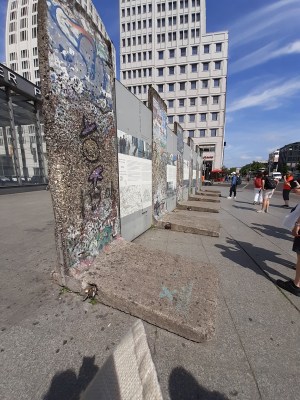
photo of sections of the wall on a street
Sections of the Berlin Wall forming an educational display for passers-by

The rest of it was to be painted by local artists, then broken up for sale as souvenirs. The Wall was so huge that there are still plenty of pieces to meet tourists’ demands, and they must be a healthy source of revenue for the city’s coffers.

Berlin is now an upbeat, creative and cosmopolitan place, full of green spaces, wide tree-lined boulevards and light.

Standing outside our hotel on the Kurfürstendamm (Berlin’s answer to London’s Bond Street), we could hear not the roar of traffic, but copious birdsong.

photo of the Leonardo Hotel
Where we stayed

There are very few motorists, because Berlin’s public transport system is so efficient and affordable that you don’t need a car to get around. Their trams, trains, U-bahns and buses are also very easy to use. There are no ticket barriers anywhere, as it’s assumed all travellers will be honest and buy tickets. This trust may not be misplaced, according to Lenin, who joked, “If Germans ever stormed a railway station, they’d first buy a platform ticket.”

selfie with my daughter by Checkpoint Charlie
With my daughter by the iconic Checkpoint Charlie

As in British towns, electric scooters are rife. The abundance of cycle paths in this flat city allows them to operate relatively safely. I wish I’d been quick enough with my phone camera to capture a sight that seemed to epitomise twenty-first century Berlin: a stream of electric scooters gliding freely past Checkpoint Charlie, still maintained as a landmark, into what used to be East Berlin.

Testdriving an iconic Trabant was a highlight of our visit to the wonderful DDR Museum

I had an unfortunate encounter with an electric scooter near the Brandenburg Gate, when I tripped over one left lying on the pavement. The scar on my left knee was an unwanted souvenir. But I also brought back a much better souvenir: a piece of the Berlin Wall,  which now sits on my desk as a permanent reminder to myself that no obstacle is truly insurmountable. Except that electric scooter by the Brandenburg Gate, obviously.

photo of souvenir piece of Berlin Wall with plastic mount

This post was originally written for the July 2022 issue of the Hawkesbury Parish News


Cover of Everyday Kindness hardback anthology
I was thrilled when L J Ross chose my story inspired by the Berlin Wall for inclusion in her charity anthology…

If you enjoyed this piece, you might enjoy this short story I wrote a couple of Christmases ago as a guest post for Helen Hollick’s blog, in which a souvenir of the Berlin Wall plays a crucial part: Christmas Ginger. It was later selected for L J Ross’s Everyday Kindness anthology in aid of Shelter, the charity for those without homes or in poor housing, and in the audiobook  edition it was read by the distinguished actress and novelist Celia Imrie.

graphic of Celia Imrie as narrator of Christmas Ginger
…and when Celia Imrie was chosen to narrate my story for the audiobook version edition.


Posted in Family, Personal life, Travel

The Silver and the Gold

In the wake of our national preoccupation with platinum, my thoughts have turned to silver and gold.

When I was eight years old, my family moved to the USA for a year to be with my father in his new job. I boarded the plane with Tiny Tears and Teddy in my arms, ready to embrace my new home and school with enthusiasm and an open mind.

While my older brother and sister refused to take part in the classroom flag salute with which every school day began, I got stuck in, hand on heart:

I pledge allegiance to the flag, and the United States of America, and to the Republic for which it stands, one Nation under God, indivisible, with liberty and justice for all.

A strange substitute for our comfortable daily religious assembly back home, sandwiching a quick prayer between two familiar hymns, but I wanted to fit in.

Before long, I’d made my Girl Scout Promise: “On my honor (sic), I will try to do my duty to God and my country, to help other people at all times, and to obey the Girl Scout laws.” Although I had to recite it only once, I remember the words far better, maybe because they chimed better with the gentle, apolitical hymns I was used to in assembly. Our school birthday hymn ended, “We hope you will be healthy and strong all the way; Strong to do right, slow to do wrong; and helpful to others all the day long.”

Another thing I learned as a Girl Scout was to sing this simple song in a round:

Make new friends, but keep the old;
One is silver and the other gold.

I rated my Girl Scout friends as silver, while my classmates back in England, at the school I rejoined a year later, were very much gold.

Six years later, we moved for four years to Germany, where I attended the Frankfurt International School with students from over sixty countries. It was time again to make silver friends. I kept in touch with the golden ones at home via numerous twenty-page letters handwritten on lurid stationery. Well, this was the 1970s.

In those days, long-distance friendships relied on such old-fashioned methods of communication. As we progressed through life, it was too easy to lose touch. Then along came the internet. Whatever else you think of social media, it’s a great means of tracing old friends. Thanks to Facebook, around the time of the Platinum Jubilee, I was able to welcome to my home here in the Cotswolds my old Canadian friend Debra, a classmate from Frankfurt International School.

We hadn’t seen each other in real life since the year of the Queen’s Silver Jubilee.

photo of Debbie and Debby
With Debra Esau, friends reunited this summer after 45 years

What the Girl Scout song neglects to mention is that the alchemy of time eventually transforms silver friends into gold, and that meanwhile your hair may turn silver. But that’s a price I’m happy to have paid.

This post was originally written for the July/August edition of the Tetbury Advertiser.

Posted in Events, Family, Personal life, Travel

On Track for the Holidays

A few years ago, my husband suggested we download an app* that keeps track of family and friends via their mobile phone signals.

He tends not to listen when I tell him where I’m going, and the most frequent message left on my mobile is from him, saying, “Debbie, where are you?”

He once called me on a Friday afternoon, concerned that our daughter was late home from school. My reply: “That’s because she’s here with me in the car, and we’re on our way to Cornwall for the weekend.” We had of course told him of our plans many times before we left.

While my husband was all in favour of the app, my daughter and I were not keen. It felt intrusive, like being microchipped or electronically tagged.

When the pandemic put paid to travel, we let the matter drop, but when we started to travel again this spring, and with my daughter planning some gap year adventures, we agreed to install the app for reassurance.

Our first chance to test it came in April, when my husband and daughter headed to the south of France for a week. As I’d made all the bookings, I felt personally responsible that everything should go smoothly, so I was glad to use the app to track their progress . With planes, trains and automobiles involved in their journey, there was ample opportunity for trouble – flight delays, cancellations and missed connections – even before we factored in my husband’s propensity to misplace his possessions.

Initially, following their progress on the app made me feel like a spy, but it soon became enjoyable and absorbing, although the intermittent phone signal made it slightly unreliable.

Often they appeared to be in two different places, even when I knew from speaking to them on the phone that they were in the same vehicle or hotel. Part way through their trip, I discovered that if I hit the right button, I could follow their progress at micro level.

When they were in Avignon, for example, I could trace their progress along the ancient bridge, although it didn’t tell me whether they did the famous dance immortalised in the song, “Sur le Pont d’Avignon”, as we did when we visited ten years ago. Fortunately, I remembered the ancient bridge no longer reaches the other side of the river, but stops mid-stream. Otherwise I might have been concerned that they’d dropped off the end and been swept away by the Rhône.

So thanks to the app, I was able to relax while they were away, and on their return, I knew exactly when to put the kettle on to make them a welcome-home cup of tea.

Admittedly, my husband returned minus his glasses (mislaid before they’d boarded the first plane), his jacket (lost, then found, then lost again), and his wallet.

All we need now is an app to keep track of his possessions.

This post first appeared in the Tetbury Advertiser‘s May 2022 edition. 

*The tracking app we used is called Life360.

Speaking of Holidays…

I’ve chosen as the topic of the next HULF Talk – a Hawkesbury Upton Literature Festival event – “Holiday Reads“. On Saturday 25th June, I’ll be chatting with three guest authors to help you find your next books to take on holiday – or to read at home this summer to travel by book. Between them, Carol Cooper, Kate Frost and Helena Halme have written engaging, easy-to-read novels set in holiday destinations all over the world,  from Scandinavia to Zanzibar, from Cornwall to the Mediterranean. For more information and to book your tickets, visit the HULF website at www.hulitfest.com.

graphic advertising HULF Talk

Posted in Family, Personal life, Writing

Bring Back the Magic Roundabout

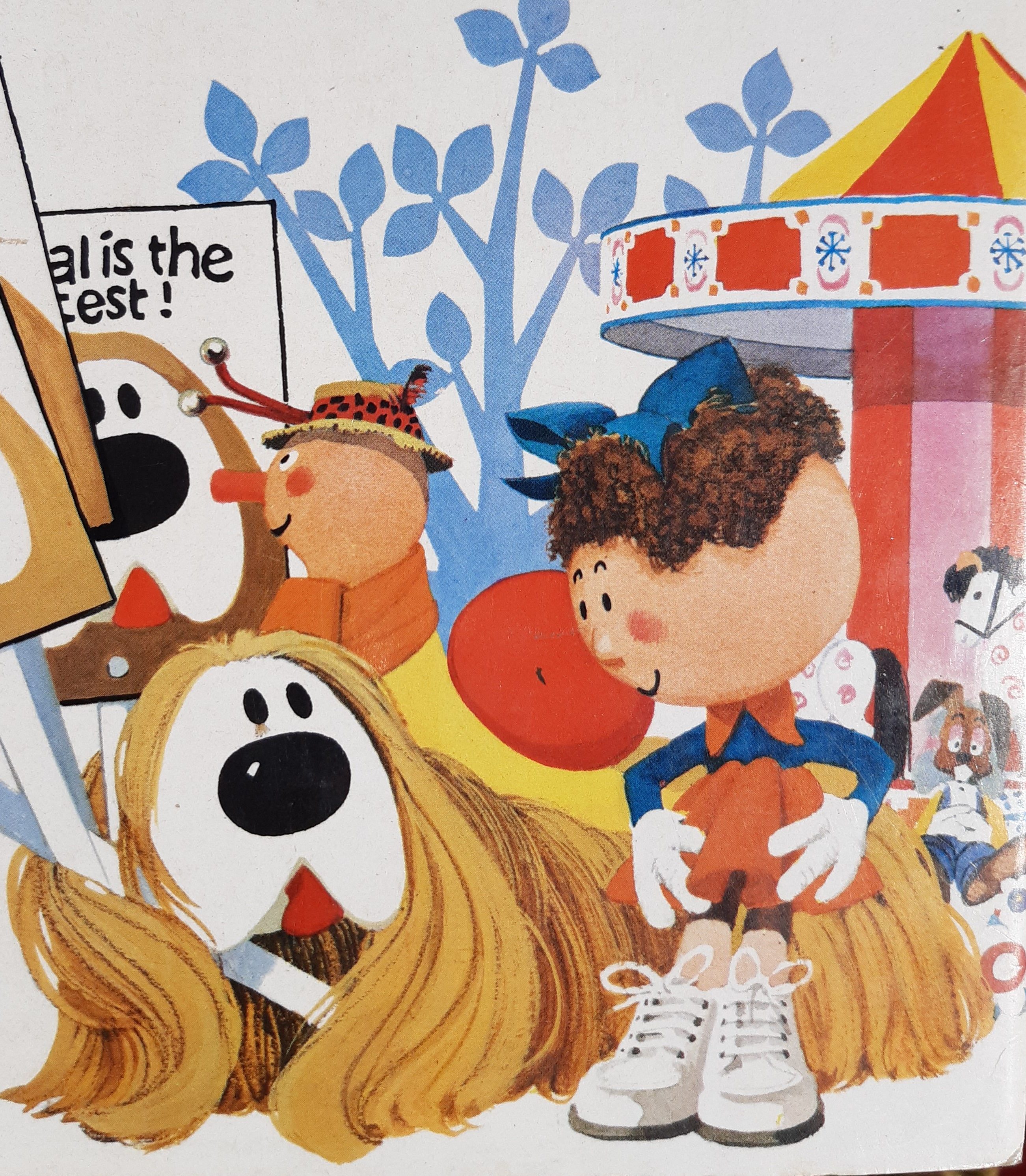
Cover a souvenir hardback book, The Best of Dougal
I couldn’t resist buying this secondhand souvenir book of The Magic Roundabout when my daughter was little

When I was a child,  national and international news featured very little in my world view. My parents took a daily newspaper, but I would have been too preoccupied with my comics to pay much attention to their paper.

Television news didn’t feature much in our family viewing, because it was only on at tea-time and bedtime. If I caught the headlines, it was by chance rather than on purpose, because I was still sitting in front of the telly after watching The Magic Roundabout, or whatever other children’s programme preceded the news in those precious five minutes beforehand.

The gentle humour and underlying moral message delivered by Dougal and friends provided a warm feeling to brace us for whatever bad news the evening bulletin might bring. It was the televisual equivalent of lining your stomach with a glass of milk before a night out imbibing strong drink.

The radio news was even less prominent in my life, and chiefly in the form of The World at One, its opening pips the signal that it was time for me to go back to school after having lunch at my maternal grandma’s.

I’m forever grateful to BBC Radio 4 for scheduling timeless classics such as Desert Island Discs and Just A Minute at 12.25pm each weekday, when Grandma and I would be sitting down to eat.

The theme music of Desert Island Discs still makes me think of cold lamb and bubble and squeak and Grandma’s delicious gooseberry tart with a slightly metallic flavour from being stored overnight in the tin she’d baked it in.

I think Desert Island Discs must have been broadcast on Mondays, when Grandma was serving up leftovers from her Sunday dinner.

Pic of a Desert Island Discs book and a retro style radio
I just had to buy this book celebrating the iconic Desert Island Discs, still on air after eighty years!

That’s not to say that as a child I was completely ignorant of current affairs. I remember Grandma, born in 1900, impressing upon me the significance of Churchill’s funeral as a tribute to a great man and the end of an era. I would have just turned 5. I can even recall JFK’s assassination, more because of the unprecedented appearance in our kitchen of the sobbing next-door neighbour who ran in to break the news to us, rather than because I had any idea of the political significance. Well, I was only 3.

On our weekly visit to my paternal grandparents, my grandfather used to pass me his evening newspapers when he got home from work. Commuting from Sidcup to London, he’d buy both the Evening Standard and its rival the Evening News to read on the train home. I was only interested in the picture crosswords and the cartoons. The hard news passed me by.

How differently will the current generation of children remember national and world news when they’re my age? In our multimedia age, however their parents consume their news, newspaper, radio, TV or online, children seem to have no escape from gruelling and traumatising headlines. I just wish they’d bring back The Magic Roundabout to soften the blow, for adults and children alike.

This article first appeared in the Hawkesbury Parish News, April 2022.


POSTSCRIPT ABOUT HECTOR’S HOUSE

line drawing of Hector's House by T E Shepherd
Hector’s House bookshop – by Thomas Shepherd (Copyright Thomas Shepherd http://www.teshepherd.art.com)

My love of those old pre-news children’s shows is the reason why the village bookshop in my Sophie Sayers Village Mysteries is called Hector’s House.

I’d already decided the proprietor – and Sophie’s future romantic interest – would be called Hector Munro (more about that choice in another blog post here). As Sophie’s late Great Auntie May had been a benefactor to Hector when setting up his bookshop, and had a sense of fun, I decided she would insist that he call the shop by the name of her choice – which was Hector’s House.

Hector and Sophie are not old enough to have seen the tea-time children’s show featuring the amiable puppet dog – but I think Sophie at least would have appreciated his catchphrase and its variants that always closed the show: “I’m just a great big lovable old Hector.”

Find out more about the Sophie Sayers Village Mysteries here. 

Posted in Family, Reading, Writing

A A Milne – My More Distinguished Twin

The author aged about 5, with a teddy, in her front garden
Me, aged about 5, in my front garden with my multi-coloured teddy as my ally of the moment.

Ever since I was a child, I have wondered what it would be like to have a twin.

As the youngest of three children, with a brother and sister five and six years older than me, I used to crave an ally of my own age to provide a balance of power in our family group.

At one stage, I tried to conjure up an invisible friend as a twin substitute, but I soon dropped her as unconvincing and dull, despite my having a sufficiently vivid imagination to believe that bears would get me if I stepped on cracks in the pavement.

It took me until I was nine to find a suitable alternative: Patricia Lawrence, a girl in my class at primary school. We took our shared birthday as a sign that we should be inseparable best friends, and so we were until at the age of 11 we headed for different secondary schools and drifted apart.

Unless you’re a leap-year baby, finding someone who shares your birthday should not be difficult. There’s a 1 in 365 chance with anyone you meet.

For many years, four people in my immediate family had their birthdays on New Year’s Eve – three related by blood and one by marriage. When my mother, aged nine, was asked what she wanted for her tenth birthday, she replied, “A baby brother”. My grandmother conveniently obliged.

Next on my to-read list: A A Milne’s only mystery novel – endorsed by P G Wodehouse, no less!

I know a lot of people, yet the only other person I’m aware of who shares my birthday is A A Milne, born in 1882. In tribute to Milne’s most famous creation, our shared birthday is now deemed National Winnie-the-Pooh Day. I wonder what Milne would make of that, when he wrote much more besides the Winnie-the-Pooh stories and poems, including screenplays for the embryonic British film industry, various novels, short stories, and humorous articles for Punch magazine.

Alan Alexander Milne died before I was born, but growing up in a household where Pooh stories were staple bedtime stories, I always felt a certain bond with him.

photo of two teddy bears
My favourite childhood Teddy (right) with a bigger friend, Galloway, rescued from a charity shop in Dumfries

Another Milne-related memory from my childhood is my first experience of school drama, when I played the Queen in my infant school’s production of Milne’s poem “The King’s Breakfast”. The King was played by one Malcolm Bothwell, which even then struck me as an impressive name. In later life he’d have been right at home in the cast of Shakespeare’s Macbeth.

Feeling that Milne belonged to my childhood, I’d never considered him in the context of his own time, so I was startled to discover recently that:

(a) he was taught at school by the Victorian author HG Wells

(b) in adulthood he played on cricket teams with J M Barrie, P G Wodehouse, and Sir Arthur Conan Doyle (another author irritated not to gain more recognition for his huge output of fiction besides his most famous creation).

That’s one remove from Christopher Robin, Peter Pan, Sherlock Holmes and Bertie Wooster sharing a social occasion – what an interesting fantasy dinner party guest list they would make.

Meanwhile I’m pleased to be sharing A A Milne’s birthday later this month. If he was still alive, on January 18th, he’d be 140. There’s nothing like being the more junior twin to make one feel younger. Thank you, Mr Milne – and happy birthday to us both!

(This article was first published in the January 2022 issue of the Hawkesbury Parish News.)

NB E H Shepard‘s wonderful original drawings of Winnie-the-Pooh are still in copyright, which is why I’ve shared images of different bears here instead


Who is your more famous twin? I’d love to know!


Another Tale of Twins: Murder by the Book
(Sophie Sayers Village Mystery #4)

cover of Murder by the Book
Available in paperback and ebook for Kindle (included in Kindle Unlimited)

I’d always wanted to write a novel featuring twins, and having established the charming Hector Munro as the heroine’s romantic interest in my Sophie Sayers Village Mystery series, in the fourth installment, Murder by the Book, I couldn’t resist cloning Hector to produce his more mischievous and daring brother Horace.

Unlike the sensible Hector, who has chosen the gentle career of a bookseller in the Cotswold village of Wendlebury Barrow, Horace has ventured overseas, working as an adventure holiday guide in Australia. When he comes home to visit one January, he puts Sophie’s loyalty to the test – and finds out some secrets Hector would rather he didn’t know.

This perfect seasonal read is available in both paperback and ebook for Kindle, and if you are a member of Kindle Unlimited, you’ll have free access to this and all my novels as part of your subscription.

Order your copy of Murder by the Book online here – or place an order for the paperback at your local neighbourhood bookshop. (That would please Hector!)